Welcome Aboard the Party Train: The Pennsylvania–Texas Power Nexus
Written by Kenneth Heineman in the Features category and the Winter 2026 issue Topics in this article: Congress of Industrial Organizations, David L. Lawrence, Franklin Delano Roosevelt, Harry S. Truman, Henry A. Wallace, John L. Lewis, John Nance Garner, Joseph F. Guffey, Lew Schwellenbach, Philip Murray, Pittsburgh, St. Marys (Elk County), Texas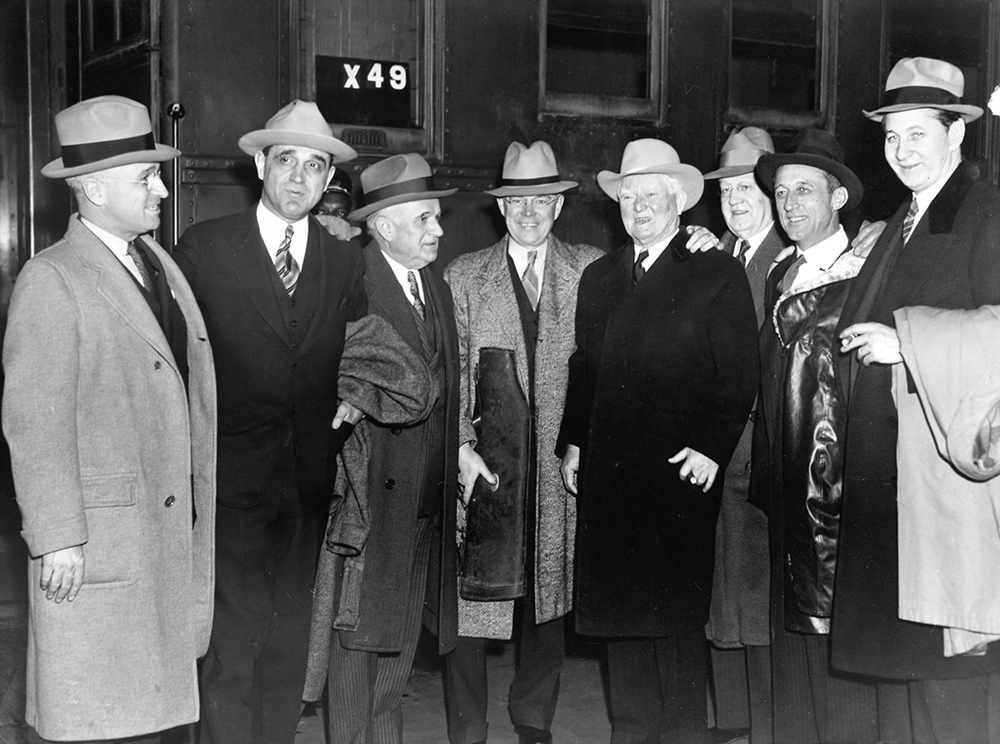
The Garner Pack meet up at the train station in Washington, D.C., in 1937. From left, they are Sen. Harry Truman, Sen. Sherman Minton, Sen. Joe Guffey, unidentified man, Vice President John Nance Garner, Sen. Clyde Herring, Sen. Carl Hatch, and Sen. James Murray.
Harry S Truman Presidential Library
As U.S. House Speaker and Vice President John Nance “Cactus Jack” Garner (1868–1967) of Texas could attest, no congressional outing in the 1930s was complete without Pittsburgh’s Joe Guffey (1870–1959). In 1901, Guffey’s uncle, James, with money borrowed from the Mellon family, brought in Spindletop on the Gulf Coast. James Guffey midwifed the Texas petroleum industry — and provided the Mellons with a little company that they called Gulf Oil. Twenty-two years later, Joe Guffey’s Pittsburgh partner, Mike Benedum, drilled Santa Rita Number One in the Permian Basin. After the Santa Rita strike, the Lone Star State accounted for 20 percent of global oil production.
Joe Guffey, who preferred the adrenaline rush of prospecting to attending boring lectures at Princeton, acquired 200,000 acres of Texas oil fields. Everyone in Texas finance, oil and politics (they were interchangeable) knew Joe Guffey. To Garner, who loved his bourbon and late-night poker sessions, Guffey possessed a most desirable character trait: He played cards like an oil-field worker on a four-day drunk.
Washington, D.C., attorney Joe Tumulty, Woodrow Wilson’s personal secretary and a Garner friend, wished his liveliest client would be more careful about attracting the attention of the Internal Revenue Service. Republican Treasury Secretary Andrew Mellon and Joe Guffey intensely disliked each other. Though their Scots Irish Presbyterian forebears may have been allied in Ulster, James and Joe Guffey had opted to play on team Irish Catholic Democrat. Both were well beyond Presbyterian Republican
respectability. Auditing Joe Guffey’s income tax returns, if he had even remembered to file them, became a Mellon pastime.
The political realities of the 1920s frustrated Guffey and Garner. Guffey was a National Democratic Committeeman from a state that had not gone to a Democratic presidential candidate since 1856. Keystone Republicans had a lock on federal and state elected offices. Congressional Republicans, fearful that immigrants were communist radicals and future Democratic voters, drove the successful movement in 1921 and 1924 to limit the largely Catholic and Jewish immigration from southern and eastern Europe. Sen. David Reed of Pittsburgh was a leader in this crusade.
In contrast, though Texas Democrats may have been the only game in their backyard, that just meant they were the largest U.S. House voting bloc in a minority national party made up of southerners and a few stray northern Irish Catholics. They could not advance much in the way of a farm policy and failed to block Mellon’s corporate and income tax cuts. Texas Democrats and Pennsylvania Republicans, did, however, rally behind Lone Star congressman Tom Connally to extend and enlarge the oil depletion allowance — a considerable tax break for an industry important to both states.
Garner was the unofficial leader of House Democrats, leveraging every bit of influence he could muster. He and his best friend, Republican Speaker of the House Nicholas Longworth of Cincinnatti, collaborated in making committee assignments and setting the legislative agenda. The informal organization they founded, the Bureau of Education, was a sanctuary from Prohibition where legislators could be trained in the nuances of writing a bill and playing poker. Its distinguished graduates included Fred Vincent, Fiorello La Guardia, and Sam Rayburn — who went on, respectively, to become a U.S. Supreme Court justice, a New York City mayor, and a speaker of the House.
Guffey and Garner had attended the disastrous 1924 Democratic National Convention in New York City. The Democrats were divided over Prohibition and riven by its Catholic and Ku Klux Klan factions. Guffey and his secretary, a working-class Irish Catholic from Pittsburgh named David Lawrence (1889–1966), were shocked by the hatred they witnessed. Garner was so disgusted he went back to Texas before the 103rd ballot was held to nominate a doomed presidential candidate. The Texan was no friend of African American civil rights, but he had fought Prohibition, opposed immigration restriction, and partnered with a South Texas political machine that mobilized Mexican American voters (Tejanos). Garner had the distinction of being among the few members of Congress fluent in Spanish — and to have had the Klan burn a cross outside his home in Uvalde.
The advent of the Great Depression and the implosion of the Republican Party changed the political fortunes of Garner and Guffey. The Texan became speaker of the House in 1931 and the vice presidential running mate for New York governor Franklin Roosevelt in 1932. Three of Garner’s Texas lieutenants served as chairs of House committees important to the advancement of the New Deal: Agriculture, Commerce and Judiciary. Garner had not only moved Texans into the center of national power but also built an extensive, and geographically expansive, network of allies in the House and Senate.
Although Guffey tried valiantly, and unsuccessfully, to deny Republican president Herbert Hoover the second largest pot of electoral votes in the nation, Keystone Democrats had momentum. In 1934, Guffey defeated Senator Reed while David Lawrence constructed a formidable Pittsburgh Democratic machine.

Pittsburgh politician Joe Guffey, pictured here in 1937, served two terms in the U.S. Senate, from 1935 until 1947.
Library of Congress Prints and Photographs Division
While Garner’s title was presiding officer of the Senate, who only voted to break ties, he was a lot more than a ceremonial ornament. He had been in Congress since 1903. Most of the newly elected Democrats had little idea how to write and pass legislation. In the House, Garner may have been absent, but he was not gone. His two successors as speaker were past the average life expectancy of white males in the 1930s and not in fine health. Both struggled to manage what Garner called “strutting roosters” ruffling feathers in the henhouse and interfering with egg production. Garner set up a Bureau of Education office in the Senate and invited House members over in need of instruction.
When President Roosevelt and Virginia senator and Appropriations Committee chair Carter Glass came out against establishing the Federal Deposit Insurance Corporation (FDIC) in 1933, Garner was ready. He gave Republican senator Arthur Vandenberg of Michigan the nod to speak, and he introduced the FDIC. Though a staunch conservative, Vandenberg had been shocked by the banking collapse in Michigan and believed that small depositors should not suffer for the sins of irresponsible financiers. Senators were not used to a vice president working the floor like a House whip in search of votes — let alone a Democrat who wrangled support across party lines. Roosevelt, who had feared that the FDIC would amount to an endless taxpayer-bailout of incompetent bankers, could only marvel that Texas was “running the government of the United States more largely than any other state.”
Unlike previous midterm elections where the party holding the White House lost seats in the House and Senate, the Democrats enlarged their majority in 1934. The Senate’s “Garner Pack” grew to 26 members. Three newcomers, Harry S. Truman (1884–1972) of Missouri, Lew Schwellenbach (1894–1948) of Washington, and Joe Guffey joined the Pack. Of the three, Guffey had the greatest wealth and political experience. Moreover, Guffey and Garner were generational peers born a few years after the Civil War. Truman and Schwellenbach were like their younger brothers or nephews.
Although Guffey championed civil rights and labor unions, the less liberal Garner respected work horses and disdained show horses. Moreover, ideological disagreements were no excuse for failing to address America’s economic crisis. The Garner Pack held the balance of power between the Democratic “Liberal Bloc” and conservative Republicans and a faction of resentful southern Democrats who feared growing federal power.
Secretary of the Interior and Public Works director Harold Ickes, a native of Pennsylvania and leader of the Liberal Bloc faction in the executive branch, regarded Guffey as a corrupt compromiser. Ickes was not alone in that assessment. Liberal journalist Joseph Alsop observed that, “The Guffey [political] machine is a study in streamlined medievalism.” Pennsylvania, Alsop continued, was “Guffeyland,” where Guffey lorded over his “vassals.” Curiously, neither Ickes nor Alsop hurled such invective against the Philadelphia Republican machine, which in contrast to Pittsburgh’s Democratic organization had a well-documented record of corruption. The Liberal Bloc was more likely to castigate (and try to purge) Democratic moderates than attack Republicans.
Admittance to the Garner Pack had many benefits. Garner was close to Senate Majority Leader Joe Robinson of Arkansas. That relationship gave Guffey, Schwellenbach and Truman access to Robinson. Rookie senators typically spent years trying to get the attention of the leadership and advance their legislation. That was not the case for Garner’s friends. Moreover, Robinson was a fixture at the exclusive Jefferson Islands Club on the Chesapeake Bay. Guffey, Truman and Schwellenbach received membership invitations and the opportunity to shoot clay pigeons, sip fine whiskey, and play poker. They could also cut legislative deals out of the sight of hostile reporters and politicians.
When not shooting skeet at the Jefferson Islands Club or attending a Washington Nationals baseball game, there were other outings to have further afield. Guffey had a train and comfortable rail cars stocked with whiskey and cigars. He always received immediate clearance to take his train to locales both famous and obscure. Guffey took the Garner Pack to the Kentucky Derby at Churchill Downs in Louisville. He also had access to Col. William Kaul’s private 10,000-acre hunting camp in St. Marys, Pennsylvania, 119 miles northeast of Pittsburgh. Far more coal than passenger trains sped by St. Marys, underscoring its desired isolation from prying eyes.
In Roosevelt’s first term, Garner’s congressional operation oversaw the drafting of historic legislation regulating Wall Street, creating pensions for senior citizens, granting collective bargaining rights to industrial workers, establishing public work relief programs, and providing price supports to struggling farmers. In 1935, Guffey got an act through to stabilize coal production and assist the United Mine Workers Union (UMW) in its organizing drives. Although Garner was skeptical of the integrity of UMW leader John L. Lewis (1880–1969), he heartily congratulated Guffey on the Senate floor. To Garner, it took considerable political skills to persuade usually intelligent legislators to support such a poorly conceived bill.
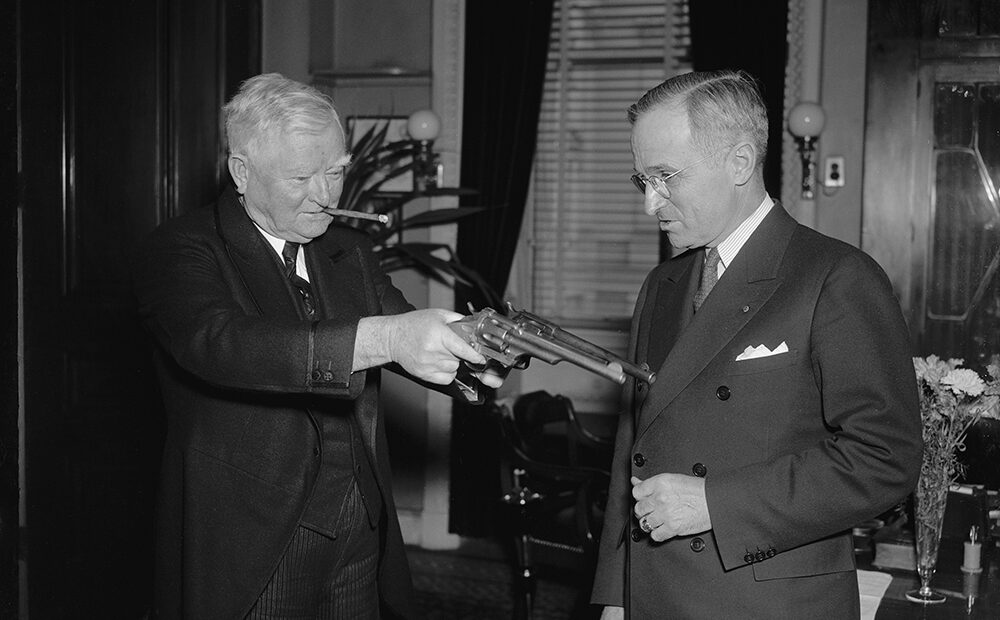
Garner and Truman admire Jesse James’ revolvers, 1938.
Library of Congress Prints and Photographs Division
Within weeks of the 1936 landslide presidential election, the New Deal suffered lasting, self-inflicted wounds. In 1935, John L. Lewis had established the Committee for Industrial Organization (later named the Congress for Industrial Organizations, or CIO). Phil Murray (1886–1952) of Pittsburgh became CIO vice president and leader of the Steel Workers’ Organizing Committee. Their goal was to mobilize industrial workers. One of its organizing tactics, however, enraged Americans across the political spectrum: the sit-down strike. Members of the United Auto Workers union in December 1936 seized control of a General Motors shop in Flint, Michigan. Sit-down strikes proliferated, even as violent confrontations erupted in the steel mills and automobile plants of Illinois, Ohio and Pennsylvania.
Garner and Roosevelt, for the first time in their partnership, shouted at each other, with the Texan demanding that the federal government end the sit-down strikes. Many of the southern and western Democrats in the Garner Pack regarded Lewis as an irresponsible, if not criminal, radical. Guffey, however, recognized that CIO-affiliated steel workers and coal miners were vital to Pennsylvania Democrats’ electoral power. Keystone and national Democrats needed CIO campaign funds and volunteers. Beyond those pragmatic considerations, Guffey believed that the CIO was justified in its tactics. Garner Pack members accepted that their friend had his reasons for standing with Lewis.
While the CIO roiled the political waters in early 1937, the Liberal Bloc had been working on a plan to deal with the conservative Supreme Court. The Liberal Bloc could not forgive the court for decreeing that numerous New Deal initiatives were unconstitutional in 1935 and 1936. Roosevelt kept Garner and the congressional leadership in the dark right up to the moment the executive branch delivered its court reform proposal to the legislative branch. Reformers proposed empowering the president to appoint a new, more liberal justice to the court for every member over the age of 70.
The Garner Pack was appalled — with the exception of Guffey. He had been outraged when the court declared that his coal act was unconstitutional. Guffey thought that most judges, regardless of their ranking in the judicial pecking order, were reactionary tools of corporate Republicans. The struggle over “court packing” continued fruitlessly for months — right up to the moment when Senate Majority Leader Robinson died. Many of Robinson’s friends were convinced that the stress from the court battle had given him a fatal heart attack. On the Robinson funeral train returning from Arkansas, the Garner Pack terminated the court fight. Garner, knowing that Guffey still supported Roosevelt’s plan, excused him from attending the deliberations. It was, Guffey observed, an act of consideration, not retribution, on Garner’s part.
With the end of the bitter 1937 congressional session, Guffey loaded the Garner Pack on his train to St. Marys. All were looking forward to delightful nights of poker and bourbon. Most brought their shotguns in anticipation of hunting deer. Sen. Sherman Minton of Indiana, like Harry Truman, was a combat veteran of the Great War and had experience handling guns. The same was true for Count Jerzy Potocki, the Polish ambassador to the United States. Sharp foreigners knew that wherever Garner and Guffey went, political intelligence was sure to be found.
As westerners, senators Carl Hatch of New Mexico and James Murray of Montana knew how to hunt, though that did not prevent Hatch from falling into an ice-cold stream. Hatch’s dignity, however, was not the only casualty. Roosevelt, in an attempt to keep friendly lines of communication open with Garner, wrote a heartfelt letter lamenting an “unfortunate hunting accident” at St. Marys. It seemed that there was an aged hunting dog at the Kaul lodge named Bessie. Roosevelt had met her and went away with fond memories. Regrettably, and for reasons unknown, so Roosevelt wrote, “Joe Guffey [had] removed the tinkling little bell which was always worn around her neck.” Without her bell, Bessie was difficult to locate. At least, the president concluded, “if Bessie had to go you shot her instead of whistling her up and cutting her throat with a knife. Dear Bessie probably never knew what hit her.”
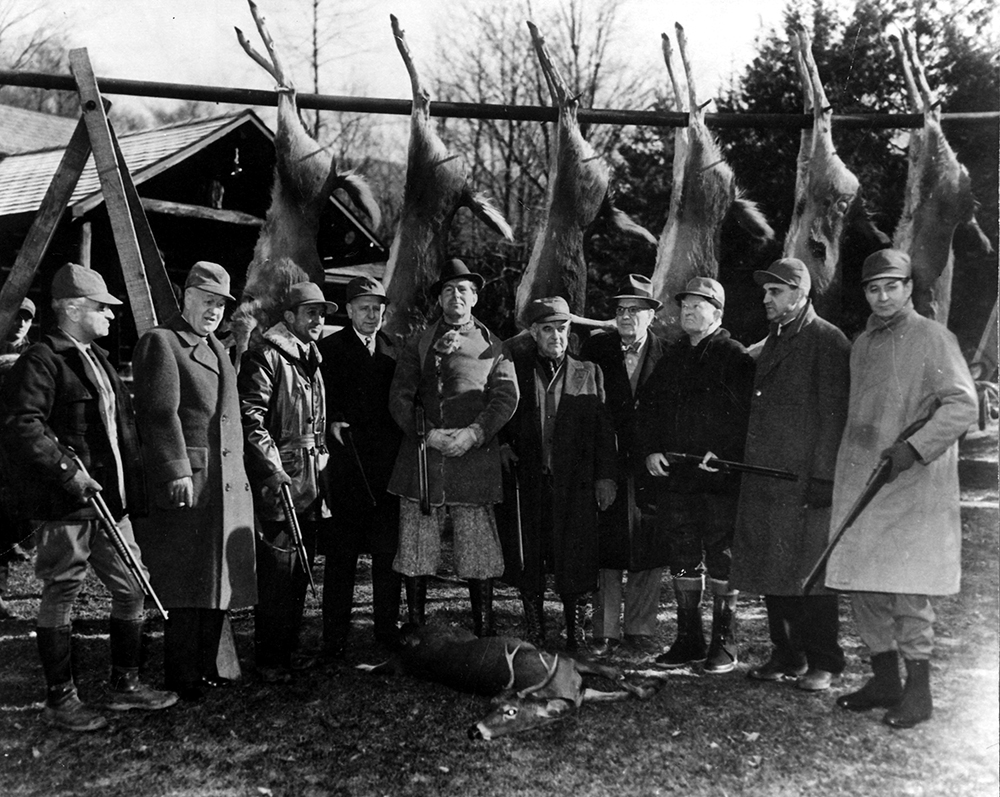
The Garner Pack poses during a hunting trip in St. Marys, Pennsylvania, in 1937. They are, from left, Sen. Harry S. Truman of Missouri, Sen. Clyde Herring of Iowa, Sen. Carl Hatch of New Mexico, Sen. George Radcliffe of Maryland, Polish ambassador Count Jerzy Potocki, Sen. Joseph Guffey of Pennsylvania, Col. William Kaul, Vice President John Nance Garner of Texas, Sen. Sherman Minton of Indiana, and Sen. James Murray of Montana.
Harry S Truman Presidential Library
Guffey invited David Lawrence to St. Marys. He had been reluctant to go but no one turned down a command performance from Guffey. In part, Lawrence’s trepidation stemmed from the fact that he had never gone hunting. He was city born and raised. Moreover, though he had served in the Great War, he had not gone overseas. Lawrence had received little military training in the handling of arms. When a deer stumbled in front of him, Lawrence was convinced that Truman and Garner, seeing the sorry figure he was cutting in the woods, fired the kill shots and then generously gave him credit.
There was another reason why he had not wanted to join the party. Lawrence was the product of a working-class immigrant Irish Catholic family. The political machine he had been building fused the steel workers’ union, the Democratic Party, and the Catholic Church into “The Iron City Trinity.” By background, Lawrence was in cultural sync with steel workers’ leader and fellow Pittsburgher Phil Murray. Many members of the Garner Pack, in contrast, hailed from the South and the West. They were cautious in their approach to the CIO and hesitant to grant too much regulatory power to the federal government. Lawrence had not interacted much with rural Protestants and avoided them as much as possible, given their Republican proclivities. The Garner Pack, on the other hand, could have been mistaken for the gathering of a Republican chamber of commerce, drank whiskey like the people from his neighborhood, and embraced most of the New Deal. They were Guffey’s kind of people.
Lawrence ended up enjoying his time at St. Marys and came away impressed with Truman. He admired a Baptist who drank, smoked, played poker, and came out of an Irish Catholic Democratic machine in Kansas City, Missouri. Though surrounded by corruption, Truman was personally honest and committed to public service. That was the Lawrence ethos. Lawrence’s Pittsburgh operation endeavored to avoid most of the graft that plagued the Kansas City machine — an astounding feat that someone like Truman could appreciate.
After the hunting trip, Guffey enmeshed Lawrence into the Garner Pack. Lawrence visited Washington often, joining the Garner Pack in the Senate dining room. He learned to move easily among the southern Democrats, the CIO, and other emerging urban party bosses. Though in terms of population and votes, Pittsburgh did not seem to be on a par with Chicago or New York City, but its role as citadel of the steel workers’ union gave the Iron City considerable political clout. Lawrence had become a national Democratic Party insider — one who played well with the CIO and anti-CIO southerners.
In 1938, the Liberal Bloc had convinced Roosevelt to purge conservatives in the Democratic primaries. Not only did that effort largely fail, but the midterm elections also saw a voter backlash against the 1937 sit-down strikes and an economic downturn that erased most of the gains made since 1933. As Garner tried to explain to Roosevelt, there was no longer a New Deal majority in Congress and there would be no more domestic reform legislation. When Roosevelt decided to run for an unprecedented third term in 1940, Garner returned to Texas. Though gone, he kept in contact with congressional friends and former Democratic National Committee chair and U.S. Postmaster General Jim Farley.
The Liberal Bloc, undeterred by its lack of power in Congress, convinced Roosevelt to choose Agriculture Secretary Henry Wallace as his running mate in 1940. Garner and the Pack were appalled, regarding Wallace as someone with poor judgement who could be easily manipulated.
Lawrence had a peculiar experience with Wallace. Guffey tasked Lawrence with driving Wallace around Pennsylvania on behalf of the 1940 campaign. Attempting to make conversation, Lawrence expressed his delight with how Wallace was helping Democrats secure the farm-state electoral votes. Nonchalantly, Wallace replied that he was unpopular in the farm states and that Republicans would likely sweep the region. Instead, Wallace happily observed, his electoral strength was in New York City — which Democrats had locked down. Lawrence resisted the temptation to ask Wallace why he was on the national ticket. As it turned out, Wallace was right; he could not even carry his home state of Iowa.
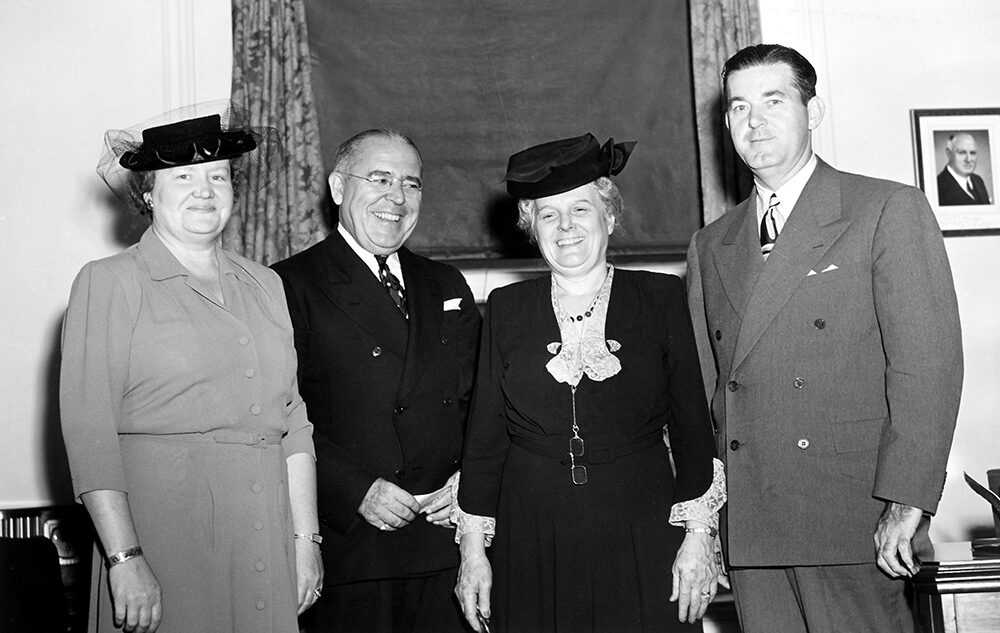
Pennsylvania Democrats—from left, Ruth Grigg Horting, Pennsylvania Democratic Party vice chair; David Lawrence, National Democratic Party committeeman and Pennsylvania Democratic Party chair; and Emma Guffey Miller, National Democratic Party committeewoman and sister of Joe Guffey—meet with Robert Hannegan, right, chair of the Democratic National Committee, prior to the 1944 Democratic National Convention.
Harry S Truman Presidential Library
Meanwhile John L. Lewis campaigned against Roosevelt. Lewis advocated an isolationist foreign policy and charged that Roosevelt was leading America into the Second World War. He arrogantly vowed to resign as CIO leader if Roosevelt won reelection. Although Lewis tried to back away from his pledge, Phil Murray became CIO president soon after the 1940 election.
In 1941, the Senate had placed Truman in charge of the newly created Special Committee to Investigate the National Defense Program. Truman insisted that committee membership include Republicans. Once America entered the war in December 1941, Truman rooted out contractor fraud and the shoddy production of war materials, saving countless lives and $15 billion in taxpayers’ money (or $272 billion today).
The geopolitical realities of the Second World War elevated the stakes of the 1944 presidential election. Roosevelt intended to run for reelection. A number of influential Democrats had grave concerns. They had seen how much Roosevelt had aged since Pearl Harbor. He had frequent memory lapses and tired easily. Not having access to his medical records, key Democratic senators and urban party bosses did not know that Roosevelt suffered from hypertension and congestive heart failure. Even without a doctor’s report, however, they were convinced that Roosevelt was a dead man walking. If Wallace remained on the ticket as vice president, he would become president sooner than later.
Both the Garner Pack and the big-city machine bosses were on board replacing Wallace with Truman. There were, though, two holdouts: Roosevelt and Phil Murray. Once Roosevelt recognized that he could not leverage the bosses and the senators the way he had done in 1940, the president agreed to give Wallace the consolation prize of commerce secretary. Roosevelt offered the party bosses a list of alternatives to Wallace — with Truman’s name reluctantly included. They insisted on Truman, and Roosevelt finally relented. Republicans subsequently charged that Roosevelt consented to put Truman on his ticket only if it had been “cleared” with CIO Political Action Committee leader Sidney Hillman. In reality, Hillman did not set CIO policy; he was just the Jewish New York bogeyman the far right evoked to scare voters in middle America.
Murray made CIO policy — and he enthusiastically supported Wallace. His interactions with Wallace had been positive, though superficial. Conversely, Murray had next to no acquaintance with Truman. He did, however, have a reflexive distrust of southern and western Democrats. That made him inclined to believe the worst about Truman and to buy into the derogatory gossip that the Liberal Bloc trafficked. Moreover, Murray was so far removed from Washington’s insider politics that he did not realize Roosevelt was dying.
Lawrence had known Murray for decades. Both came out of Pittsburgh’s working-class Irish Catholic cultural milieu. Murray would listen to him, though he did not like what he heard. From what Lawrence had witnessed himself, and had learned from others whom he trusted, he informed Murray that Wallace was a disaster. He reassured Murray that Truman would be an acceptable friend of organized labor. Lawrence would not fully level with Murray as to how sickly Roosevelt was, since that would betray confidences, but he was adamant about dumping Wallace. Murray reluctantly concurred with Wallace’s demotion, though convinced that he had made a grievous error in judgment.
The Roosevelt–Truman ticket won the 1944 election. As Guffey, Garner and Lawrence had foreseen, the vice president elected in 1944 did, indeed, become president within a matter of months.
Few could have predicted that a Garner Pack outing seven years earlier would have had such profound impact on American history. Then again, for shrewd politicians like Garner and Guffey, there were compelling reasons to hold regular meetings of the Board of Education, hunt deer at St. Marys, cheer on the ponies at the Kentucky Derby, and enjoy the amenities at the Jefferson Islands Club. These were opportunities for serious legislators to discuss and hone policy initiatives. Of course, the Garner Pack outings were enjoyable, but they also built a foundation of camaraderie, mutual respect, and political moderation. Best of all, the drinks were on Guffey’s dime.
Further Reading
Alsop, Joseph, and Robert Kintner. “The Guffey Capture of Pennsylvania.” Saturday Evening Post (April 16, 1938): 16–17, 98, 100, 103. / Farley, James A. Jim Farley’s Story: The Roosevelt Years. New York: Whittlesey House, 1948. / Guffey, Joseph F. Seventy Years in the Red-Fire Wagon: From Tilden to Truman Through New Freedom and New Deal. Washington, D.C.: Privately printed, 1952. / Heineman, Kenneth J. A Catholic New Deal: Religion and Reform in Depression Pittsburgh. University Park: Pennsylvania State University Press, 1999. / Roosevelt, Franklin D. to John Garner, December 9, 1937. In Franklin D. Roosevelt Presidential Papers, President’s Personal File, 1416, John Garner, Franklin D. Roosevelt Presidential Library. / Timmons, Bascom N. Garner of Texas: A Personal History. New York: Harper and Bros., 1948. / Weber, Michael P. Don’t Call Me Boss: David L. Lawrence, Pittsburgh’s Renaissance Mayor. Pittsburgh: University of Pittsburgh Press, 1988.
For archival insights into the Guffey–Garner relationship, see Franklin D. Roosevelt Presidential Library, Gubernatorial Papers, President’s Personal Files, and the Democratic Party National Committee Papers; and Library of Congress, Jesse Jones and Joseph Tumulty Papers.
Kenneth J. Heineman is a professor of history and global security studies at Angelo State University in Texas. He is the author of seven books, including A Catholic New Deal: Religion and Reform in Depression Pittsburgh, which received the Philip S. Klein Prize from the Pennsylvania Historical Association. He has just completed a new manuscript, Bourbon, Cigars, and a Bucket of Warm Spit: “Cactus Jack” Garner and the Rise of Texas Political Power.