The Hobby That Became a Museum: Landis Valley Village & Farm Museum, 1925–2025
Written by Jennifer Royer in the Features category and the Summer 2025 issue Topics in this article: agriculture, artifacts, collecting, Conestoga wagon, fraktur, George D. Landis, Henry K. Landis, Lancaster, Lancaster County, Landis Valley Village and Farm Museum, museums, Nettie May Landis, Oberlander Trust Fund, Pennsylvania Dutch (Pennsylvania German), Pennsylvania Historical and Museum Commission, Pennsylvania Trails of History, redware pottery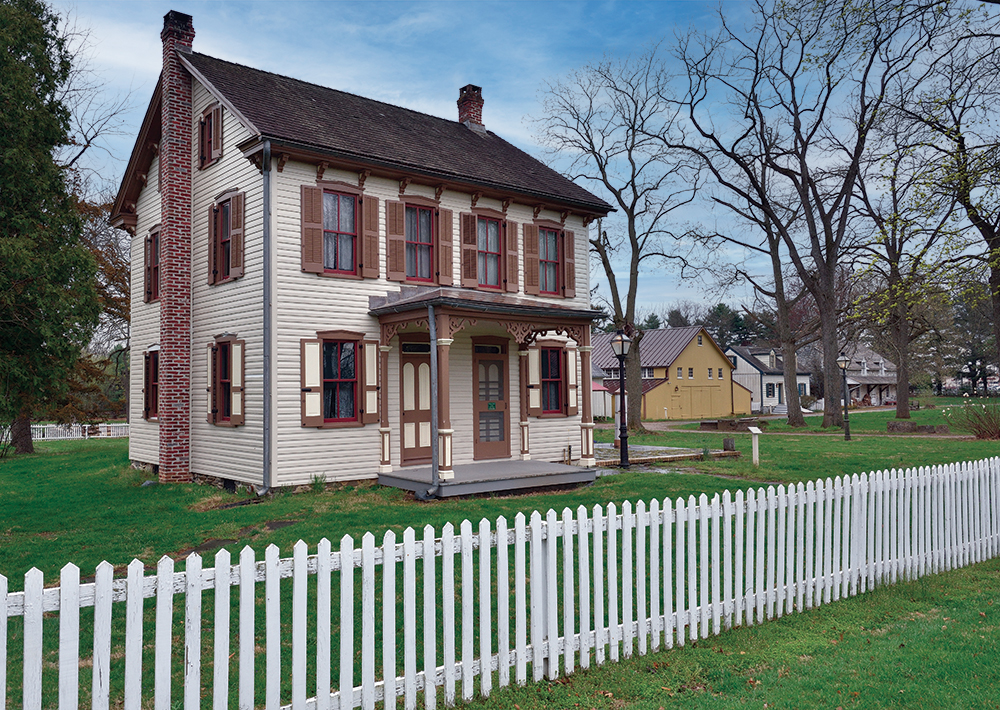
Henry and George Landis moved into this house in 1879, when they were teenagers, and it would remain the family’s residence throughout the brothers’ lives. It still stands on the museum grounds.
Pennsylvania Historical & Museum Commission
Brothers Henry Landis (1865–1955) and George Landis (1867–1954), the founders of Landis Valley Village & Farm Museum, were descendants of Germanic Mennonite families who moved to the area that would become Lancaster County in 1717. As young boys, Henry and George were encouraged by their forward-thinking parents and several teachers to pursue their personal interests and begin collecting. This childhood passion grew into an understanding of the importance of preserving the artifacts of ethnic cultures, in this case the Pennsylvania Germans (also known as the Pennsylvania Dutch).
Roughly 75,000 German-speaking Europeans came to Pennsylvania from 1683 through 1820. They were the largest immigrant group to come to Pennsylvania and they made up 40 percent of the state’s southeastern population by 1790.
After being persecuted for several generations, German Protestants were invited to Pennsylvania by William Penn, who offered them a place to live and worship in peace. The Landis family lived south of Zurich in Switzerland. Jacob Landis immigrated to Lancaster County in 1717, a century after his ancestor Hans Landis, whose story is documented in the Martyr’s Mirror, was beheaded in Zurich in 1614.
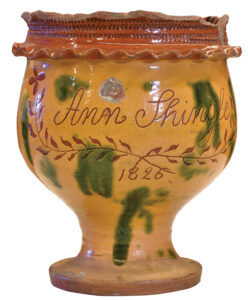
Redware pottery made from red clay with sgraffito designs is a traditional Pennsylvania German craft.
Landis Valley Village & Farm Museum, Pennsylvania Historical & Museum Commission
There were two waves of German immigrants arriving in 18th century Pennsylvania. Protestant sectarians dominated the first wave that arrived roughly between the 1690s and the 1720s. This group included the Mennonites, the Amish, the German Baptist Brethren (Dunkards) and others. The Mennonites came from Switzerland and the southern German states. The Dunkards came from Krefeld and Wittgenstein, Prussia. German Reformed and Lutherans dominated the second wave, arriving between the 1720s and the 1750s. These groups came from countries or states bordering the Rhine River. In the 1740s, as part of the second wave, Moravians arrived from eastern German principalities.
The material culture create by Pennsylvania Germans through the 19th century reflects their Germanic origins and what was learned from past generations, but it also incorporates the influences of their new country and the traditions of the English settlers their ancestors had encountered. These changes, along with personal touches, gave the Pennsylvania German material culture a character of its own.
Decorations and the use of color was part of the lives of the everyday Pennsylvania Germans. Colorful objects, made for men and women of all ages, made their surroundings brighter and more pleasant. The decorations were done by professionals, amateurs at home, and itinerants.
The Landis brothers’ vision of a study collection of artifacts would preserve knowledge that might otherwise have been lost. With the opening of the Barn Museum in 1925, they would, in Henry’s words, invite visitors to learn “how people lived in the past so they can show the world how to be better off in the future.”
Growing Up Collecting
Henry and George first began collecting in 1877 when they were boys, inspired and guided by their mother Emma, who was also a collector. The brothers’ initial interests evolved around natural history — collecting birds’ eggs, insects, and mineral specimens, as well as Native American stone tools. They also collected postcards, coins, postmarks, stamps and books, with Henry leading the way. Henry wanted to know a little about everything, and it was this curiosity that fueled his lifelong passion for collecting.
Throughout their teen years, the brothers collected locally, as well as through a network of friends, other collectors, and dealers from across the country. For instance, they traded some of the eggs they collected from Lancaster County for eggs from collectors in other locations.
In 1884 Henry founded the Landis Valley Agassiz Association for like-minded collectors. Through this association, he expanded the Landis brothers’ network and collections by initiating object-for-object trades with other members, spending money only on postage. As they continued to acquire new objects, the brothers designed and built a “what-not” cabinet in 1891 to house and display their growing collections.
Determining how best to build their collection from sources both near and far became the brothers’ goal for the remainder of their lives. In 1889, at the age of 22, George began buying entire sale lots of antiques at public auctions in the Lancaster area. This tendency of the brothers to collect locally produced objects, often in multiples, continued through the 1940s — a span of more than 50 years.
Urban and Rural Collecting
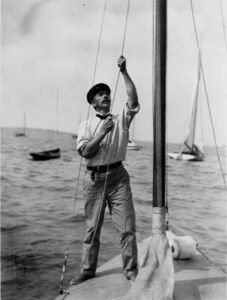
Henry Landis lived in New York City, where he worked as an editor between 1894 and 1924. During that time, in addition to leisure activities such as sailing in Port Washington, New York, as pictured here, he frequently purchased antiques and books and sent them back to Landis Valley for the collection.
Landis Valley Village & Farm Museum, Pennsylvania Historical & Museum Commission
As an adult, Henry lived in New York City, hoping to find his own life’s work away from Landis Valley. Throughout the years he worked mostly as an editor for various publications, including The Engineering Magazine, a periodical devoted to industrial progress; Progressive Age, a trade journal for gas, electricity and water utilities; Plain Talk, a magazine about progressive causes in Port Washington, New York; and The Gas Age, a gas industry newspaper with offices across the country. He also wrote technical articles for magazine publishers and worked as a land broker. Henry resided in boarding houses and on a houseboat, and he owned land where he proposed to build a bungalow where he would live along with his family.
George lived happily in Landis Valley, running Grandfather Landis’ farm, selling stone, raising wheat and tobacco, running for and winning the seat of Manheim Township assessor, holding the Lancaster County contract for garbage disposal, managing and selling agricultural fertilizer for J. Scott Dickey & Co., and caring for the rental property he owned with his brother. In Landis Valley, Henry and George both owned their grandfather’s farm, a brick tenant property in Landis Valley, and eventually their parents’ home.
Henry and George used their disposable income to make purchases. In a letter to George in 1916, Henry wrote that he was not attending evening banquets or meetings so that he could devote his money to books and music. In 1918 Henry wrote, “Just received a wedding announcement for Landis Shaw Smith who is named after me. He doesn’t get anything. Nobody gets anything but the book men.”
The brothers regularly attended auctions separately, looking for deals—George at rural Lancaster County sales, Henry at auction houses and through dealers in New York. They would also visit antique shops wherever they traveled. They would then write back and forth about what they bought. In 1920 George wrote that when he was in Philadelphia for jury duty that he “may have time to look up some secondhand stores in the evening.”
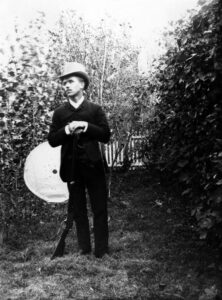
George Landis remained at the Landis Valley farmstead for his entire life and avidly collected firearms, in addition to the many other artifacts the brothers accumulated. Here he stands with a Winchester rifle, about to test it.
Landis Valley Village & Farm Museum, Pennsylvania Historical & Museum Commission
More than 50 New York City auction catalogs, dated from 1911 to 1924, and a directory of New York City book dealers highlight the purchases Henry made and the prices he paid. George did not keep records, but some of the entries in his father’s diary indicate that he was still collecting. On March 14, 1914, his father wrote, “George went to public sale at Roseville — Charlie Landis sold his mother’s things — he bought a lot.” On November 19, 1921, he reported, “George was at a public sale. He bought a brand-new wooden fork and an apple stirrer.” And on February 16, 1923, “George bought an old flintlock pistol, now has a pair of them exactly alike.”
Henry and George had separate collecting interests but acquired items for each other and themselves. George was most interested in firearms. Henry in books and mostly anything else he could afford. From 1912 to 1915, Henry purchased 1,135 books for a total of $1,819.07. From 1918 to 1924, Henry spent $1,769.49 on antiques. He purchased 100 firearms, 500 antiques, 60 pieces of furniture, and an unknown amount of Native American relics.
Henry was unable to keep all his purchases in a boarding room or on a houseboat, so he regularly shipped items to Landis Valley or brought them along when he was visiting. In 1918 he wrote to George that he was sending $60 worth of books and bringing home a “grip-full of antiques” on his next visit. He had previously shipped three boxes to Landis Valley. The brothers stored everything in their parents’ house.
While the brothers were living their adult professional lives and collecting, they were also dealing with personal issues that affected their whole family and future. Nettie May Landis (1879–1914) was more than 10 years younger than her brothers. The three siblings had a very close relationship that was strengthened by Nettie’s frequent childhood illnesses.
The family tried to keep Nettie’s childhood as normal as possible. She was able to start school when she was 9 years old and attended the log, one-room, public Roseville School, located on the Old Reading Road (Oregon Pike). After her first week of school in 1888, Nettie wrote to Henry, “I commenced to go to
school last Monday. I like school very much.” Besides school, Nettie also enjoyed outdoor activities such as farming, working with animals, fishing, and growing and selling tobacco on her own small tract of land.
In 1893 Nettie enrolled at Millersville State Normal School, the first state school in Pennsylvania for training teachers. It was the first time Nettie lived away from her family and Landis Valley. She was only able to attend the school for three years. While there she contracted pleurisy, a lung ailment.
After two years at home, Nettie attended St. Catherine’s Hall, a small girls’ school in Brooklyn, New York, that catered to young ladies with delicate health. There she could continue her studies and be close to better doctors and her brother, Henry. Nettie was only able to attend for one semester because
her health worsened, and she returned to Landis Valley.
In 1900 Nettie’s pleurisy was cured. For the next 10 years, she worked on her paintings, cultivated postcard pen pals, enjoyed time with George, and often visited Henry and various museums in New York City; however, in 1911 she was diagnosed with tuberculosis. Nettie then went west to live in a drier climate. She visited Colorado, Arizona, California and Mexico, finally settling in St. George, Utah, in 1913. Nettie lived on a ranch and raised poultry to sell. George would visit Nettie and once bought her a dog, which she named “Buster,” to keep her company.
On May 4, 1914, Nettie died from pulmonary tuberculosis, the same day George left Landis Valley for Utah to visit her. He learned the sad news when he arrived, after missing the telegram that had been sent to Landis Valley. He then returned home with Nettie’s remains and Buster. Their father wrote in his diary, “Nettie May was the chain that bound our family together.”
Many of Nettie’s belongings, including her own paintings on china and canvas, were saved and added to the Landis brothers’ collection. Nettie’s death also seemed to give her brothers a push to reassess their lives, goals and collecting habits, as both men began purchasing more frequently and in larger amounts.
In 1924 Henry wrote to George, “I feel as if I need a change . . . I feel as if I am in a rut.” With that, Henry retired and moved back to Landis Valley permanently. Both brothers then began planning their retirement together.
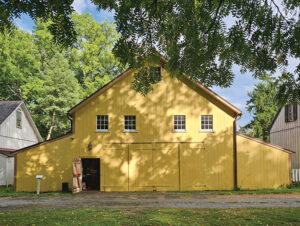
The brothers began storing their collections in this building, which they called the “Implement Shed” but is known today as the Yellow Barn.
Landis Valley Village & Farm Museum, Pennsylvania Historical & Museum Commission
The Barn Museum
In 1924 the Landis brothers retired and settled together in the family home in Landis Valley. A year later, they decided to turn their private collection into a museum. They expanded the home’s carriage barn and called it the Barn Museum.
It was natural for the brothers to turn collecting as a hobby into collecting for public education. The Landis family members were all interested in posterity and proud of their Pennsylvania German heritage. George had already begun gathering local artifacts while Henry had a greater appreciation for the culture from living in New York so long. He sensed a ticking clock. In 1927 he wrote, “There is yet time to get together what remains.”
The brothers never married nor had any children; therefore, they decided to put their time and money into something that no one else in their area had done.
In 1927 the Lancaster Sunday News reported that the Barn Museum housed a most unusual exhibition of relics. There were “widely varied items” that made “the country barn a modern wonderland.”
The Landis brothers continued to buy artifacts. In March 1927 they purchased 300 lots at 18 public auctions. This continued through the late 1930s. They were acquiring as many as 5,000 pieces a year and even purchased two Conestoga wagons for $1.50.
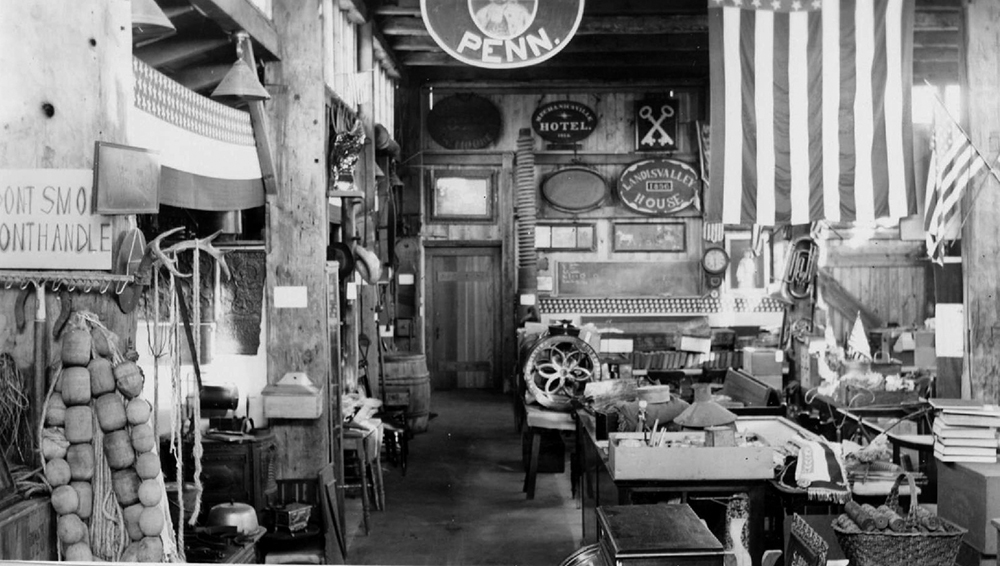
This view shows the interior of the Implement Shed, circa 1939.
Landis Valley Village & Farm Museum, Pennsylvania Historical & Museum Commission
That same year, the Landis brothers realized they needed more space than the carriage barn could hold, so they built a barn out of timber framing from another barn in Landis Valley. The pieces were reassembled to resemble a factory mill building, which they called the “Implement Shed.” Later the name was changed to the “Yellow Barn.”
Oberlaender Trust
The Landis brothers needed financial assistance to run the Barn Museum and build fireproof buildings. In 1939 the Oberlaender Trust of the Carl Schurz Memorial Foundation Inc. of Philadelphia began to subsidize the museum. Founded in 1931, the Oberlaender Trust was developed by Gustav Oberlaender to promote strong relationships between the United States and Germany.
In 1941 Henry Landis spoke at the opening of the revitalized Landis Valley Museum. He told the crowd, “We collected almost everything that came along and soon we found we had no place to put it all. There were boxes and boxes full. Fortunately, we ran across the Carl Schurz Memorial Foundation, and they have supplied some of the buildings. We are pleased to see a lot of people here, and we hope they will carry ideas home to their towns and villages and start a museum there. You can start them if you have the ambition and the money.”
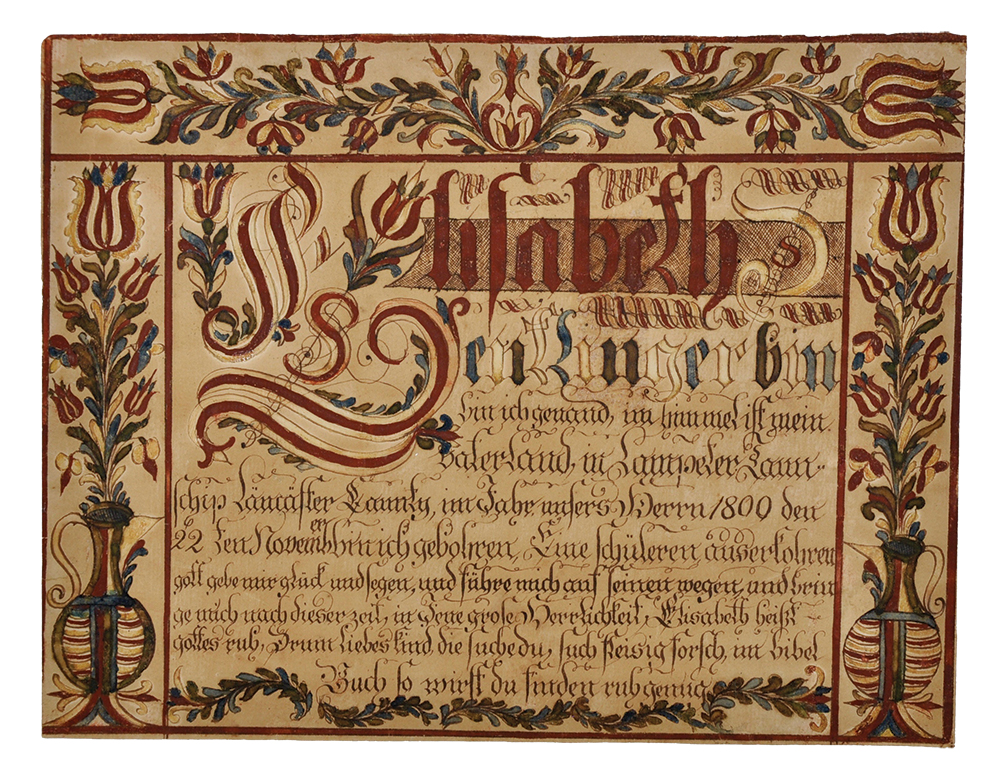
Pennsylvania German fraktur artists created handmade house blessings and birth and baptismal certificates with ornate calligraphy and illuminated illustrations. Henry Landis purchased this work by a Leacock Township artist on Friday, September 8, 1939, for $4.50. In translation it reads, “Elizabeth Dentlinger I am called, in heaven is my fatherland, in Lampeter Township, Lancaster County, in the year of our Lord 1800 on 22nd November I was born.”
Landis Valley Village & Farm Museum, Pennsylvania Historical & Museum Commission
Along with assisting the Landis brothers, the Oberlaender Trust was involved in supporting rescue operations for Jewish scholars fleeing Nazi persecution in Germany and Austria. One of the individuals aided by the trust was Dr. Felix Reichmann (1899–1987), an Austrian Jew who owned Vienna’s leading scholarly bookstore. In 1938 a long-term bookstore employee and secret Nazi Party member denounced Reichmann for his perceived political views. Reichmann was subsequently arrested and sent to the Dachau and Buchenwald concentration camps. After a year-long imprisonment, he was released, and he immigrated to the United States, where he was hired to serve as assistant curator and librarian of Landis Valley Museum in 1940.
Reichmann was appointed to organize and document the Landis Valley Museum collection. Although he began organizing the library, he did little with the other artifacts and exhibits. Increasing tension between Reichmann and the Landis brothers may have been the cause, as the brothers restricted Reichmann’s access to the collection.
In November 1942 Reichmann had a final falling out with the Landis brothers and quit. He stated that he was disappointed that the brothers would not cooperate “in an effort to make over their helter-skelter agglomeration of collected items into a well-organized modern museum. . . . It was perhaps too much to expect that these men, after a lifetime of independence, would fit themselves into a modern, professional museum organization.”
The Oberlaender Trust became thoroughly involved in the affairs and future of the museum, which became its most expensive and labor-intensive project. Over 14 years, the trust contributed $88,371 to Landis Valley Museum. The trust engaged the services of the Muhlenberg Brothers of Reading to design fireproof buildings and D.L. Warfel of Lancaster to construct them. A tavern (with office, library and kitchen), gun shop, and two long wagon sheds were built. The new buildings, costing $30,000, allowed flexibility to display objects and demonstrate various activities while withstanding fire.
Henry and George deeded 3.14 acres of the farm and some personal holdings to the Oberlaender Trust and kept 2.2 acres for themselves, which included their house and outbuildings. They were also allowed to stay on as curators for life.
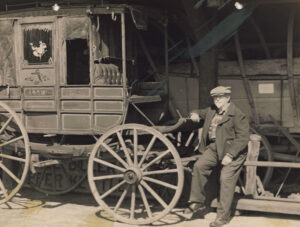
Here, Henry Landis poses with a mail coach from Perry County in 1953. By this time the land, buildings and collections of the Farm Museum had been transferred to the Commonwealth of Pennsylvania.
Landis Valley Village & Farm Museum, Pennsylvania Historical & Museum Commission
After Reichmann’s departure, Henry continued to document the collection and, in 1948, he finally completed a catalog of the museum’s holdings. He also photographed some of the artifacts and maintained scrapbooks. By 1949 the Landis brothers had spent approximately $300,000 purchasing 250,000 artifacts. In addition to other pieces, there were 30,000 books, 5,000 pamphlets, 5,000 excerpts and clippings, 3,000 fraktur documents and decorative prints, 300 record books, and 1,500 firearms. They never sold anything. What they acquired by donation or purchase remained in the collection.
The Oberlaender Trust incorporated the complex as the Landis Valley Museum. Its concentration would be on the lifeways of the Pennsylvania Germans. It was to be an educational institution, not an antiques depository. The museum’s purpose was to preserve for future generations Pennsylvania German artifacts that would be of interest to historians and students. Entertainment was of secondary importance.
The Landis brothers continued to work toward the development of a larger complex to exhibit their collections. They proposed other buildings: a replica courthouse, a technical crafts building, a decorative arts building, and a large storage shed for larger apparatus.
In 1942 the Landis Valley Museum Association was organized for the purpose of promoting the public relations of the museum, assisting in placing it on a self-sustaining basis, and encouraging the preservation of historic materials and folk art. During World War II, the activities of the association were suspended from 1943 to 1945.
On the Pennsylvania Trails of History
In 1953 the Pennsylvania Historical & Museum Commission (PHMC), the official history agency of the Commonwealth of Pennsylvania, acquired Landis Valley Museum after a bill was passed in the House and Senate unanimously. The sale included the Yellow Barn, tavern, gun shop, wagon sheds, the brothers’ house complex, 5.34 acres of land, and all of the collections. Henry and George were to retain some of their personal collections, live in the house, and serve as museum curators for life. The bill also appropriated $50,000 to pay necessary expenses.
The purpose of this transfer was to ensure permanency to the museum, continue its operation, and enlarge its scope. It was expected that the museum would grow in size, popularity, usefulness and value to the people of the commonwealth and visitors.
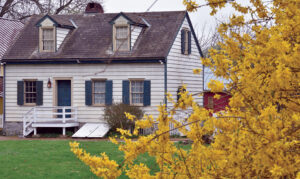
The collections of the Landis brothers have been augmented through the years with acquisitions of artifacts and buildings related to Pennsylvania German agricultural life. This early 19th-century log building, known as the Erisman House after its last owner, originally stood on West Orange Street in Lancaster. It was rescued from destruction and ultimately moved to the site.
Pennsylvania Historical & Museum Commission
From 1953 to the 1970s, the Pennsylvania Farm Museum of Landis Valley, as it was renamed, continued to grow. Most of what had been the village of Landis Valley had been acquired, including the Bitzer Garage for a transportation display and storage, land to build a typical Pennsylvania Dutch bank barn, the Brick House, and the Grossmutter House. Nine properties, including a hotel, and 46 acres were purchased for $250,000. Some historic buildings were removed from their original sites and relocated to the museum. The 200-year-old Sextons House, Epley Blacksmith Shop, a one-room schoolhouse, a surveyor’s shop, a dry house, and Erisman Doll Hospital were moved to the museum. Other buildings were constructed on the museum grounds, including a Colonial-style orientation building with offices and an auditorium, the Textile Building, a firehouse, a steam barn, a country store, a toll house, an 18th-century settler’s village, and a museum store. In the 1970s, a highway bypass was built so that the main highway that ran through the museum could be closed. Perimeter fencing and an electronic fire and security system were installed.
Popular programs that began at Landis Valley Museum in the 1950s continue to this day. Harvest Days, an annual event in October highlighting traditional Pennsylvania German lifestyles, features live music, exhibits, children’s activities, and demonstrations of farming practices, crafts and open-hearth cooking.
During the winter of 1985–86, the Heirloom Seed Project was initiated to preserve historically significant vegetable, herb and ornamental seeds. The site, again renamed as the Landis Valley Museum, issued its first heirloom seed catalog in December 1987. Its first Herb & Garden Faire was held shortly afterward in the parking lot, selling only the museum’s heritage seeds and plants.
Landis Valley Museum has received widespread recognition, and in recent years the site has made appearances in the national media. In 1993 Julia Child taped a segment of Good Morning America in the tavern, and in 1997 the site was transformed into the 1870s village of Walnut Hill for scenes in the movie Beloved starring Oprah Winfrey and Danny Glover.
In 1999 two additional buildings were opened to complete the museum’s existing layout. These buildings included the Landis Collections Gallery and Wagon Storage. The Bitzer Barn/Farm Machinery and Tool Barn was renovated and unveiled in 2006. These three buildings modernized the facilities that housed the Landis brothers’ original collections.
In 2005 the name of the museum was changed to the Landis Valley Village & Farm Museum, the name it holds today. It is one of PHMC’s 23 historic sites and museums on its Pennsylvania Trails of History. More than 27,000 annual visitors come to the museum where the Landis brothers’ legacy continues and grows, as the current mission statement proclaims, to “provide today’s diverse audiences a glimpse into the lives, ingenuity and material culture of the rural Pennsylvania Germans from 1740 to 1940.”
Further Reading
Beisert, Oscar, and Irwin Richman. The Photography of Henry K. Landis. Mechanicsburg, PA: Stackpole Books; Lancaster, PA: Landis Valley Associates, 2013. / Johnson, Elizabeth. Landis Valley Museum: Pennsylvania Trail of History Guide. Mechanicsburg, PA: Stackpole Books; Harrisburg, PA: Pennsylvania Historical & Museum Commission, 2002. / Landis Valley Cookbook. Mechanicsburg, PA: Stackpole Books; Lancaster, PA: Landis Valley Associates, 2009. / Richman, Irwin. Pennsylvania German Farms, Gardens, and Seeds: Landis Valley in Four Centuries. Atglen, PA: Schiffer Publishing, 2007. / Richman, Irwin. The Landis Family: A Pennsylvania German Album. Charleston, SC: Arcadia Publishing, 2008. / Royer, Jennifer. Weathervanes: Three Centuries of Pennsylvania Folk Art Tradition. Lancaster, PA: Landis Valley Village & Farm Museum, 2016. / Royer, Jennifer. Thrown, Fired and Glazed: The Redware Tradition from Pennsylvania and Beyond. Lancaster, PA: Landis Valley Village & Farm Museum, 2020.
Jennifer Royer is the curator at Landis Valley Village & Farm Museum and author of Thrown, Fired and Glazed: The Redware Tradition from Pennsylvania and Beyond and Weathervanes: Three Centuries of Pennsylvania Folk Art Tradition.