
Teammates & Rivals: Satchel Paige, Josh Gibson and the Pittsburgh Crawfords
Written by William Kashatus in the Features category and the Summer 2025 issue Topics in this article: African Americans, Bill Foster, Cumberland Posey Jr., Forbes Field, Great Migration (African American), Greenlee Field, Gus Greenlee, Hill District (Pittsburgh), Homestead Grays, Jackie Robinson, James “Cool Papa” Bell, James Raleigh “Biz” Mackey, Josh Gibson, Jud Wilson, Leroy "Satchel" Paige, Leroy Matlock, Negro League Baseball, Negro National League, Oscar Charleston, Pittsburgh, Pittsburgh Crawfords, William "Judy" Johnson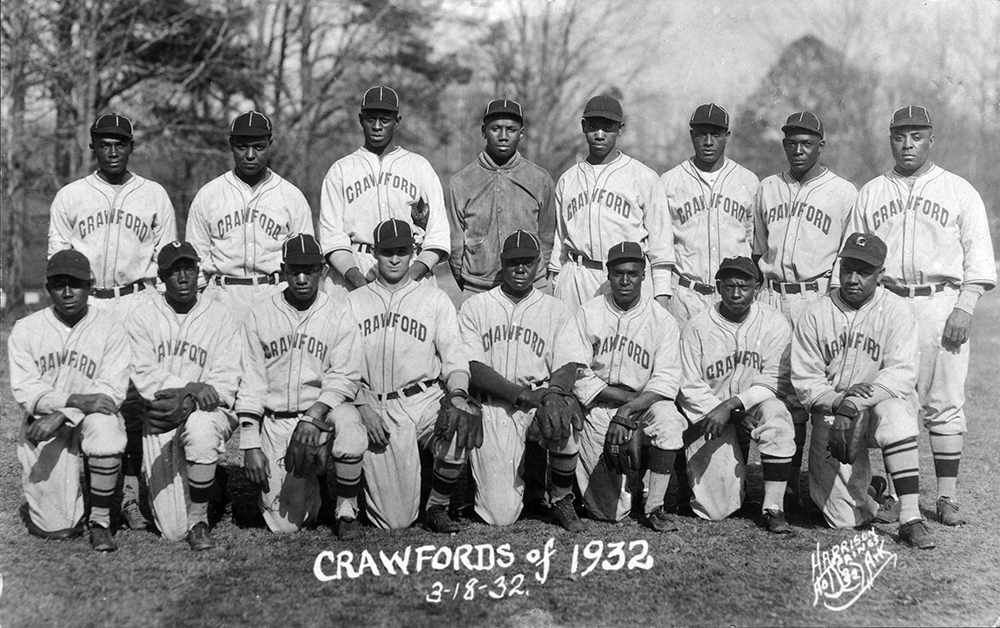
The 1932 Pittsburgh Crawfords are, standing from left to right, Benny Jones, L.D. Livingston, Satchel Paige, Josh Gibson, Ray Williams, Walter Cannady, Cy Perkins and Oscar Charleston. Kneeling in front are Sam Streeter, Chester Williams, Harry Williams, Harry Kincannon, Henry Spearman, Jimmie Crutchfield, Bobby Williams and Ted “Double Duty” Radcliffe.
Wikimedia Commons
On September 10, 1942, the Negro American League champion Kansas City Monarchs faced the Negro National League champion Homestead Grays at Forbes Field in Pittsburgh. It was Game Two of a best-of-seven matchup that would determine the World Series of Black baseball.
The Monarchs had taken a one-game lead in the series the previous day, handily defeating the Grays, 8–0. Homestead was out for revenge. Unfortunately, the weather was not cooperating. Rain had fallen in Pittsburgh for most of the day and threatened to continue throughout the game, limiting the number of fans who attended.
It was a relatively uneventful contest until the seventh inning. With Kansas City holding a 2–0 lead, the Grays were at bat with two outs and a runner on third base. Satchel Paige (1906–82), the Monarch’s ace pitcher, was on the mound. Known for his showmanship as well as a flair for the dramatic, Paige deliberately walked the bases loaded to face Josh Gibson (1911–47), the Grays’ catcher and the most feared slugger in Black baseball.
The two stars had faced each other on many occasions before and there was a personal, ongoing feud between the two to prove who was the greater star. Paige was determined to win this showdown at all costs.
When Gibson stepped to the plate, Paige began heckling him: “I’ll bet you $5 that I strike you out, Josh.”
The trash-talking continued throughout the at-bat. Prior to each pitch, the outspoken hurler would tell Gibson the location. “Get ready, Josh,” warned Paige. “I’m going to throw smoke at yo’ yolk.”
No sooner had Satch thrown the chest-high fastball that the umpire called, “Strike One!”
“This one’s going to be a pea at yo’ knee!” Paige wound up and threw a blazing, knee-high fastball.
“Strike Two!” cried the umpire as Gibson watched the pitch fly by.
Infuriated, the Grays’ catcher spat on the ground and dug deeper into the batter’s box, determined to swing from the heels at the next pitch. “Now I’m going to throw you another fastball. Only it’s gonna be a little faster than the other one,” said Satchel.
The pitch was another knee-high fastball, but a few miles faster than the previous delivery just as promised. Josh swung with all his might . . . and missed. He threw his bat down in disgust and stomped off the field.
Kansas City went on to win the game, 8–4, and later swept the Grays to clinch the world championship, four games to none; however, the Paige–Gibson showdown of Game Two was partially fabricated by the Hall of Fame pitcher in his autobiography, Maybe I’ll Pitch Forever.
Although Paige did strike out Gibson on three pitches to end the inning and preserve the lead, there is no record of him taunting Josh. News accounts also report that Gibson fouled off the first two pitches before missing the third strike, and the box score of the game shows that Paige did not walk a single batter.
The encounter is part of the rich folklore surrounding Paige and Gibson, the two towering figures of Negro League Baseball. Although they are joined at the hip by history, Satch and Josh were as different in backgrounds, physiques and personalities as two individuals can be. Paige was the son of a gardener born and raised in Mobile, Alabama, where he got the nickname “Satchel” toting bags at the local train station. Gibson was the son of a steelworker raised in Pittsburgh. Paige, at 6 foot, 3 inches and 180 pounds, was a lanky, right-handed pitcher who generated his power from his string-bean legs. Gibson, a 6-foot-1, 200-pound catcher, had the perfect physique for a power hitter with broad shoulders, muscular arms and a barrel chest that tapered down to a slim waist. It was in their personal demeanors, however, that the two stars differed most.
Paige was a remarkably gifted pitcher with an oversized personality who basked in the limelight. Gibson, a supremely talented catcher, steered clear of publicity. Satch played to the crowd, which earned him the respect, but not affection, of teammates; he was a loner, one who teammates saw on the field but seldom off it. Josh was a team-first player, which earned him the love and admiration of both teammates and opponents. At the same time, both men had tremendous pride in their baseball abilities and gave each other a begrudging respect, especially when they played together on the Pittsburgh Crawfords in the 1930s.
Between 1932 and 1936, Paige and Gibson were the brightest stars on the Crawfords. It was during this five-year period that the two men became superstars, cementing their status as the greatest Negro League ballplayers of all time. They also enjoyed an impressive supporting cast that included six other future Hall of Famers: first baseman and manager Oscar Charleston (1896–1954), outfielder James “Cool Papa” Bell (1903–91), pitcher Bill Foster (1904–78), third baseman William “Judy” Johnson (1899–1989), catcher Biz Mackey (1897–1965), and infielder Jud Wilson (1894–1963). Armed with the finest players in Black baseball, the Crawfords compiled a record of 219 wins, 134 losses and 12 ties during the five-year span and won three Negro National League titles (1933, 1935, 1936) with the 1935 team being considered the greatest of all time.
Denied the opportunity to play in the white major leagues at the beginning of the 20th century, African American communities formed their own teams and leagues as the Great Migration from the South swelled the urban populations of the North. These ball clubs were important cultural vehicles for the Black collective identity as they enabled talented African American athletes to demonstrate their grace and competence outside the workforce and in the neighborhood where they faced daily discrimination. Often playing white teams, the Black clubs demonstrated that they could beat anybody if given an equal opportunity.
In Pittsburgh, there were two Negro League teams who competed for baseball dominance — the Homestead Grays and the Pittsburgh Crawfords. The Grays came to prominence earlier than the Crawfords. Founded as a semipro club in 1900 by the Black youth of Homestead on the southern outskirts of Pittsburgh, the team, by 1910, had been transformed into a professional club. The players were migrants from the upper South and their descendants, most of whom held skilled jobs at the Homestead Steel Works. Cumberland Posey Jr. (1890–1946) was their star player and ultimately the teams’ owner. Posey’s genius lay in his ability to sign top talent, including future Hall of Famers Josh Gibson, Smokey Joe Williams, Oscar Charleston and Willie Wells, all of whom made the Grays the most successful independent Black ball club in the East.
The Grays remained an independent team until 1929, when they joined the American Negro League. When that league ended after just one season, the team again played independently — winning their first two titles in 1930 and 1931 as eastern champions — before joining the Negro National League in 1933. The 1931 team, which was highlighted by six future Hall of Famers, has been considered one of the best of all time.
The Crawfords, on the other hand, began as an interracial team of local Hill District youth who played ball together in neighborhood sandlots. The players included Black migrants from the South and white European immigrants, all of whom were attracted to industrial jobs in the city. In 1930 the Crawfords, now comprised of all Black players, were taken over by William Augustus “Gus” Greenlee (1893–1952), a college graduate and veteran of World War I who controlled the city’s numbers rackets. He also owned and operated the Crawford Grill, a fashionable gathering place for Pittsburgh’s Black elite as well as jazz musicians like Duke Ellington and Louis Armstrong. Both the restaurant and the team quickly became perfect vehicles for burnishing Greenlee’s gangster reputation, while at the same time boosting the pride of the local Black community.
Envious of the Grays’ success, Greenlee was determined to dethrone Homestead and build his own baseball dynasty. To that end, the wealthy racketeer, in 1932, turned the “Craws” into a professional club. Refusing to ask for playing time at the segregated Forbes Field, home of the Pittsburgh Pirates, Greenlee shelled out $100,000 to build the first African American–owned stadium in the Negro Leagues. Next, he added lights for night games and filled the 7,500-seat Greenlee Field with fans by stealing star players from the Grays who were suffering financial hardships from the Great Depression. Among the jumpers were Gibson, Cool Papa Bell, Oscar Charleston and Judy Johnson. Greenlee also lured Satchel Paige away from the Birmingham Black Barons. Finally, Greenlee, in 1933, revived the defunct Negro National League and became its first president. These three actions guaranteed the dominance of the Crawfords for the next five years and enabled Paige and Gibson to blossom as the greatest talents in Black baseball.
Although the 1932 Crawfords somehow lost their season series with the Homestead Grays, they finished the year with a record of 32 wins, 26 losses and 1 tie against top Black competition. Allegedly, the team won another 67 games against lesser-talented Black and white independent clubs. Paige and Gibson stole the spotlight from manager Oscar Charleston, initially considered the teams’ biggest star.
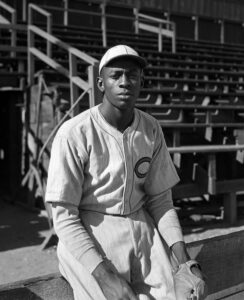
Satchell Paige is pictured here during his stint with the Cleveland Cubs, shortly before he was recruited by Gus Greenlee to play for the Pittsburgh Crawfords.
Wikimedia Commons / Los Angeles Times Photographic Collection
On April 29, 1932, Paige was given the honor of opening Greenlee Field against the New York Black Yankees, owned by dancer Bill “Bojangles” Robinson. Paige pitched scoreless ball for eight innings, but the Black Yanks took a 1–0 lead in the top of the ninth. When Josh Gibson came up to the plate with one out in the bottom of the frame, the fans anticipated a game-tying home run, and they almost got it. On the third pitch of the at-bat, Gibson got a fastball and crushed it to deep centerfield about 480 feet from home plate. Somehow Yankee centerfielder Clint Thomas caught the ball, leaping against the fence to preserve the New Yorkers’ 1–0 lead and eventual victory. But Paige got revenge on July 16 when he threw a no-hitter against the Black Yankees at Greenlee Field. Paige went on to post a record of 14–8 that season with an ERA of 2.46 against Black opponents while striking out more than one batter per inning. “I ended up on about the best team ever put together in any country—the best team, white or black,” wrote Paige of the 1932 Crawfords in his autobiography.
Gibson was even better than his batterymate that season. In just 490 at-bats, Josh collected 186 hits, 45 doubles, 16 triples and 34 homers for a .380 batting average, a .417 on-base percentage, and a .745 slugging percentage. Hailed as the “Black Babe Ruth,” Gibson, had he played in a more homer-friendly park, would have hit even more home runs than the 240 he recorded during his career. But Greenlee Field’s left field wall was located 350 feet away from home plate. Although the wall was not high, a hill in left field added to the height, making it difficult for a pull hitter like Gibson to clear it.
Greenlee, a natural promoter, advertised Paige as “the World’s Greatest Pitcher” and promised that Satchel would strike out the first nine men he faced each game. He was just as effusive in his praise of Gibson, who he called the “World’s Greatest Hitter” who would slug at least one homer every game. Not only did the two superstars deliver regularly on Greenlee’s predictions but also sometimes surpassed them. Despite their stellar performances, Paige and Gibson were not always paid their worth.
When the 1933 season opened, Greenlee warned that “there will be no big salaries for any of the players this year.” With the Great Depression in full swing, the Craws’ owner was feeling the financial pinch, both at the gate and in his other business interests. Nevertheless, with the average salary being $125 a month, Gibson and Paige were doing well financially, making twice that amount. But that didn’t stop Satchel from augmenting his income whenever possible. His greed resulted in a poor performance for the Crawfords. In 1933 Paige suffered his first losing season going 5–7 in the new Negro National League. The mediocrity was due, in part, to the fact that Satchel operated on his own schedule. If he could make more money pitching elsewhere, he jumped the team. As a result, he joined the Crawfords in late spring, pitched for them until August and returned, without apology, in late September to help the team battle for the pennant.
Another reason for the subpar performance was his experimentation with new pitches as well as a variety of deliveries. Instead of relying strictly on his fastball, Satchel added a curve as well as a “hesitation pitch,” in which he stopped briefly midway through his motion before delivering the ball to home plate to disrupt the hitter’s timing. In addition, Paige deviated from his natural three-quarter arm slot by throwing overhand, sidearm and submarine. In time, these changes would make him unhittable, but at this early stage of his career the adjustments needed to be refined and came at the expense of winning more games.
Instead, the Craws relied on Gibson, who played 137 games, missing only a dozen. Josh hit .467, leading the team in batting average and home runs with 55. The most impressive of Gibson’s homers in 1933 was a 512-foot shot in the small coal-mining town of Monessen in western Pennsylvania. According to teammate Cool Papa Bell, “Josh had a short compact swing and took a very short stride, not like other sluggers who took long strides and had big swings. Josh was never fooled. He didn’t just hit home runs, either. He hit for a very high average. He hit over .400 many times for the season and hit over .400 against major league pitching.”
Unfortunately, Gibson’s heroics were not enough to save the pennant for the Crawfords who were defeated by the Chicago American Giants for the Negro National League title.
Paige rebounded in 1934 when he went 14–2 in the Negro National League with a total of just 2.16 runs, earned and unearned, allowed for every nine innings he pitched. His most impressive victory came on July 4 in an overpowering no-hitter against the Homestead Grays. Satchel fanned at least one hitter every inning for a total of 17 strikeouts — a feat that tied the major league record set by Dizzy Dean of the St. Louis Cardinals the year before. “I’d say Satchel was the toughest pitcher I ever faced,” said Buck Leonard, the Grays’ power-hitting first baseman. “Satchel had an exceptional fastball. We knew he was going to throw it, but we could not hit it. It would get up to the plate and just rise a little, just enough for you to miss it.”
Paige was also establishing himself as a showman. Not only was he unpredictable, witty and wisecracking, but he had the talent to back it up. Once he called in his outfielders while he struck out the side. He made batters look foolish with his pinpoint control and rising fastball while trash-talking them during the at-bat. Each success inflated his ego, making him more arrogant. He even complained about Gus Greenlee’s publicity campaign. “Even though he advertised both Josh and me,” wrote Satch, “Gus knew I was pulling in the big crowds. Those other players ate lean meat because I pulled [crowds] like that. If it wasn’t for me, they’d have been eating side meat, that’s what.”
Apparently, Gibson never criticized Paige in the press or off the field. Perhaps realizing that he was no match for Satchel’s wit and style, Josh let his bat do the talking for him and kept their rivalry strictly on the diamond. On the other hand, Paige’s showmanship and arrogance did cause resentment among his other teammates.
According to shortstop Jake Stephens, Satchel “was a clown with a big mouth” and a “spendthrift.” “Give ‘em $150 a month,” he added, “first thing you know he’s living on top of the world.”
Cool Papa Bell was also angered by Greenlee’s promotion of Satchel when “we had pitchers who would win more games than him.” But Judy Johnson appears to be the only teammate who confronted Paige. Once, when Satchel loaded the bases with nobody out, the third baseman walked out to the mound and said, “Some of the boys were hoping you’d get yourself into this spot. They think you’ve got a big mouth.” Paige said nothing but proceeded to strike the side out on nine pitches. When he returned to the bench, Paige, determined to get the last word, found Johnson and told him, “The next time that happens, I’ll just ask you boys to take a seat on the bench while I take care of the situation.”
Paige did not help his cause when, in a salary dispute with Greenlee, he jumped the team before the end of the 1934 season to make more money pitching for an interracial semipro club in Bismarck, North Dakota. Infuriated, Greenlee banned Paige from the Craws for the 1935 season. Satchel did not seem to care, though. He returned to Bismarck where he posted a 43–2 record for a team that won 97 games that summer.
Despite Paige’s absence, the 1935 Crawfords compiled a 51–26–3 (.656) record and defeated the New York Cubans in a close seven-game series for their only undisputed Negro National League pennant. The team is arguably the greatest in Negro League history largely due to the presence in the lineup of four future Hall of Famers: Gibson, Oscar Charleston, Cool Papa Bell and Judy Johnson. But there were others who contributed as well. Leroy Matlock (1907–68) replaced Satchel as the team’s ace, posting a 1.52 earned run average, and the rest of the pitching staff was solid. While historians still debate Matlock’s win–loss record, some claiming it was as low as 10–1 and others as high as 18–0, Cool Papa Bell put the left-hander’s season in perspective. “In 1935, Leroy just rolled past everybody,” he said. “He didn’t have great stuff, but he had outstanding control and the ability to spot his pitches. Nobody could scare him.”
While Matlock dominated the pitching, Oscar Charleston’s star-studded lineup did the rest. Swinging a 41-ounce bat, Gibson hit .369 with 11 home runs, 63 RBIs, and a 1.109 on-base plus slugging percentage during the regular season and batted .355 against the Cubans in the NNL championship series. Center fielder Cool Papa Bell hit .345, scored 68 runs, and stole 12 bases. Second baseman Pat Patterson (1911–84) batted .386 with 23 extra-base hits and 41 RBIs. Although aging infielders Oscar Charleston and Judy Johnson hit in the .270s, they both provided exceptional defense at first and third base respectively.
In 1936 Greenlee agreed to take Paige back, realizing that Satchel had been his biggest drawing card and that he needed him to keep the turnstiles moving. For Paige, returning to Pittsburgh was a matter of pride. He wanted to reclaim his title as ace of the team, which had been temporarily held by Matlock. It took Satchel, who returned to the Craws in May, all of one month to dispatch Matlock who, in June, jumped the team to play in Mexico. Paige went 10–3 that season in league play, the next best pitcher being Sam Streeter who was 3–1.
Gibson also had an outstanding season, hitting .360 with 11 home runs in league play. No one else on the Craws hit .300, including future Hall of Famers Oscar Charleston (.285), Cool Papa Bell (.256) and Judy Johnson (.239). In addition, an unverified report claims that Gibson hit 84 homers in a total of 170 games that year, which would include semipro contests. Essentially, the 1936 Crawfords were carried by Satch and Josh. The team won 36 games and dropped 24, good enough to make it to the Negro National League championship and defeat the Washington Elite Giants.
Then, as suddenly as the Crawfords ascended to the top of Black baseball, the team collapsed. In 1937 Paige led several of his teammates, including Gibson and Bell, to the Dominican Republic to play for the dictator Rafael Trujillo’s team. The Craws dropped to fifth place out of six teams with a 12–16 record. Somehow the team managed to finish third with a 24–16 record in 1938, but Paige, Gibson and Bell had all moved on to other teams.
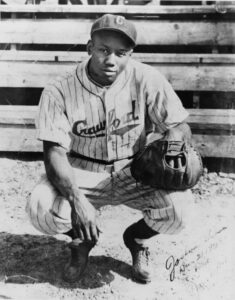
Josh Gibson played for the Homestead Grays in 1930–31 before moving to the Pittsburgh Crawfords, 1932–36. He would return the Grays in 1937 and, with the exception of a year in the Mexican League, he would continue with the Grays until his untimely death in 1947.
Courtesy of the National Baseball Hall of Fame and Museum
Pittsburgh might have survived these losses, but their attendance flatlined. At the same time Greenlee’s fortune, which was dependent on police protection, vanished in the wake of citywide political reform. In 1939 he sold the club and resigned as president of the Negro National League. Greenlee Field was demolished and the Crawfords moved to Toledo in the Negro American League. They moved again in 1940 to Indianapolis before folding.
Once the greatest pitcher–catcher battery in Black baseball, Satchel Paige and Josh Gibson, playing for different teams, became fierce rivals. Gibson returned to the Homestead Grays, becoming the cornerstone of the team’s return to the top of the Negro National League in the 1940s. Paige went on to the Kansas City Monarchs of the Negro American League where he cemented his legendary status. Whenever they played against each other, Satch went out of his way to taunt Gibson, predicting he would strike him out and then do it. “You can’t hit what you can’t see,” Paige yelled as he walked off the mound. It infuriated Gibson who would throw down his bat and storm off the field. Occasionally, Josh would hit a home run off Satchel and, as he rounded the bases, chide him, “If you could cook, I’d marry you!”
Many Negro leaguers believed that Paige or Gibson would be the first to break the color barrier after baseball commissioner Judge Kenesaw Mountain Landis died in November 1944 and his successor, Senator A.B. “Happy” Chandler, ended the “gentleman’s agreement” among owners barring Blacks from the major leagues. Of all the owners, Branch Rickey (1881–1965) of the Brooklyn Dodgers, was the first to test the waters. Although he certainly considered both stars as candidates because of their remarkable playing abilities, their personal behavior and advanced ages did not meet the standard he envisioned for the first African American to integrate the game.
Paige was too outspoken, too self-absorbed, and too loose in his morals for Rickey. Viewing himself as the centerpiece of Black baseball, Paige cared more about himself than his teammates, routinely jumping from club to club. Nor did Rickey appreciate the image the star hurler projected. A consummate showman, Satchel gave the impression of a a happy-go-lucky character, playing to the fans as he ambled onto the diamond. Paige was also earning $37,000 a year with the Kansas City Monarchs, which made him too expensive for Rickey. Finally, Satchell was 39 in 1945 and clearly on the downside of his pitching career.
Like Paige, Gibson was too unsophisticated for Rickey. His education was spotty and consisted primarily of vocational training. In addition, Josh was a fun-loving soul who gave to some observers the appearance of an ignorant man-child. Often the target of bench jockeys, he had a quick temper, didn’t take pressure well, and was known to explode at hecklers, something he would have to deal with as the first African American in the majors. Gibson struggled with alcohol, sometimes going on extended benders. Josh was also 34 years old and by the mid-1940s was suffering from recurring headaches and dizzy spells. In fact, he was hospitalized for 10 days in January 1943 after doctors discovered a brain tumor. But he refused an operation and instead returned to baseball, while the headaches and blackouts continued. None of these problems escaped the scrutiny of Rickey’s scouts, who were instructed to keep careful records of the playing performances and personal lives of every candidate being considered.
Instead, Rickey selected Jackie Robinson (1919–72), a shortstop with the Kansas City Monarchs, to break the color barrier. Although Robinson had only played one year in the Negro Leagues, he was in his mid-20s and college educated. He had also lettered in football, basketball and track at UCLA and had done so competing with and against white athletes. Finally, Robinson had served as an officer in the U.S. Army during World War II. He was a perfect fit for Rickey in terms of his youth, educational sophistication, determination to succeed under difficult circumstances, and a sense of loyalty to the American way of life.
After the Dodgers announced Robinson’s signing on October 23, 1945, Paige put on a good public face. When he was asked his opinion about Jackie’s qualifications, Satch told reporters that Brooklyn “couldn’t have picked a better man” and that Jackie was the “greatest colored player I’ve ever seen.” Deep down, however, Paige was hurt. “I’d been the one everybody said should be in the majors,” he wrote in his autobiography years later. “It was me who ought to have been first.”
Paige would eventually make it to the major leagues signing with the Cleveland Indians on July 7, 1948, his 42nd birthday. Two days later, he became the oldest man ever to debut in the majors. After two seasons with the Indians, Satchel was released. In 1952 the St. Louis Browns signed him as a gate attraction, but he still managed to be selected as the first Black pitcher named to an American League All-Star team. Paige pitched his final major league game on September 25, 1965, for the Kansas City Athletics. He was 59 years old. He was inducted into the National Baseball Hall of Fame at Cooperstown, New York, in 1971.
Josh Gibson never made it to the majors. Tragically, he died of a stroke on January 10, 1947, a few months before Jackie Robinson broke the color line. Inducted into the Hall of Fame in 1972, Gibson became the second Negro League player, after Satchell Paige, to be so honored.
Further Reading
Bankes, James. The Pittsburgh Crawfords: The Lives and Times of Black Baseball’s Most Exciting Team. Dubuque, IA: William C. Brown, 1991. / Brashler, William. Josh Gibson: A Life in the Negro Leagues. New York: Harper & Row, 1978. / Bush, Frederick C., and Bill Nowlin, eds. Pride of Smoketown: The 1935 Pittsburgh Crawfords. Phoenix, AZ: Society for American Baseball Research, 2020. / Holway, John B. Josh and Satch: The Life and Times of Josh Gibson and Satchel Paige. New York: Carroll & Graf, 1991. / Holway, John B. “Josh Gibson: The Heartbreak Kid,” Pennsylvania Heritage 20, no. 4 (Fall 1994): 18-25. / Paige, Leroy “Satchel,” and David Lipman. Maybe I’ll Pitch Forever: A Great Baseball Player Tells the Hilarious Story Behind the Legend. Garden City, NY: Doubleday, 1961. / Tye, Larry. Satchel: The Life and Times of an American Legend. New York: Random House, 2009. / Tygiel, Jules. Baseball’s Great Experiment: Jackie Robinson and His Legacy. New York: Oxford University Press, 1997.
William C. Kashatus, a resident of Paoli, is a regular contributor to Pennsylvania Heritage and the author of more than two dozen books on sports, biography, and Pennsylvania history.