
Susanna Wright: Poet and Polymath on the Susquehanna
Written by Jack Brubaker in the Features category and the Spring 2026 issue Topics in this article: American Revolution, Benjamin Franklin, Benjamin Rush, Columbia, Conestoga Indians, Deborah Norris Logan, Eliza Norris, Fairhill (Norris Mansion), French and Indian War, Hannah Griffitts, horticulture, Isaac Norris, James Logan, John Wright, Milcah Martha Moore, poetry and poets, Quakers, Robert Barber, Samuel Blunston, silk, Susanna Wright, Susquehanna River, women, Wright's Ferry, Wright's Ferry Mansion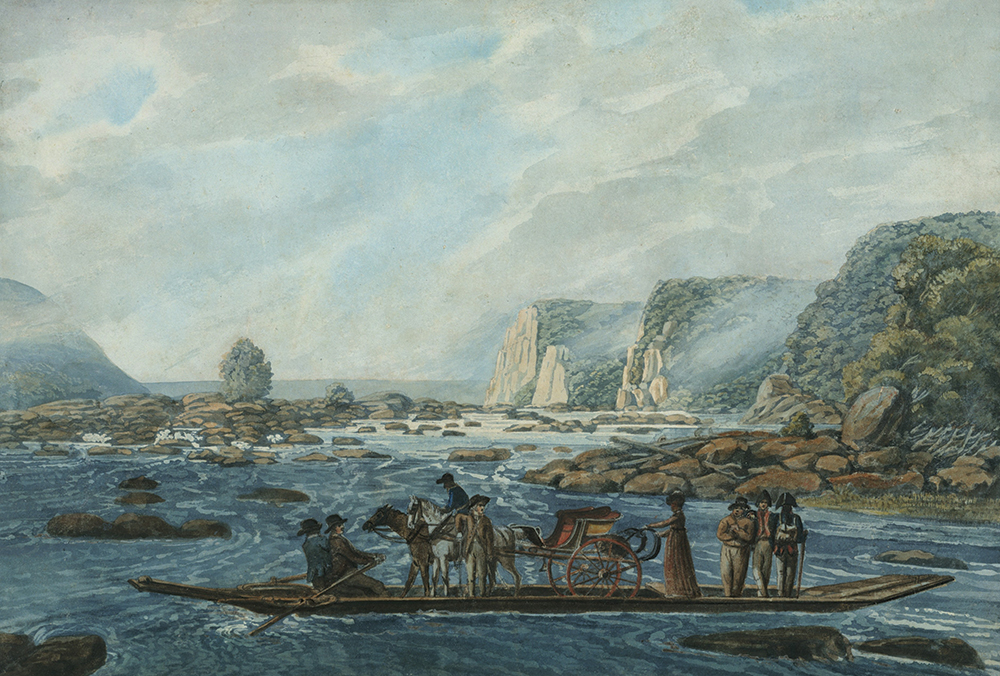
John Wright began transporting people and merchandise across the Susquehanna River in 1730. This painting, A Ferry Scene on the Susquehanna at Wright’s Ferry, near Havre de Grace, was created in watercolor, gouache and black chalk on white wove paper around 1813 by Pavel Petrovich Svinin (1787–1839).
Metropolitan Museum of Art (Rogers Fund, 1942)
No right has man his equal to control,
Since, all agree, there is no sex in soul;
Weak woman, thus in agreement grown strong,
Shakes off the yoke her parents wore too long.
Those lines of poetry, written in a rigidly paternalistic 18th-century America, establish Susanna Wright (1697–1784) as one of America’s early supporters of women’s equality. More subtly, the poem, entitled “To Eliza Norris—at Fairhill,” asserts an equally unorthodox opinion for that time: A single woman can successfully make her own way in the world. (Susanna Wright never married and neither did her friend Elizabeth Norris.) The progressive stance of “To Eliza Norris” and the quality of Wright’s other poems secure her reputation as one of the foremost poets of Colonial America.
A contemporary said Wright wrote “not for fame” and “never kept copies.” The number of poems now available may be only a fragment of her original work. “To Eliza Norris,” one of the last poems Wright wrote, was not rediscovered until 1981. That poem made a total of only four poems attributed to Wright at that time. Milcah Martha Moore (1740–1829), a fellow poet who resided in Philadelphia, had copied most of the other 30-odd known Wright poems in a blank book that was not printed until 1997 — two centuries after Wright died. That delay in retrieving the bulk of Wright’s poetry helps to explain why those who know something about her life might name another of her many interests — among them, law, medicine and horticulture — before mentioning poetry.
Susanna Wright was a writer and a thinker of the first order. Her cogent correspondence with many poets and political leaders proves she was one of the more intriguing personalities of 18th century Pennsylvania. To fully appreciate Wright’s poetry requires knowing more about her long and varied life.
***
Susanna was born in Lancashire, England, in 1697. She died at Wright’s Ferry on the Susquehanna River in 1784. The first child of John and Patience Gibson Wright, she was followed by two sisters and then two brothers, all but one born in England, who lived to maturity. So, the Wright household was regularly busy with babies. John Wright was an affluent yeoman and linen merchant in England. He was also an elite member of the Society of Friends, or Quakers, and a close friend of Pennsylvania founder and first proprietor William Penn.
The Wrights left for America in the spring of 1714, first settling in Chester, where James Wright, the last of Susanna’s siblings to survive infancy, was born. John Wright, the patriarch, quickly became a leader of the community and the commonwealth. He served as a president judge of the courts and justice of the peace of Chester County, was elected to Pennsylvania’s Provincial Assembly, and was designated as a Quaker minister.
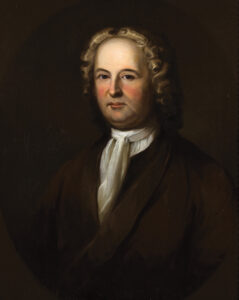
James Logan, here in a portrait by Thomas Sully, served as Susanna Wright’s primary mentor from as early as 1718, when she was 21, until Logan died in 1751.
Library Company of Philadelphia
As a Quaker and an assemblyman, Wright befriended James Logan (1674–1751), a Philadelphia Quaker and secretary to William Penn, as well as a fellow former linen merchant. Upon visiting the Wright family, Logan observed Susanna’s intellect and, as early as 1718, sent books and essays to her. Logan, who was 24 years older, became her primary mentor. They wrote regularly to each other until Logan died in 1751.
Susanna Wright also befriended the Norris family, including Isaac Norris I (1671–1735), a Philadelphia merchant and longtime member and sometime speaker of the Provincial Assembly. The Quaker Norrises built the North Philadelphia mansion called Fairhill, referred to in the poem dedicated to Eliza Norris. Eliza was Isaac’s daughter and a much younger friend of Susanna Wright in her later years.
In 1722, eight years after the Wrights moved to Chester, Susanna’s mother died. John Wright and Susanna raised the younger children in Chester and, beginning in 1726, in Hempfield Township, Lancaster County, at a place on the east side of the Susquehanna called Shawanah Town, later known as Wright’s Ferry and, finally, Columbia.
Moving from the relatively refined settlement at Chester to the wild frontier prompted what may be Wright’s earliest extant poem, untitled and undated, like many of her poems. She clearly laments the exchange of civilized society for the isolation of the wilderness in her introductory quatrain:
From all the social world estrang’d
in desert wilds and woods,
Books and engaging friends exchang’d
For pendant rocks and flood
Wright concludes that, despite the isolation of the frontier, nature has its attractions. She is resigned to the daily monotony of labor on the land “unlike those days of peace / By earlier prospects given!”
The Wrights did not leave their entire social world behind. A number of other Quaker families from Chester and Darby joined them in the new settlement. They included the families of Samuel Blunston and Robert Barber, also wealthy members of the Quaker elite. Eventually, these men controlled many of the important political offices in Lancaster County, which was formed from Chester County in 1729 — three years after the Quakers moved to Wright’s Ferry.
Susanna, age 29 when the Wrights left Chester, purchased 100 acres of land James Logan had set aside for the area’s Quaker oligarchy. Her father bought 150 acres beside her. Blunston and Barber settled on substantial properties of river land adjacent to the Wrights. Blunston, a surveyor, directed the building of the county’s first courthouse and served in the Pennsylvania Assembly. Barber was the county’s first sheriff. John Wright named the county for his home in England and reprised his Chester County roles as president judge of the courts and justice of the peace in Lancaster. He was re-elected to the Pennsylvania Assembly and served part of a term as speaker. He also began operating a ferry — a critical transportation link — across the Susquehanna.
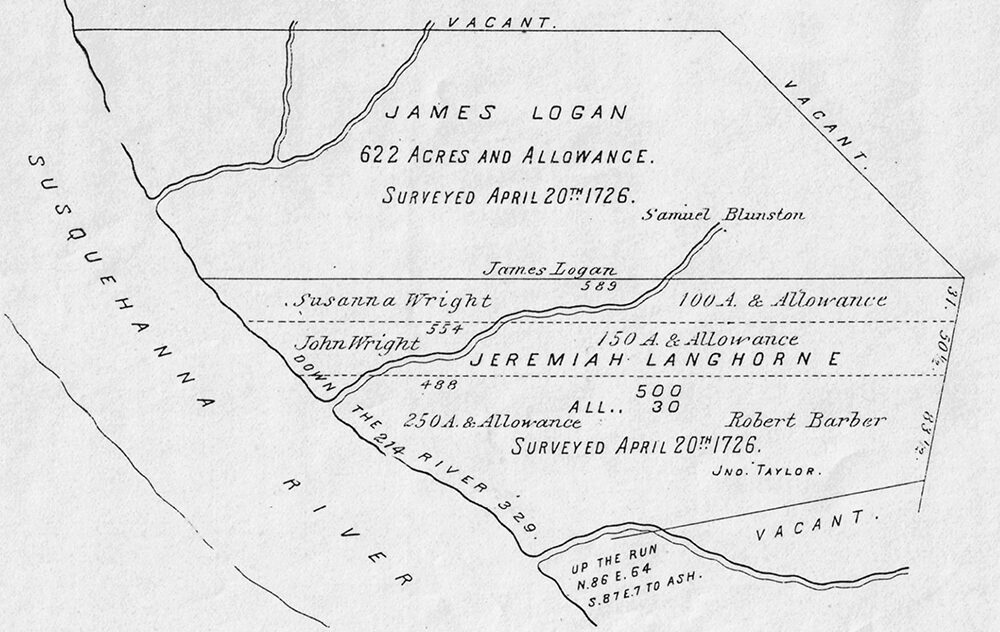
In 1726 William Penn’s secretary in Pennsylvania, James Logan, surveyed lands fronting on the Susquehanna River for a group of English Quakers. Samuel Blunston, Susanna Wright, John Wright and Robert Barber purchased those properties at the core of what is today Columbia.
Columbia Historic Preservation Society
Wright built a log structure along the river. He and Susanna probably lived there with Susanna’s two young brothers. Blunston and Barber and other Quakers constructed more substantial homes than Wright’s riverside cabin. All but one of these structures built in the first half of the 18th century have been demolished.
The remaining building is Wright’s Ferry Mansion, which Susanna’s brother James instructed German indentured servants to build in 1738. Susanna moved there from her father’s cabin. Wright’s Ferry Mansion is a remarkable example of how the Quaker upper class lived in early-18th-century Pennsylvania and has been carefully preserved as such. Much of the Georgian stone house, including window frames and paneling, exterior doors and pine floors, is original. It is the only English Quaker house in Pennsylvania furnished exclusively with items dating to the first half of the 18th century.
As neighbors on the frontier, Samuel Blunston and Susanna Wright spent considerable time together. She managed his affairs when he went to Philadelphia on Assembly business. She nursed him and his wife, Sarah, during their declining years in the mid-1740s. Sarah Blunston died at the end of 1744, Samuel Blunston in September 1745. Without wife or children, Blunston willed Wright his home, Bellmont, and 900 acres of land just north of the Wrights’ properties. Blunston also gave Susanna his books, silver and enslaved Black servants, with instructions on when to free them. He split his substantial monetary estate among two nieces, a nephew and Wright.
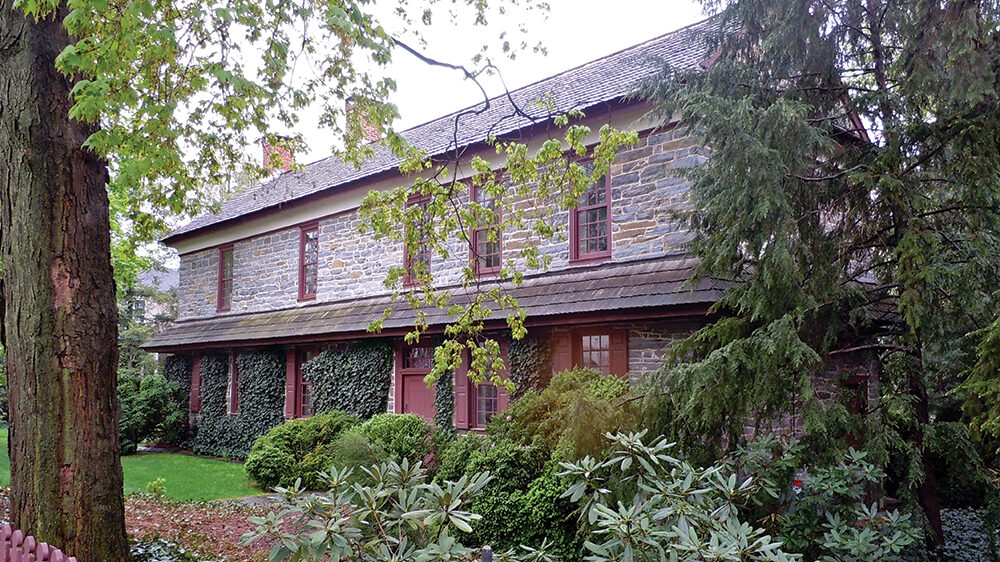
Susanna Wright lived in what is now known as Wright’s Ferry Mansion from 1738, the year her brother James built it, until the mid-1750s. She then moved to Bellmont, the mansion she inherited from her neighbor Samuel Blunston.
Wikimedia Commons / Smallbones /CC0 1.0
A decade after Blunston died, Wright moved to Bellmont and remained there until she died. Her brother James and his family also moved to Bellmont. At the same time, descendants of Samuel Blunston’s brother moved into Wright’s Ferry Mansion. The Wright and Blunston families remained entwined by inclination and residential occupation.
There is no portrait of “Suzy,” as she was known to her best friends. Along with many early Quakers, especially women, Wright never had her likeness painted. Fortunately, Sarah Barton, second wife of the Reverend Thomas Barton, rector of St. James Anglican Church in Lancaster, provided a “word portrait” after she met the nearly 80-year-old woman in 1776. Barton said Wright had “all the vivacity of a woman of 40 the compleat exercise of all the faculties — converses freely and is an excellent companion . . . being educated a Quaker (tho her good sense will not suffer her to retain the stiffness and formalities of one) she is remarkably plain in her dress & manner of living.”
Deborah Norris Logan (1761–1839), Isaac Norris’ granddaughter, also used the word “vivacity” in her description of Wright, physically and otherwise, in 1815, three decades after Wright died. Deborah Logan was born in 1761, when Wright was 54 years old. “I had the pleasure, when very young, of seeing her,” Logan wrote, “and can remember something of the vivacity and spirit of her conversation, which I have since heard some of the best judges of such merit affirm they had seldom known to be equalled. . . . In her person she was small, and had never been handsome, but had a penetrating, sensible countenance, and was truly polite and courteous in her address and behaviour.”
![Deborah Norris Logan, a granddaughter of Isaac Norris, knew Susanna Wright in her later years. The younger woman commented on “the vivacity and spirit of [Susanna’s] conversation.” This oil-on-canvas portrait is a copy after Charles Willson Peale. Courtesy of The National Society of The Colonial Dames of America in the Commonwealth of Pennsylvania](http://paheritage.wpenginepowered.com/wp-content/uploads/2026/04/F03-06-Deborah_Logan-196x300.jpg)
Deborah Norris Logan, a granddaughter of Isaac Norris, knew Susanna Wright in her later years. The younger woman commented on “the vivacity and spirit of [Susanna’s] conversation.” This oil-on-canvas portrait is a copy after Charles Willson Peale.
Courtesy of The National Society of The Colonial Dames of America in the Commonwealth of Pennsylvania
Benjamin Rush (1746–1813), a controversial Philadelphia physician who signed the Declaration of Independence, visited Wright in April 1787, just a few months before her death. He said she was frail but had maintained her love of learning and “her relish for books ‘that she could not live without them’—and that, to use her own words, ‘the pleasure of reading was to her a most tremendous blessing.’”
Deborah Norris Logan wrote that Wright “was well acquainted with books, had an excellent memory, as well as a most clear and comprehensive judgment; she spoke the French language with great ease and fluency; she had also a knowledge of Latin, and of Italian, and had made considerable attainements in many of the sciences. Her letters written to her friends, were deservedly esteemed for their ingenuity.”
Susanna Wright regularly exchanged letters with Logan, Rush, Benjamin Franklin (1706–90) and several members of the Norris family. She also corresponded with fellow poets, including Hannah Griffitts (1727–1817), a granddaughter of Isaac Norris I. Many of these letters dealt with the health of members of her or the recipients’ families. A few commented on religion, politics, poetry and other serious subjects. Letters were an essential part of Wright’s life as a writer.
But Wright did not spend all of her days reading books, writing letters, creating poetry and directing servants to carry out the more mundane duties of cooking meals, sewing clothes, making candles, gardening and maintaining livestock. She was an active participant in multiple aspects of her community and county.
At a time when there was no formal training to practice law and only men were expected to pursue the practice, Susanna Wright studied the subject. She certainly received training and encouragement from her father, who served as justice of the peace of Chester County and then Lancaster County. Samuel Blunston probably proffered his advice. After Blunston died, Wright became the arbiter of many legal decisions in Wright’s Ferry and the surrounding areas of Hempfield. If her neighbors needed to draw up a will or settle an estate, they turned to Wright for help.
Wright’s interest in the law and her father’s and Blunston’s leading positions in the county and colony spurred her interest in political affairs. Proprietary Secretary Richard Peters (1704–76) complained in a letter to Thomas Penn, William Penn’s son, that Susanna Wright had taken a leading role in distributing a political letter in the October 1742 election. Peters wrote, “Could anyone believe that Susie could act so unbecoming and unfemale a part as to be employed in copying such infamous stuff and to take her stand as she did at Lancaster in the upper room in a public house and to have a ladder erected to the window and there distribute lies and tickets all the day of the election?”
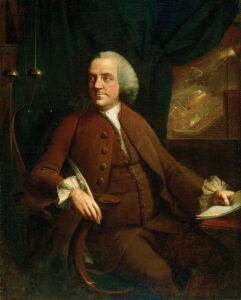
Benjamin Franklin, pictured here in a 1762 portrait by Mason Chamberlain, regularly corresponded with Susanna Wright and relied on her advice when he was searching for horses and wagons for the Braddock Expedition during the French and Indian War.
Philadelphia Museum of Art (Gift of Mr. and Mrs. Wharton Sinkler, 1956)
Wright also involved herself in military affairs, despite pacifistic Quaker principles. In 1755, Gen. Edward Braddock’s British army required wagons and horses to help carry supplies on the journey to take Fort Duquesne from the French in western Pennsylvania during the French and Indian War. The Pennsylvania Assembly assigned Benjamin Franklin to find horses and wagons for the expedition. He credited Susanna Wright for suggesting that he call leaders of the townships together to spread the word. Franklin made the arrangements and farmers provided the wagons. The Braddock expedition was a disaster, but not because the soldiers had insufficient supply wagons.
During Pontiac’s War, Wright seems to have taken a leading role in informing Franklin about details of the Paxton Rangers’ massacre of 20 Conestoga Indians at their town in Manor Township and at the Lancaster Workhouse in December 1763. In January 1764, Franklin wrote and printed an anonymous pamphlet entitled Narrative of the Late Massacres in Lancaster County. He naturally would have sought information from someone he frequently corresponded with in Lancaster County. The Conestogas lived just a few miles from Wright’s Ferry. Wright knew the adults and children by name and treated some of them when they were ill. She studied their language. She personally felt the effects of the massacre and later said its “brutal enormity so affected us, that we had to beg visitors to forbear to speak of it.”
Wright’s sympathies a decade later extended to the residents of Philadelphia who had to abandon the city when the British took over during the Revolutionary War. She clearly supported the Patriot cause, although she counseled a nephew “not to be carried away with an inordinate military enthusiasm to get yourself shot through the head.”
Susanna Wright opened her home to strangers. Benjamin Franklin, in a 1759 letter to Susanna’s brother James, mentioned that Susanna and James had provided a home for two children whose mother, Mary James, had been abducted by Indians. Perhaps from a sense of noblesse oblige, Wright also offered aid to neighbors who did not enjoy her privileges. Sarah Barton said Wright “maintains several poor families on her own land and having considerable knowledge of Physics, dispenses medicines gratis to all the sick around her who are unable to employ a Physician.”
While she had a general understanding of medical matters, Wright relied regularly on advice from three Philadelphia physicians. One of them, Lloyd Zachary, sent Wright instructions and medicine for the care of Samuel and Sarah Blunston during their final illnesses.
Wright enjoyed planting and growing things. She read books on horticulture and botany and ordered seeds from Philadelphia. In addition to growing several herbs she used in her medical practice, Wright also raised hemp, flax and indigo. She maintained an extensive apple orchard. A lane of cherry trees led to the ferry landing, which was on her property.
Wright also grew mulberry trees on which silkworms fed and then spun silk. In 1759, she fashioned the first silk stockings made entirely in Pennsylvania. In 1770, she produced the silk from which a court dress was made for Queen Charlotte, wife of King George III. The next year, when she was 74 years old, Wright won a first place award from the Philadelphia Silk Society for raising the most cocoons in Pennsylvania. In 1772, the historian Robert Proud (1728–1813) visited Wright and discovered that she was caring for 1,500 silkworms. He said she told him she could handle a million under the proper circumstances. Wright wrote a detailed treatise on the raising of silkworms that appeared in a scientific journal 20 years after she died.
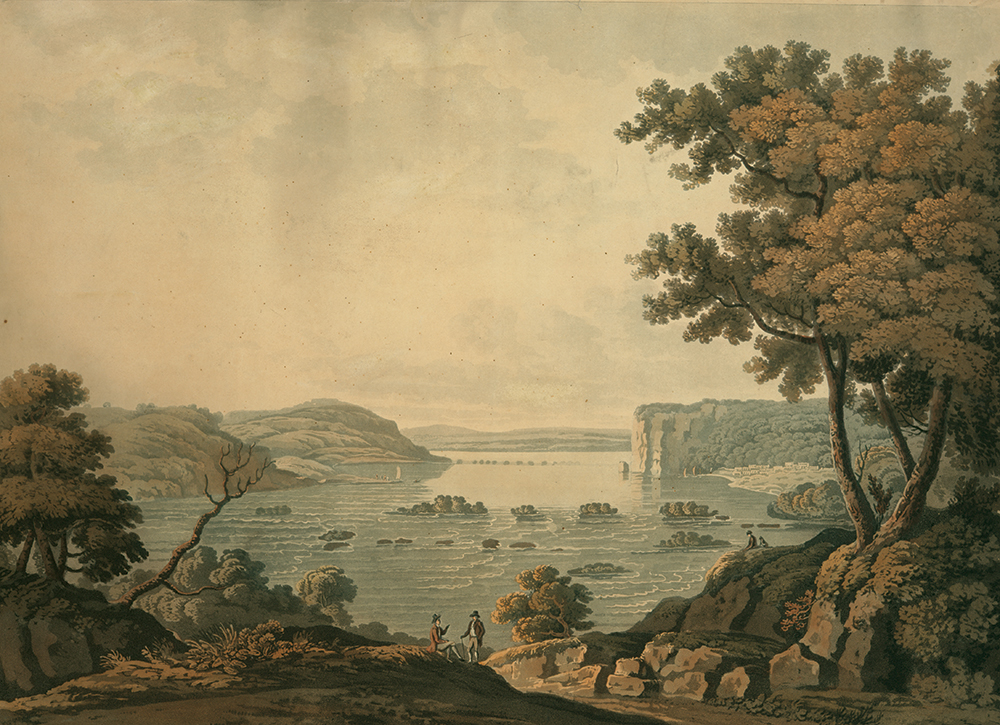
Wright’s Ferry on the Susquehanna, Pennsylvania, by George Beck (c.1749–1812), published by George Nightingale in 1809.
The Miriam and Ira D. Wallach Division of Art, Prints and Photographs: Print Collection, The New York Public Library
From growing silkworms to writing poetry may seem like a long reach, but Wright wove all of her interests and duties — including homemaker and gardener, lawyer and doctor, political adviser, silkworm cultivator and poet — into a socially and geographically constrained but intellectually vibrant life.
As for her poetry, a handful of scholars in recent decades have identified her as a key player in an informal group of 18th-century versifiers in the Mid-Atlantic region. Those poets included Hannah Griffitts and Milcah Martha Moore, previously mentioned, as well as Elizabeth Graeme Fergusson, Anna Young Smith and others. They circulated their poems and other writings. If Moore had not copied many of the poems sent to her, we would not know nearly so much about this literary circle. Wright was uninterested in literary acknowledgment beyond this group. She apparently burned most copies of her poems after sending them to Moore and others.
Susanna Wright, occasionally referred to as the “Susquehanna Muse” by her contemporaries, wrote poems as early as 1723, when she was 26, and as late as her 80s in the 1780s. Her poetry has a sameness of sound and sense, as does much 18th-century verse. She relied largely on wit and rhyme to carry her message. She was liberal in her alliteration but rarely created a memorable figure of speech. One of her most striking lines appears in “My Own Birth day August 4th 1761.” Reflecting on the brevity of life, often filled with sorrow, Wright refers to a vision of past happiness as “ a bubble on the [water’s] shining face.”
The purpose of poetry in the 18th century was to instruct at least as much as to entertain. Common subjects were immortality, justice, friendship and family. The answer to all questioning of the meaning of life was to rely on God’s plan for humanity.
Wright’s poetry was rooted in her Quaker beliefs, so most of her poems are spiritual at their core. Many address the brevity of life and the omnipresence of death, especially the death of young people. For example, Wright’s poem “On the Death of Two Infant Nephews—1736,” mourns babies who died “Unknowing what they were, Or were to be.” But this short poem also observes that these nephews avoided “Ten thousand Troubles” before dying.
One of Wright’s more trenchant poems resulted from a philosophical exchange she had with James Logan in the late 1720s or early 1730s. Logan had outlined his philosophy of the purpose of life — essentially, to create harmonious human relations. Wright answered with a poem, “The Grove,” which was found among Logan’s letters early in this century. The poem follows the pastoral pattern typical of the period but takes a decidedly dark turn. Angry men destroy a lovely grove of trees and its multiple inhabitants. Wright may have written these lines while considering the constant discord between settlers and Indians or the longstanding border dispute between Pennsylvania and Maryland. The poem’s grove of trees, in the end, is:
Forever falen – & forever Dead;
Nor Ever More Shal you Erect Arise,
& Shoot your towring Branches to the Skyes.
Most anthologies of 18th-century American poetry now include “To Eliza Norris—at Fairhill.” The longest, and one of the latest, of Wright’s poems, it stands apart because it goes beyond the standard exhortations to make the most of life, even while suffering, to address the subjects of female rights and self-realization. For any woman to criticize men who “Assert their will to govern womankind” without reasonable support — from the Bible or other authority — is unusual in the 18th century. To affirm the choice of remaining unmarried goes farther. Wright was saying that Norris was capable of acting by herself, on her own, as Wright had done, and as any man:
All you can do is but to let him see
That woman still shall sure his equal be,
By your example shake his ancient law,
And shine yourself, the finish’d piece you draw.
This would be a remarkable idea in any age, more so nearly three centuries ago in a frontier community managed, with only Susanna Wright as the exception, by men.
Susanna Wright’s greatest accomplishment may have been to pursue her multiple intellectual and business interests while remaining a plain Quaker actively maintaining a home and her family in the Susquehanna wilds. Fellow poet, correspondent and friend Hannah Griffitts wrote an appropriate epitaph for the plainly brilliant Susanna Wright. “To the Memory of My Late Valuable Friend Susannah Wright” praises Wright’s . . .
genius, thus distinguish’d and admir’d,
Above ambition’s low contrasted care,
She walk’d with wisdom, in the “vale retir’d’
And left the world its tinsel and its glare.
Sidebar: To Eliza Norris—at Fairhill (excerpt) by Susanna Wright
Since Adam, by our first fair Mother won
To share her fate, to taste, & be undone,
And that great law, whence no appeal must lie,
Pronounc’d a doom, that he should rule & die,
The partial race, rejoicing to fulfill
This pleasing dictate of almighty will
(With no superior virtue in their mind),
Assert their right to govern womankind.
But womankind call reason to their aid,
And question when or where that law was made,
That law divine (a plausible pretence)
Oft urg’d with none, & oft with little sense,
From wisdom’s source no origin could draw,
That form’d the man to keep the sex in awe;
Say Reason governs all the mighty frame,
And Reason rules in every one the same,
No right has man his equal to control,
Since, all agree, there is no sex in soul;
Weak woman, thus in agreement grown strong,
Shakes off the yoke her parents wore too long;
But he, who arguments in vain had tried,
Hopes still for conquest from the yielding side,
Soft soothing flattery & persuasion tries,
And by a feign’d submission seeks to rise,
Steals, unperceiv’d, to the unguarded heart,
And there reigns tyrant . . .
When life’s warm stream, chill’d by death’s fey hand,
Within these veins a frozen current stands;
Though conscious of desert superior far,
Till then, my friend, the righteous claim forbear –
Indulge man in his darling vice of sway,
He only rules those who of choice obey;
When strip’d of power, & plac’d in equal light,
Angels shall judge who had the better right,
All you can do is but to let him see
That woman still shall sure his equal be,
By your example shake his ancient law,
And shine yourself, the finish’d piece you draw.
Further Reading
Blecki, Catherine La Courreye, and Lorett Treese. “‘The Grove’: A Philosophic Exchange with James Logan.” Early American Literature 38, no. 1 (2003): 239–255. / Blecki, Catherine La Courreye, and Karin A. Wulf, eds. Milcah Martha Moore’s Book. State College, PA.: Penn State University Press, 1997. / Cowell, Pattie. “‘Womankind Call Reason to Their Aid’: Susanna Wright’s Verse Epistle on the Status of Women in Eighteenth-Century America.” Journal of Women in Culture and Society 6, no. 4 (1981): 795–800. / Heistand, Mrs. Henry. “Samuel Blunston, the Man and the Family.” Journal of the Lancaster County Historical Society 26, no. 9 (1922): 191–194. / Kanefield, Teri. The Extraordinary Suzy Wright: A Colonial Woman on the Frontier. New York: Abrams, 2016. / Logan, Deborah Norris. “Susanna Wright.” Analectic Magazine 5 (1815): 250–252. / Publications of the Pennsylvania Society of Colonial Dames of America. Nos. 1 and 2 (1905–1906). / Reninger, Marion Wallace. “Susanna Wright.” Journal of the Lancaster County Historical Society 63, no. 4 (October 1959): 183–190. / Schaefer, Elizabeth Meg. Wright’s Ferry Mansion. Vol. 1: The House. Columbia, PA: Von Hess Foundation, 2005. / Shirk, Willis L., Jr. “Bellmont Mansion: An Exercise in Archival Excavation.” Journal of the Lancaster County Historical Society 101, no. 1 (Summer 1999): 4–23. / Shirk, Willis L., Jr. “Wright’s Ferry: A Glimpse into the Susquehanna Back Country.” Pennsylvania Magazine of History and Biography 120: 61–67. / Wright, Susanna. “Directions for the Management of Silk-Worms.” Philadelphia Medical and Physical Journal 1, no. 28 (1804): 103–107.
Jack Brubaker worked for many years as a columnist and investigative reporter for Lancaster Newspapers. He is the author of Massacre of the Conestogas and Down the Susquehanna to the Chesapeake. His previous articles for Pennsylvania Heritage include “‘From My Own Observation and Familiar Acquaintance’: Phebe Earle Gibbons Introduces the Pennsylvania Dutch to the World” (Summer 2021) and “Three Generations on the Underground Railroad: The Gibbons Family of Lancaster County” (Fall 2019).