
Shall Liberty Dwell? James Forten and the Struggle for Black Rights in Early Pennsylvania
Written by Todd Mealy in the Features category and the Winter 2024 issue Topics in this article: Absalom Jones, African Americans, American Revolution, Anthony Benezet, Charlotte Vandine Forten, colonization of African Americans, Delaware River, James Forten, Mother Bethel A.M.E. Church, Paul Cuffe, Pennsylvania Abolition Society, Pennsylvania Hall, Philadelphia, Richard Allen, Robert Bridges (sailmaker), Robert Purvis, sailmaking, St. Thomas African Episcopal Church, War of 1812, William Lloyd Garrison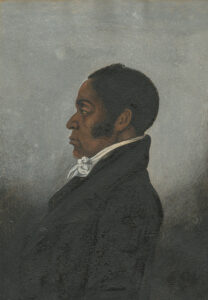
James Forten, circa 1818. It is unknown who painted this watercolor profile portrait of Forten, but some historians speculate that it may have been created by African American painter Robert Douglass Jr., who was a friend of the Forten family in Philadelphia.
Collection of the Historical Society of Pennsylvania
James Forten “is not the most well-known of Revolutionary War–era patriots,” Stephan Salisbury observed in The Philadelphia Inquirer of November 14, 2021. The qualification enabled Salisbury to emphasize the importance of Forten’s contribution to the construction of the United States: “But his story is an essential American story.”
It is appropriate to proclaim Forten’s life “essential” to the “American story.” Biographer Julie Winch called him “pure Horatio Alger.” The reference to Alger suggests that Forten was “self-made.” Indeed, Forten emulated American character, industriousness and heroism. The most requisite traits held by Forten and illustrative of any Algerian “rags to riches” hero is to be goal-driven yet sprung from poverty and carrying congealed confidence and strong moral conviction—qualities necessary to obtain the American dream.
As it were, the lives of Forten (1766–1842) and Alger (1832–99) overlapped just 10 years. The two never met, and there is no telling whether Alger ever came to know of Forten. But Alger would grow into a writer who studied events that defined Forten’s life.
Forten’s story is a case study in early American conflicts: independence and slavery, democracy and disenfranchisement, entrepreneurship and economic depression. He was a free Black resident of Philadelphia in the late 18th and early 19th centuries who ran a sailmaking shop while presiding over debates of African American resettlement in West Africa and strategic approaches to resist legislative abuses from the state assembly. When he died in 1842, one obituary memorialized him as “a prodigy,” calling him “one of the noblest men that ever trod upon the earth.”
Formative Years
Born free in Philadelphia on February 2, 1766, James Forten was the youngest of two children born to Thomas and Margaret Forten. Thomas had always lived free. Not much is known about Margaret; however, Julie Winch believes she “probably spent her early years in bondage.” A telling sign that she was likely enslaved in or near Philadelphia was how long she waited to give birth to her first child. She was 41 when she had James’ older sister, Abigail, and 44 when James was born. “Had she borne children before her freedom,” Winch wrote, “they would have been condemned to servitude.”
James’ father, Thomas, worked at a sail loft owned by Robert Bridges along a wharf at Front and Lombard streets. Thomas helped Bridges manufacture sails utilized by American and British shipowners who did business up and down the East Coast. Bridges’ Sail-Loft also earned revenue from the sale of rum, coffee and sugar.
As a free Black child growing up along the Delaware River shoreline in Philadelphia, James Forten had only a fleeting opportunity to obtain a formal education. Much of his knowledge came from shared experiences with his father. Records indicate that tales of British vessels sailing in and out of Philadelphia ports sparked James’ curiosity about the lifestyle. His father intrigued his mind with stories of ships encountering pirates in the deep sea. They debated the existence of sea monsters and other maritime legends.
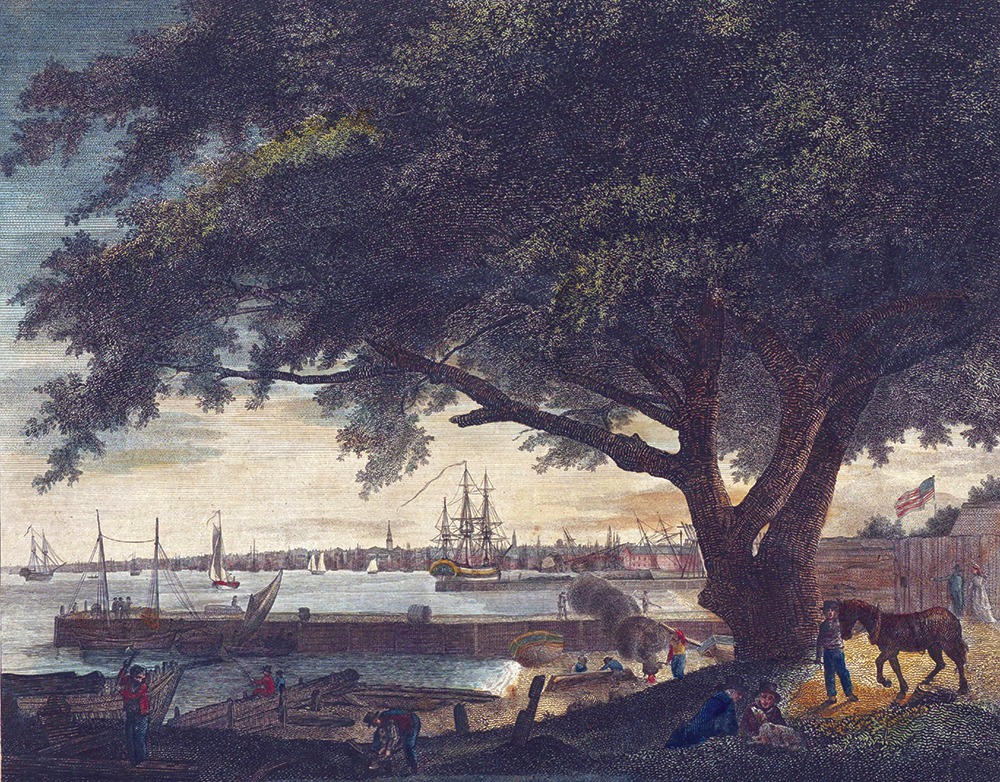
Forten grew up along the Delaware River in Philadelphia where his father Thomas was a sailmaker at Robert Bridges’ Sail-Loft. Forten learned the trade by observing his father at work.
Philadelphia Museum of Art
Like others in sailmaking families of that era, James learned by observing his father at work. Thomas was one of a few African Americans working as sailmakers in Philadelphia, but Bridges considered him one of the best in the city. Most Black Philadelphians worked in menial jobs or were still enslaved. Thomas worked alongside 30 white and nine African American sailmakers. Everyone earned equal wages. To that end, the Fortens enjoyed a financially comfortable life.
For a short time, James attended the Friends’ African School on Chestnut Street. Family friend Anthony Benezet (1713–84) was a Quaker known widely as a philanthropist and outspoken opponent of the transatlantic slave trade. Born in France, educated in England, and a Quaker since age 14, he had been operating a night school for adults and male children out of his home since 1750. In 1770 he opened the school’s doors for enslaved and free Black Philadelphians, making it the city’s first integrated school. In 1775 he opened the city’s first school for girls.
Benezet’s two major publications, A Caution and Warning to Great-Britain and Her Colonies on the Calamitous State of the Enslaved Negroes in the British Dominions (1767) and Some Historical Account of Guinea, Its Situation, Produce, and the General Disposition of Its Inhabitants (1771) were among the most consequential pieces of literature attacking the slave trade. Both pamphlets were widely distributed in British North America and in England, where abolitionists William Wilberforce (1759–1833) and Granville Sharp (1735–1813) drew inspiration in their crusade to end slavery throughout the empire. Forten was influenced by the work of all three men.
When Forten enrolled in the Friends’ African School, Benezet was serving as a curriculum writer and benefactor. His Pennsylvania Spelling-book was the school’s main text. In 1773, however, Forten missed his chance to learn from Benezet at the school, when his father fell into the Delaware River while working on a boat. Thomas’ injuries were critical, and he passed away when James was only 7. With a widowed mother and a sibling, James withdrew from school to work. He ran errands for a local grocer and was an apprentice to a chimney sweep. He also found work at the sail loft of his late father’s former employer, Robert Bridges.
The Revolution and Life at Sea
The turning point in Forten’s early life was the American Revolutionary War. At noon on July 8, 1776, Forten convened with his mother and sister at the State House Yard, Philadelphia’s center for civic gatherings, to listen to a reading of the Declaration of Independence. A year later Forten stood by his mother’s side as they watched Gen. George Washington and the Continental Army march through the city. Shortly afterward, beginning in September 1777, the British occupied Philadelphia until Continental and French forces drove them out in June 1778.
By the end of 1780, after five years of war, the Fortens struggled to make ends meet. Purchasing standard items like clothing and shoes was nearly impossible because the inflation rate was so high.
Sometime in 1781, the 14-year-old Forten heard that a privateer ship, Royal Louis, was looking for men. Although he had no experience at sea or in combat, he asked his mother if he could sign up as a crewmate.
In summer 1781, with Margaret’s blessing, James enlisted. With a new sense of purpose and pride, he found work as a powder boy and deckhand aboard the Royal Louis. The massive ship was commanded by Stephen Decatur Sr. Measuring 96 feet, 9 inches in overall length and 12 feet, 7 inches in depth in the hold, the privateer ship carried 22 cannons and a crew of 200 men.
Forten was one of 20 Black crewmates who sailed with Decatur. His responsibilities included swabbing decks, handling the sails, and raising or lowering the anchor. In the event the Royal Louis would encounter an enemy ship, Forten’s job was to run powder from cannon to cannon. The ship departed from the Philadelphia harbor on the morning of July 23, 1781. Forten boarded with only his Bible and a bag of marbles.
On the Royal Louis, Forten was involved in several engagements with British ships, including the HMS Amphion on October 8. After a two-hour skirmish that began at 11:30 a.m., the Royal Louis surrendered to the British frigate.
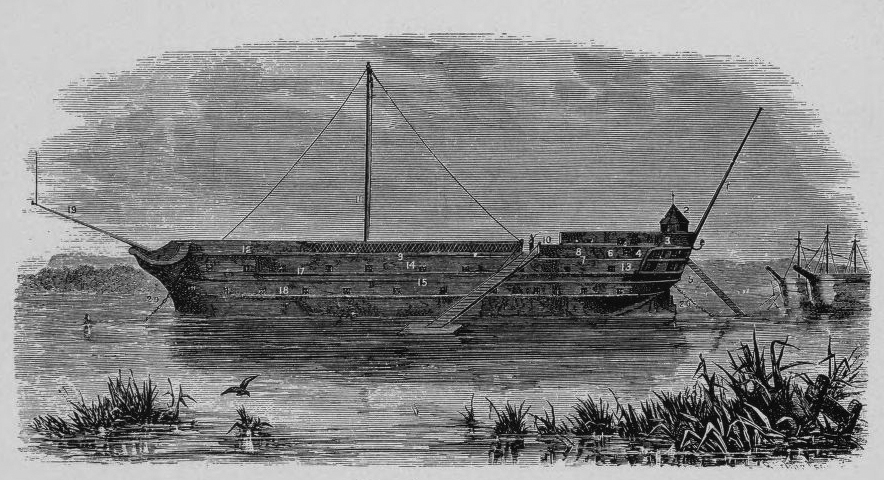
During the Revolutionary War, the teenaged Forten was held prisoner on the HMS Jersey after the privateer ship on which he was serving was captured by a British warship.
From Edgar Stanton Maclay, A History of the United States Navy, from 1775 to 1893, vol. 1 (New York: D. Appleton, 1894)
Held briefly on the Amphion before transfer to a prison ship, Forten and the other Black crewmates were threatened with enslavement. The Amphion was headed to New York City, where prisoners would be transferred to a prison ship. The British commonly sent Black prisoners to the West Indies, usually St. Lucia or the Leeward Islands. Forten, however, received an unusual offer after befriending 12-year-old Henry, son of Amphion’s captain, John Bazely (1740–1809).
According to Robert Purvis in his 1842 biography of Forten, Bazely was taken by Forten’s “honest and open countenance.” Bazely permitted Forten to take his marbles on the ship, and Forten entertained young Henry with his favorite game. The two regularly played marbles together as the ship sailed from Philadelphia to New York. Knowing how fond of the rebel prisoner Henry had become, Bazely sent for Forten to discuss an alternative to enslavement. On October 23 Bazely gave Forten an ultimatum: He could return with Henry to England or be transferred to the prison ship and then to a plantation in British North America. Bazely said Henry was about to inherit a “handsome estate” that Forten could enjoy. He also pointed out that after a few years, he could return to Philadelphia as “a wealthy and educated man.”
Forten declined the offer. As quoted in Purvis’ biography, one witness to Forten’s life on the prison ship said Forten told the captain he had been “taken prisoner for the liberties of my country, and never will prove a traitor to her interests.” Somewhat shaken, Bazely wrote a “highly commendatory” letter on behalf of Forten, ensuring that he would be spared from West Indian servitude. When retelling the story to friends, Forten credited “a game of marbles” with Henry that ultimately ensured his freedom.
Upon arrival in New York, prisoners on the Amphion were divided among three British warships. Forten found himself imprisoned on the HMS Jersey, a massive vessel featuring a naval artillery of 74 cannons that could carry up to 1,000 prisoners at a time. The British processed him under the name “Fortune” and tagged him prisoner number 4102, forced to work in the mess deck.
Forten remained on the Jersey for seven months laboring in the wardroom and working for rations, which one historian claimed to be bread lodged by worms and bran typically fed to hogs. The 200-plus days spent on the Jersey nearly killed Forten. Perhaps what saved him from starvation was the kinship he developed with fellow prisoners.
Finally, in 1782, after an exchange of prisoners, the British released Forten. With his service to the new country expired, he ventured out to find work. He landed a seafaring job on the Commerce, a decommissioned ship docked in Philadelphia and captained by Revolutionary privateer turned merchant marine Thomas Truxtun (1755–1822). The chance to work for Truxtun was enlightening for Forten, who knew he was in the presence of a preeminent American. President Washington named Truxton one of the U.S. Navy’s first commanders a decade later.
The Commerce first arrived in Liverpool, where Forten met antislavery men working to abolish the transatlantic slave trade. Liverpool, he learned, received its name from James Penny, a slave trader responsible for carrying hundreds of humans from West Africa to the Americas. He also discovered that only a year earlier, Liverpool was the departure point of the slave ship Zong, captained by Luke Collingwood, who threw 133 humans overboard to prevent the spread of disease to the healthy human cargo.
When the Commerce arrived in London, Forten negotiated the release from his contract with Truxtun after discovering work making sails along the Thames River. A significant motivator for Forten to settle in London was the opportunity to meet the great abolitionist Granville Sharp, who along with William Wilberforce won a decision by the English Court of the King’s Bench leading to the end of slavery in Britain. Forten eventually got his wish in 1785 when he attended a small antislavery gathering at a private house in London where Sharp spoke about slave trading. To Forten’s amazement, Sharp was not alone. Also there was Thomas Clarkson (1760–1846), an abolitionist celebrated for the essay “Is It Lawful to Make Slaves of Others Against Their Will?” Even more surprising, Forten later learned that much of the content for Sharp and Clarkson’s speeches derived from the works of Anthony Benezet, who had died the year prior.
The experience in England was a watershed moment for Forten. Never before had he been so invested in discourse over slavery and the slave trade. When he returned to Philadelphia in 1786, the freedom of his people would consume him for the remainder of his life.
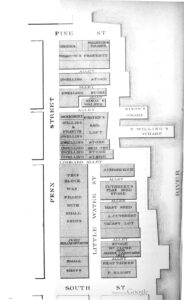
This map of the Philadelphia harbor between Pine and South streets in the early 1800s locates Forten’s Sail Loft on the block across from T. Willing’s wharf.
From Abraham Ritter, Philadelphia and Her Merchants (Philadelphia:Published by the Author, 1860)
Sailmaker and Freedom Fighter
In Philadelphia, Robert Bridges was still in business and had no reservations about hiring Forten, son of one of his most skillful sailmakers. Bridges eventually promoted the 22-year-old Forten to foreman of a staff numbering up to 40 workers. The job meant Forten had the freedom to tinker with the trade’s innovations and negotiate with shipowners — primarily white men. His main occupation was to measure sails to fit ships with new fore-and-aft sails or square-mizzen topgallant and upper and lower topsails. Forten offered something to Bridges’ business that the owner could not provide: He was an experienced sailor with voyages in war zones and across the Atlantic. The partnership was effective: Bridges granted Forten access to negotiate with seasoned merchants and shipowners. Forten could hone his craft preparing sails for schooners, brigs, ocean-going square riggers and privateers. In return, Forten brought more business to Bridges’ Sail-Loft.
In 1792 Bridges loaned Forten $250 to purchase a two-story frame house on Shippen Street, located in a community known as Southwark. Now one of the few Black homeowners in the area, Forten eventually repaid Bridges in installments. Living with him in the riverside home were his mother, sister, her husband William Dunbar, and their children.
Forten was a faithful employee at the Bridges Sail-Loft. Sailmaking was a labor of love, and the prize for his ingenuity, competence and fidelity arrived in 1798 when Bridges offered to sell the business to Forten.
Bridges died in 1800. His will notes that he was the owner of enslaved Africans — a peculiar find considering Bridges and Forten shared a father-son relationship. In fact, as Winch has pointed out, Forten lived for a time in Bridges’ home alongside those kept in bondage. Later in life, Forten would name one of his sons Robert Bridges and a daughter after Bridges’ wife Harriet.
Years earlier, while employed at Bridges Sail-Loft, Forten encountered a 34-year-old sea captain from New England, Paul Cuffe (1759–1817), a Quaker who arrived in Philadelphia to sell whale oil and bone. The two men met along Pine Street, where Cuffe established a vendor station selling his whale cargo. It was there that Forten and Cuffe formed one of the most unique partnerships in Revolutionary-era antislavery circles.
Cuffe was born the youngest of 10 children to a Native American (Wampanoag) mother and an African (Ashanti) father who had been enslaved and brought to Massachusetts but was freed through manumission. Cuffe possessed experience in his trade, having sailed from the Gulf of Mexico to the West Indies and from Nantucket to Newfoundland. Although he was born on Cuttyhunk Island, east of Massachusetts, Cuffe spent most of his childhood on a 100-acre farm near Westport. Like Forten, Cuffe lost his father at an early age and, at the start of the Revolutionary War, had been taken prisoner for three months off the coast of New York by the British.
In 1777 Cuffe and his brother David coauthored an antislavery petition. The brothers demanded full citizenship rights for free Blacks from the General Court of Massachusetts. Within six years, Massachusetts abolished slavery. For his leadership on the state’s early abolition efforts, Quaker minister Rev. Peter Williams Jr. said in his eulogy of Cuffe, “For this triumph of justice and humanity over prejudice and oppression, not only the colored people of Massachusetts but every advocate of correct principle owes a tribute of respect and gratitude to Paul Cuffe.”
By age 25, Cuffe was operating a cod fishing enterprise out of Westport River, running to Newfoundland and the Strait of Belle Isle. He built a 42-ton schooner, Mary, and employed a crew of 10. After five years, he expanded his business to include whaling. It was in 1793 when Cuffe’s crew took the cargo of six whales to Philadelphia and started a business and civic enterprise with Forten.
Meanwhile, two African American ministers at St. George’s Methodist Episcopal Church, Richard Allen (1760–1831) and Absalom Jones (1746–1818), left the church when authorities decided to segregate the congregants by creating a separate gallery for Black people. Subsequently, in 1787, the two men founded the Free African Society, a Black religious mutual benefit organization. The institution was the precursor to the first Black churches in America. Jones, who wanted to lead a Black congregation that would be part of the Methodist Episcopal Church, received authorization for the establishment of the African Episcopal Church of St. Thomas in Philadelphia. Allen went on to establish what is now the Mother Bethel African Methodist Episcopal (AME) Church, located at the corner of Sixth and Lombard streets in the city, dedicated on July 29, 1794. Around this time, Forten forged significant partnerships with Allen and Jones in the early struggle for Black rights.
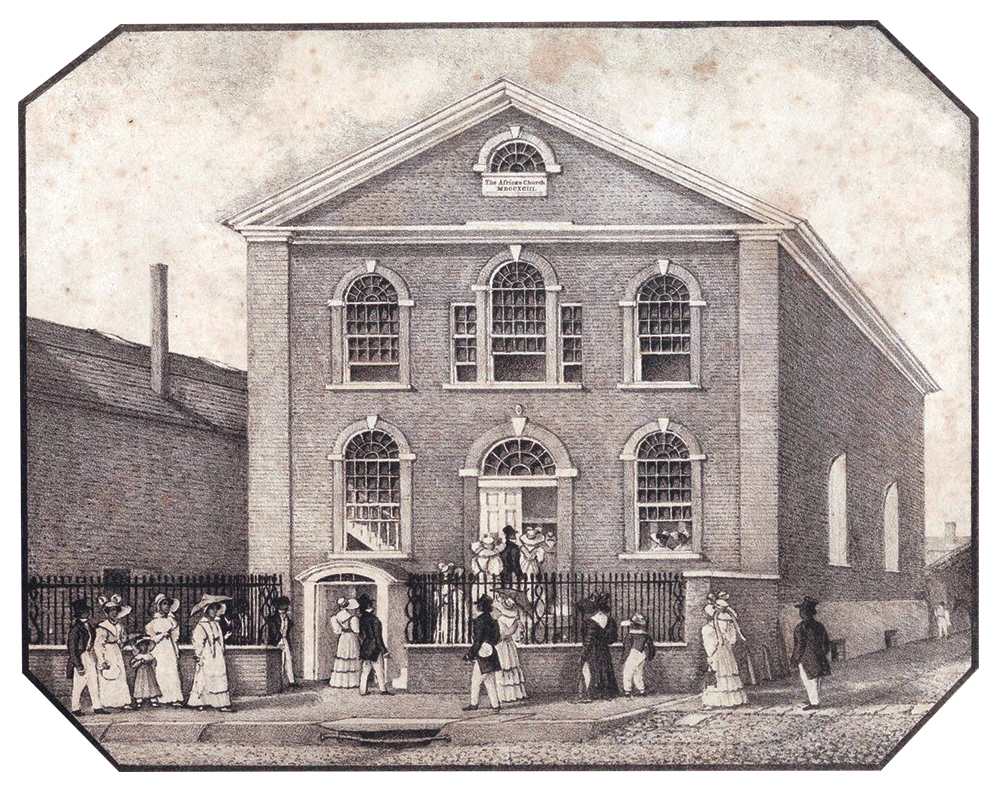
Forten was an active member of the African Episcopal Church of St. Thomas in Philadelphia. He was wed to Charlotte Vandine there in 1806, with Absalom Jones officiating. This Kennedy & Lucas lithograph from a drawing on stone by W. L. Breton depicts the church on a Sunday morning in 1829.
Library Company of Philadelphia
To Forten, the idea of a separate Black church was appealing. He eventually joined the African Episcopal Church of St. Thomas and was an active member there over the years. He helped raise funds, oversaw the church’s school, and was later on the vestry.
In 1793 Congress passed the Fugitive Slave Act, a law requiring the return of enslaved people who had escaped from one state to another. Forten deemed the federal act egregious to freedom and later worked with a committee of Black Philadelphians to compose a petition to the U.S. Congress calling for legal protections for free Blacks. While lawmakers debated the petition in 1799, the House of Representative eventually voted 85 to one to end the debate.
In January 1800 Forten expressed his frustration in a letter to Massachusetts Congressman George Thatcher (1754–1824), the lone affirmative vote. “Though our faces are black, yet we are men,” Forten exclaimed, “yet we have the feelings and passions of men and are as anxious to enjoy the birth-right of the human race. . . . Think how anxious we must be to raise ourselves from this degraded state.”
In 1806 Forten married Charlotte Vandine (1785–1884) at the African Episcopal Church of St. Thomas, with Absalom Jones officiating. Over the next 10 years the Fortens would have seven children: Margaretta (1806–75), Charlotta (1808–14), Harriet (1810–75), James Jr. (1811–ca.1870), Robert Bridges (1813–64), Sara Louisa (1814–84), and Mary Theresa (1815–42). Two other sons would be born later, William Deas (1823–1900) and Thomas Willing Francis (1827–97). Charlotte, like James, was a committed abolitionist and later, in 1833, she and daughters Margaretta, Harriet and Sarah were among 18 women who organized the biracial Philadelphia Female Anti-Slavery Society.
The War of 1812
Forten faced his next fight to protect Pennsylvania’s Black population during the War of 1812. Unemployment in Pennsylvania was high, and competition for jobs between African Americans and white people became a political issue about nine months into the war. In 1813 the Pennsylvania House of Representatives received petitions for laws requiring all African Americans to register with the state and all Blacks coming into the commonwealth to register within 24 hours. Other laws would give the state the authority to sell the services of African Americans convicted of crimes and to levy a tax on free Blacks for the support of their poor.
Forten responded anonymously in a blistering pamphlet, Letters from a Man of Colour, demanding equal rights between the races. “There are men among us of reputation and property, as good citizens as any men can be, and who, for their property, pay as heavy taxes as any citizens are compelled to pay,” he wrote, while calling the legislation “degrading.” The bill, he said, is designed to force free Black Pennsylvanians into slavery. “Many of our hundred years ago; many of our fathers, many of ourselves, have fought and bled for the independence of our country. Do not then expose us to sale. Let not the spirit of the father behold the son robbed of that liberty which he died to establish, but let the motto of our legislators, be—‘The Law knows no distinction.’”
It is no coincidence that the bill was defeated in the Senate. While Forten celebrated the victory in Philadelphia, the British had advanced on Washington, D.C., and set federal government buildings on fire in late August 1814. Philadelphia was presumably in the crosshairs as the British advanced on Baltimore.
On August 26, Forten attended a meeting at the State House Yard to discuss defense of the city. Following the meeting, he joined the Committee of Defense to “promote and encourage the immediate formation of volunteer companies” with duties to fortify towns throughout Philadelphia. With Absalom Jones, Richard Allen and Russell Parrott (1791–1824), Forten mobilized a militia of nearly 2,500 Black Philadelphians.’
In defense efforts, Forten, one of the few Black war veterans in town, used materials from his sail shop to make canvas bags for the volunteers. The massive troop met at the State House on September 21. From there, they marched to Gray’s Ferry, where they worked for two days building up fortifications, although the British never reached eastern Pennsylvania, because they failed to take Fort McHenry on September 13.
On December 14, the Pennsylvania Senate appointed a committee to explore the need for more troops that Black Pennsylvanians could raise. Wasting no time, an optimistic Forten mobilized a “Black Legion” assigned with a white officer in anticipation of a call to duty. Some historians believe Forten marched with troops to an encampment in Camden, New Jersey, where they were turned away. Forten’s contemporaries, including his youngest son, William, left behind a testimony that Forten did, indeed, raise “A battalion of colored troops . . . under an officer of the United States Army, and they were on the point of marching to the frontier when peace was proclaimed.”
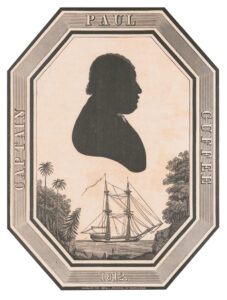
Forten’s friend Paul Cuffe, merchant, sea captain and abolitionist, was a proponent of colonization of formerly enslaved Blacks in Sierra Leone. This silhouette of Cuffe with a view of his ship, dated 1812, was engraved by Mason & Maas from a drawing by John Pole.
Library of Congress, Prints and Photographs Division
The Colonization Question
On February 15, 1815, Forten wrote to his friend Paul Cuffe: “It has pleased the Almighty disposer of all things, to once more bless this late distracted country with Peace . . . great joy that was mannifested by all classes of Society in this City.” This correspondence was the first in a series of letters between Forten and the entrepreneur following the war. At this time, however, they explored the prospect of having African Americans relocate to Africa.
Cuffe called the African resettlement endeavor “the redemption of Africa.” He wasted no time in giving the enterprise a try. Just as the war ended, Cuffe sailed with 38 free African Americans for Freetown, Sierra Leone, a British colony on the coast of western Africa. The London African Institution managed the settlement.
Forten thought fondly of Cuffe’s enterprise. While Cuffe was in Sierra Leone, Forten helped launch a branch of the African Institution in Philadelphia. He then wrote to Cuffe in 1815,“I approve very highly of your proposition of building a ship for the African trade by men of color and shall lay it before the Society when we meet.”
Forten found Cuffe’s plan virtuous at its inception, but by 1816 white Americans seized control over the African colonization movement. In December, preachers, businessmen and politicians met in the nation’s capital to form the American Colonization Society (ACS) “to promote and execute a plan for colonizing the Free People of Colour residing in our country, in Africa, or such other place as Congress shall deem most expedient.” Supporters included President James Monroe and former presidents Thomas Jefferson and James Madison, as well as Speaker of the House of Representatives Henry Clay and George Washington’s nephew Bushrod Washington, ACS’s first president. ACS had no members of color, nor did it prioritize African American interests. It was driven more by the prospects of removing free Blacks from the United States, as members believed their presence would encourage slave rebellions.
If the close friendship with Cuffe blinded Forten to how problematic resettlement to Sierra Leone had become, the Black community in Philadelphia opened his eyes. In January 1817 Forten chaired a meeting of the Philadelphia African Institution inside Richard Allen’s Bethel AME Church. Fearing the wholesale deportation of free Blacks, an enthusiastic audience of some 3,000 people rejected Forten’s intention to partner with Cuffe. For Forten, the meeting offered a startling epiphany. He would concede his blind spots in the following resolution: “To cast into the savage wilds of Africa the free people of color seem to us the circuitous route through which they must return to perpetual bondage. Parents will be torn from their children—husbands from their wives—brothers from brothers—and all the heartrending agonies which were endured by our forefathers when they were dragged into bondage from Africa, will be again renewed, and with increased anguish.”
Activism for Black Rights in the New Century
At the turn of the decade, Forten taught reading, writing and arithmetic to Black children. Although the first public schools in Pennsylvania had been established in 1818, they were segregated by race and gender. Ever since his return from England in 1786, Forten occasionally held free classes at his home or, later, at the Church of St. Thomas. The inception of the public school system had little bearing on the state of Black education, and the state assembly did not allocate money for Black schools. Because of the need, Forten continued to teach until 1822, when the Pennsylvania Abolition Society donated a building and pressured legislators to designate funds for teachers. Forten, no longer needed to instruct primary or secondary students, invested time and money into the Infant School for Coloured Children.
Existing as the only school program for poor male and female children, ages 2 to 5, the curriculum of the Infant School for Coloured Children, as stated in its constitution, provided lessons on interfaith principles of human conduct: industry, charity, compassion and morality. The school was funded by a one-time payment of $20 dollars and a $2 annual fee.
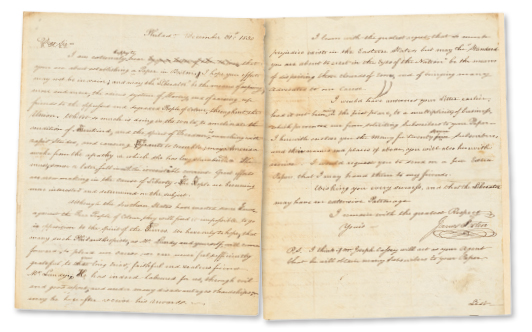
Shortly before launching The Liberator, Garrison sent Forten a donor request. Forten responded with this letter and the names of 27 subscribers.
Boston Public Library
In 1830 Forten received a donor request from a brash abolitionist, 25-year-old William Lloyd Garrison (1805–79), a transplant to Boston from Baltimore, asking for financial support for a newspaper he wanted to publish. Garrison received Forten’s response on December 31, the day before the first publication of The Liberator. Forten wrote, “I hope your efforts may not be in vain; and may the ‘Liberator’ be the means of exposing more and more, the odious system of slavery.” Included in the letter were $54 and the names and addresses of 27 subscribers from Philadelphia. Six months later, in June 1831, Garrison and Forten met for the first time at the second annual National Convention of Free People of Colour in Philadelphia. Forten would contribute letters to The Liberator throughout the rest of his life.
In fall 1831, Nat Turner’s rebellion in Virginia dominated the news. Fearing that slave uprisings might consume the South, state legislatures took action to pass repressive laws that worsened conditions for enslaved and free Black Southerners. Likewise, life for Black people in the North grew more difficult. In Pennsylvania, a petition requested the legislature to explore two laws stripping Black Pennsylvanians of their civil liberties. One law would have closed the door on the emigration of free Blacks from other states into Pennsylvania. The second bill would have repealed the state’s personal liberty law protecting free Blacks from kidnapping allowed under the federal Fugitive Slave Act. In October, Forten wrote to Garrison suggesting that he was hopeful that Nat Turner could be remembered “as one of the pre[e]minent agents, if not the sole cause [responsible for] bringing the evils of slavery more prominently before the public.”
In January 1832, Forten worked with his son-in-law, Robert Purvis (1810–98), husband of his daughter Harriet, and entrepreneur-activist William Whipper (1804–76) to pen a counterpetition. “Why is this distinction now to be proclaimed for the first time in the code of Pennsylvania? Why are her borders to be surrounded by a wall of iron against freemen whose complexions fall below the wavering and uncertain shades of white?” they asked.
The men included data in the petition revealing an inequality in tax collection. Compiled from public records, they showed Black Pennsylvanians paid significantly higher property taxes. Moreover, the data showed that revenue was not invested back into the poor community, mostly African American. Finally, they showed that some 50 Black benevolent societies already operated across the state, each with the capability of helping both the poor and newcomers to the commonwealth.
This moment is another inflection point for Forten’s commitment to social progress. Pennsylvania’s Act for the Gradual Abolition of Slavery, passed in 1780, had nearly eradicated slavery in the state. Large Black populations were thought to pose new threats to Pennsylvania’s political and economic institutions. Where its original constitution awarded suffrage to all male property owners born free, lawmakers amended the constitution by 1838 to exclude Black men from the franchise by inserting the word “white.”
Robert Purvis, working with a committee that included his father-in-law Forten, wrote Appeal of Forty Thousand Citizens, Threatened with Disfranchisement, to the People of Philadelphia, hoping to gain support in preventing the ratification of the new constitution. “It is the safeguard of the strongest that he lives under a government which is obliged to respect the voice of the weakest,” Purvis wrote. “When you have taken from an individual his right to vote, you have made the government, in regard to him, a mere despotism; and you have taken a step towards making it a despotism to all.” Unfortunately, after 47 years of suffrage to freeborn Black men, the new constitution eliminated it.
As Forten neared the end of his life, the country had regressed. Not only had the institution of slavery grown stronger in the South, but voting rights in the North were now determined by skin color.
On March 14, 1838, just a few days after the state legislature ratified the new constitution, and while Philadelphia’s Black community was in an uproar over what had just happened, Forten and leaders of the Colored Citizens of Philadelphia discussed the matter at the Presbyterian Church. Colonization was again at the center of this meeting. Some Black leaders — not Forten — argued that life had grown so difficult for them in America that they should reconsider relocating to Africa. As reported in the Philadelphia Public Ledger, the group offered thanks to “those gentlemen who, on the floor of the Convention, stood by us in the hour of need . . . and to others who voted against the insertion of the word ‘white.’”
Forten then joined a committee of five to write a formal objection to the new constitution and what they deemed a by-product: the increased efforts of the American Colonization Society. In the remonstrance, which was subsequently distributed to churches and state and local Black conventions, Forten and the committee declared, “We honor Pennsylvania and her noble institutions too much to part with our birthright, as her free citizens, without a struggle.”
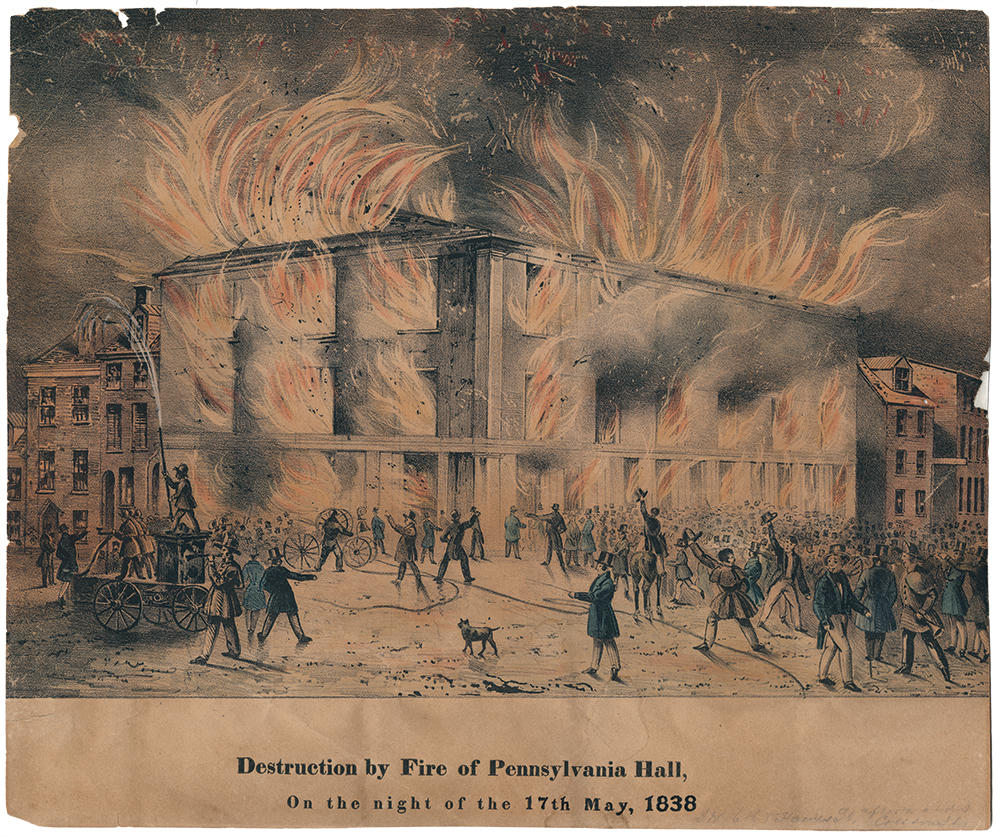
Pennsylvania Hall in Philadelphia was built in 1837–38 as a venue for lectures by abolitionists, women’s rights advocates, and other reform movement speakers. Four days after it opened, the hall was set ablaze by antiabolitionists and was destroyed.
Library Company of Philadelphia
Moreover, the battle between Northern abolitionists and antiabolitionists had reached a zenith, as political enthusiasm around the state’s new constitution caused many violent confrontations. During the spring of 1838, Forten and other abolitionists funded the construction of Pennsylvania Hall, a large community center designed to hold scientific and political events. At a public gathering keynoted by William Lloyd Garrison on May 24, a mob of antiabolitionists ransacked the building, breaking windows and destroying the blinds inside. Although the crowd of about 3,000 people escaped safely, the mob had set the hall ablaze. The fire raged for hours. At about 10 o’clock, the roof collapsed. By 11 o’clock, the entire hall that Forten helped erect was “a mass of ruins,” Garrison reported in The Liberator.
Forten was angry. In 1839 he formed the Vigilant Committee of Philadelphia to serve various purposes in the struggle for Black rights. The vigilance committee worked to protect Black Philadelphians from slave kidnappers and to offer financial support in cases of civil liberty violations. Most of all, Forten and his agents financed and assisted enslaved freedom seekers. Until his death, Forten used his home on Lombard Street to shelter escapees. Between 1839 and 1842, he invested about 78 percent of his wealth in enterprises of the vigilance committee. His estate, once estimated at $300,000, shrank to $67,000 by the time of his death.
Legacy
James Forten died at 75 on February 24, 1842, at his home. He must have sensed he was near the end. Only days before he died, he placed a notice in the local newspaper that he and two sons, James Jr. and Robert Bridges, had become business partners. They renamed the sail shop at 95 South Wharf to James Forten & Sons, Sail Makers. Following Forten’s death, it became James & Robert B. Forten Sail Making.
Upon Forten’s death, Garrison wrote in The Liberator, “Had he been a white man, the same amount of character would have placed him among the most distinguished citizens of the country.”
Forten’s self-made story is like no other. He was, by his death, one of the few African Americans able to shape the abolitionist spirit. Born free but impoverished, he died comfortably, but not without great sacrifice. After his death, the Peoples’ Press defined his life as one of consistency: “Had James Forten of sixteen, been introduced to James Forten of seventy-six [actually 75], the two would not only have recognized each other, but would have rushed to a mutual and cordial embrace.” Indeed, time had passed, issues had changed, and the conditions for Black Americans grew more difficult. Forten’s “temperate, upright,and consistent mode of living” always formed the nucleus of the great American revolutionary, his obituary lamented. It is his disposition that future abolitionists would use to reshape the movement on the eve of the Civil War. Everything about his life echoes this final legacy: “Where my country is, there shall liberty dwell.”
Further Reading
Allmendinger, David F., Jr. Nat Turner and the Rising in Southampton County. Baltimore: Johns Hopkins University Press, 2014. / Douty, Esther M. Forten the Sailmaker: Pioneer Champion of Negro Rights. New York: Rand McNally, 1968. / Jackson, Maurice. Let This Voice Be Heard: Anthony Benezet, Father of Atlantic Abolitionism. Philadelphia: University of Pennsylvania Press, 2009. / Purvis, Robert. Remarks on the Life and Character of James Forten. Philadelphia: Merrihew & Thompson, 1842. / Winch, Julie. “‘You Know I Am a Man of Business’: James Forten and the Factor of Race in Philadelphia’s Antebellum Business Community.” Business and Economic History 26, no. 1 (Fall 1997): 213–28. / —. A Gentleman of Color: The Life of James Forten. New York: Oxford University Press, 2002.
Todd M. Mealy, Ph.D., is a historian and educator who resides in Lancaster County. He is the author of 14 books and is a regular contributor to Pennsylvania Heritage. His most recent articles for the magazine are “The Fastest Man on Earth: Barney Ewell and the Story of Two Missed Olympiads (Spring 2022) and “Without Fear and Without Reproach: Octavius V. Catto and the Early Civil Rights Movement in Pennsylvania” (Winter 2021).