
Recovery of the Bald Eagle in Pennsylvania: A Conservation Success Story
Written by Joseph Luxbacher in the Features category and the Spring 2024 issue Topics in this article: bald eagles, conservation, National Aviary, Pennsylvania Game Commission, United States Fish and Wildlife Service, wildlife management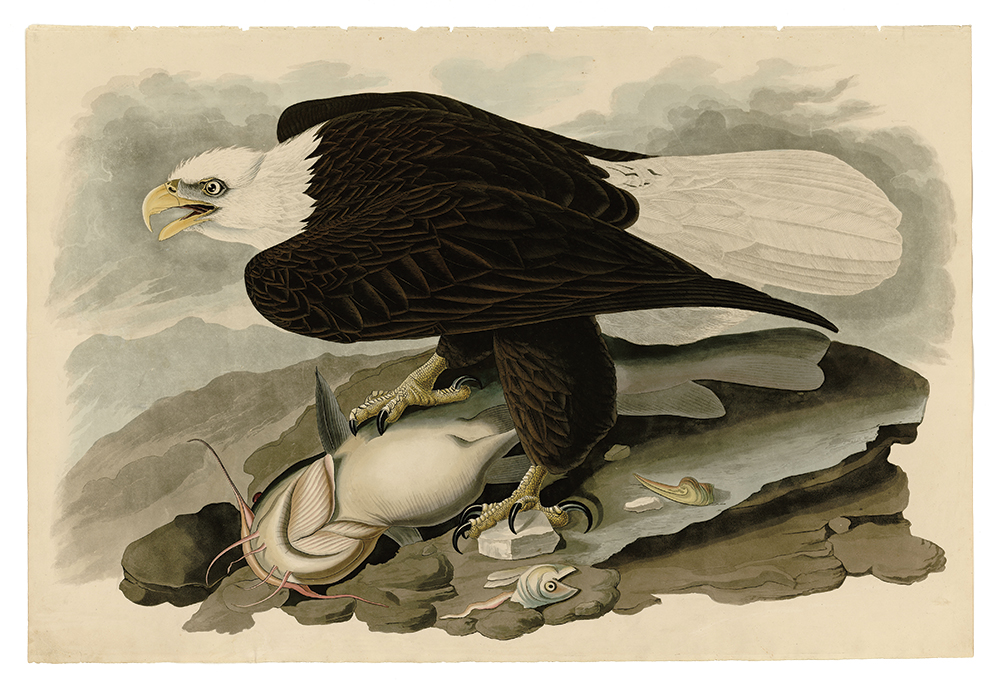
A male white-headed, or bald, eagle feasts on a yellow catfish in this illustration “Drawn from Nature & Published” by John James Audubon and “Engraved, Printed & Coloured” by Robert Havell. It is plate 31 from Audubon’s Birds of America, published 1827–38.
Wikimedia Commons / University of Pittsburgh
Easily recognizable by its white head and tail, dark brown body, hooked yellow beak, and large black talons, the bald eagle is truly a majestic bird. In Pennsylvania, as well as most other parts of North America, bald eagles are apex predators, atop the avian food chain. Humans have been their only primary adversary over the past couple of centuries.
When Columbus arrived in America in 1492, it is estimated there were more than 100,000 bald eagles nesting in the area that now encompasses the lower 48 states. They were common across the entire continent, particularly around lakes, streams and rivers, as fish are a primary staple of the bald eagle’s diet.
The first major decline of the species in Pennsylvania began in the mid-1800s, coinciding with a similar decline of waterfowl and shorebirds. The Lands Act, established in 1792, encouraged settlers to move westward and colonize the frontier. Speculators, hunters and farmers quickly began spreading across the Keystone State, clearing woodlands, polluting streams, and seriously degrading eagle habitat along the way.
Early pioneers often viewed the bald eagle as an adversary, a rival competing for limited fish and game resources and possibly even a threat to young livestock. As a consequence, bald eagles were poisoned, hunted and shot at virtually every opportunity.
By the mid-1900s bald eagle population had declined precipitously throughout North America, largely because of the irresponsible use of pesticides — particularly DDT. As raptors, bald eagles fed upon fish from lakes and waterways that had been contaminated with pesticides by runoff. The highly concentrated levels of DDT they ingested impacted their reproduction by weakening their eggshells. The weakened shells, unable to support their contents or the parent birds sitting upon them, cracked before the offspring could hatch.
A species that is unable to reproduce is obviously in serious trouble, and bald eagles quickly became critically endangered. A 1963 census conducted by the U.S. Fish & Wildlife Service found only 417 nesting pairs in the lower 48 states. At that point the prophetic lyrics from a John Denver song — “he’d be a poorer man if he never saw an eagle fly” — almost came to pass.
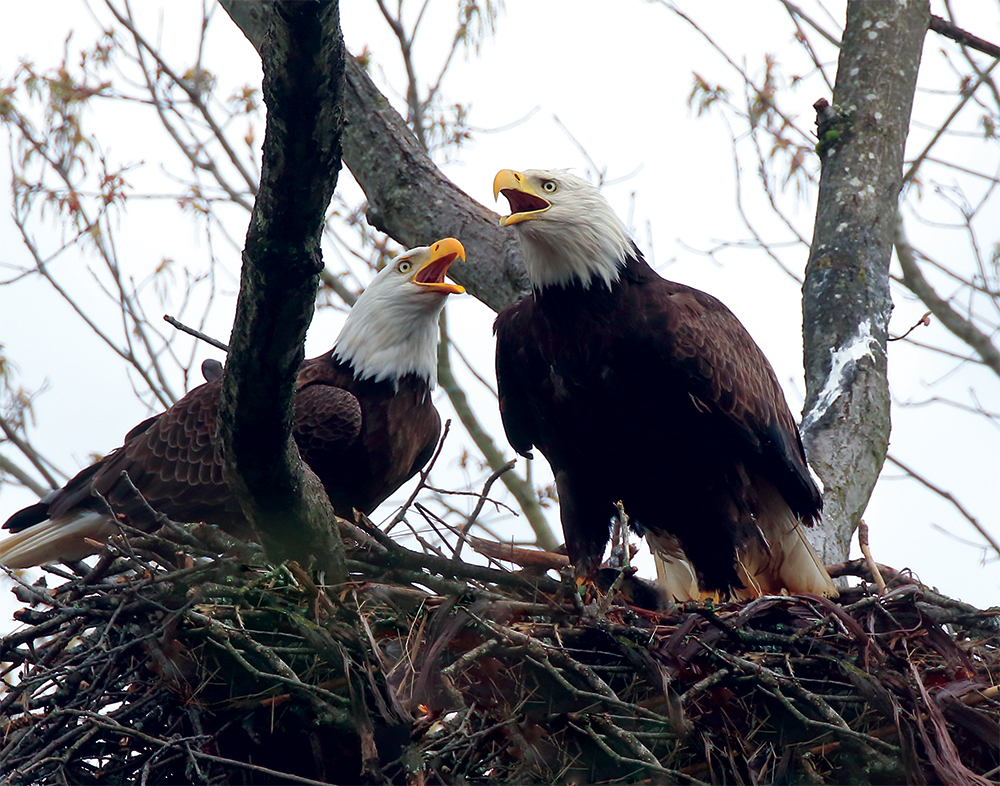
Pennsylvania’s bald eagle conservation success can be measured by its 2019 nesting population of 300 pairs as compared to 1980, when there were only three.
Photo, Annette Devinney
Dr. Sean Murphy, state ornithologist with the Pennsylvania Game Commission, explains that a mix of factors have enabled the bald eagle to make a seemingly miraculous recovery from the brink of extinction. Most notable was the federal government’s 1972 ban on domestic use of DDT because of its harmful impact on the environment. This action was in large part a response to naturalist Rachel Carson’s classic 1962 book Silent Spring, in which the Springdale, Pennsylvania, native educated the American public on how DDT and similar pesticides can bioaccumulate to dangerous levels in the aquatic food web and subsequently have a devastating impact on apex predators such as bald eagles.
The years following the publication of Silent Spring also saw the establishment of the U.S. Environmental Protection Agency in 1970 and the passing of numerous laws designed to protect the environment and human health. A groundswell of committed conservation efforts spearheaded by various environmental groups and supported by the American public led to the enactment of the Endangered Species Act of 1973, which provided critical habitat protection for eagles and other endangered wildlife.
In 1987 the U.S. Fish & Wildlife Service also instituted a nationwide ban on lead shot used in ammunition for waterfowl hunting. All states were required to comply with the ban, and Pennsylvania did so in 1988. The elimination of lead shot also helped with species recovery, as bald eagles were susceptible to secondary poisoning by consuming lead pellets embedded in ailing or dead waterfowl on which the eagles feasted.
The elimination of DDT and lead shot in aquatic ecosystems, coupled with restoration of prime bald eagle habitat provided by the Endangered Species Act, have enabled bald eagle populations to recover throughout much of their original range. Clean water regulations have also reduced stream and river pollution, which in turn has contributed to healthy fish populations that have aided the recovery as well.
Bald eagles were removed from the federal endangered species list in August 2007 and their numbers have continued to grow in the years since. The Bald Eagle Population Size Report: 2020 Update, published by the U.S. Fish & Wildlife Service, provides the most current population estimate of bald eagles, which in the lower 48 states is greater than 300,000 individuals. That number includes more than 70,000 nesting pairs and indicates that the bald eagle population has quadrupled since the last set of data was collected in 2009.
Bald Eagle Biology, Nesting and Reproduction
Bald eagles are swift and powerful raptors native only to North America. Their Latin name, Haliaeetus leucocephalus, is translated to mean “white-headed sea eagle,” a reference to its genus classification. Bald eagles are considered a member of the sea eagle group that includes large raptors such as Steller’s sea eagle (Haliaeetus pelagicus) of northwestern Asia and the white-tailed eagle (Haliaeetus albicilla) of Eurasia.
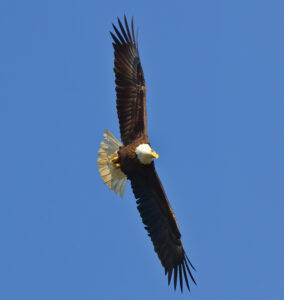
The wingspan of the bald eagle ranges from 5½ to 8 feet.
Photo, Annette Devinney
Despite their given name, bald eagles are not, in the literal sense, bald. The term “bald” refers to an old English use of the word meaning “white.” The eagle’s head as well as its tail are distinctly white feathered. Bald eagles do not attain these distinctive white features, however, until they are about 5 years old, so juvenile eagles look very different from adults. The young birds are almost entirely brown, with occasional white markings on the undersides of their wings and chest. As the juvenile gets older, the bill turns from dark brown to yellow, and the head and tail feathers turn white.
Bald eagles have broad wings appropriate for both powerful thrusting in flight as well as soaring on updrafts. Like most raptors, female bald eagles are larger than males, weighing up to 14 pounds and sporting 7- to 8-foot wingspans. Males are only slightly smaller.
The eagles have excellent eyesight and can identify objects several times further away than humans. They are efficient hunters as well as opportunistic scavengers and subsist primarily on a prey base that includes fish, wading birds, ducks, squirrels, rabbits, reptiles and road-killed animals. The habit of feeding on roadkill is a primary reason why collisions with cars remains one of the most common causes of eagle mortality.
When a hungry eagle focuses in on a potential meal, they strike swiftly and silently from above and use their long and powerful talons, or claws, to secure and kill the prey. Once the unfortunate victim is dead, the eagle uses its sharp-tipped beak to tear off and swallow chunks of food. The chunks are temporarily stored in the crop, an area located just below the throat, before digestion occurs. An adult eagle can store more than 2 pounds of prey food in the crop, which has a noticeable bulge when filled.

The acute vision of the bald eagle allows it to spot prey nearly 2 miles away. A third eyelid that is clear, called the nictitating membrane, can be shut to protect the eagle’s eye without affecting its vision.
Photo, Dana Nesiti
Bald eagle vocalization can range from a short staccato whining call to a high-pitched scream. They emit a variety of calls for the purposes of threat, greeting and territorial defense. For example, a territorial vocalization is typically a high-pitched scream that is emitted when other birds or humans approach a nest site. Juvenile eagles also use distinctive “begging” calls when they are hungry and want food.
Bald eagles, like other corvids, such as the raven and whooping crane, are socially monogamous, mating for life. As a prelude to tying the knot, the pair engage in a series of courtship rituals as they strengthen their bond. The most famous of these rituals is the cartwheel flight, in which male and female eagles fly upward to a great height, lock talons, and then go into a cartwheel spin as they fall toward the ground, breaking apart at the last minute. From that point on, the parental pair are together and share the responsibility of building a nest and raising their young.
An eagle nest typically consists of a small truckload of interconnecting sticks, branches and twigs that encircle a central cup of softer materials where the eggs are laid. The central cup is generally lined with grasses, mosses, weeds, sod and feathers. There is no mistaking a bald eagle’s nest. Ranking among the largest of all bird nests, it is a massive structure that is typically reused, repaired and updated every year.
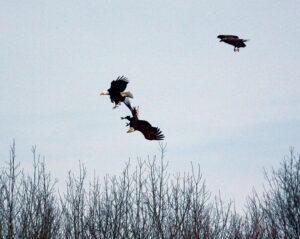
A courtship ritual of bald eagles, known as cartwheel flight, involves the male and female locking talons at a towering height and then falling toward the earth in a spinning cartwheel motion, releasing their grasp at the split second before reaching the ground.
Pennsylvania Game Commission / Photo, Jacob Dingel
Because bald eagles love fish, their nests are almost always located high in a tree near a water source, such as a lake, river or swamp. A typical nest is 5 to 6 feet in diameter and 2.5 to 4 feet deep with a shape that conforms to the tree where it is built. Some nests have reached even larger dimensions.
Bald eagles lay their eggs from February through April. The female generally lays one to three eggs, with two being the most common clutch size. Eagle eggs are large and dull white in color with no distinct markings. One egg is laid per day, but not always in successive days. The clutch is usually completed in three to six days.
The incubation period of the eggs is generally about 35 days in length, although there may be some variation. Incubation begins with the first egg, so the young hatch out over a series of days. Both parents take turns keeping the eggs warm day and night until they hatch, although the mother does most of the chick-sitting. The father primarily provides food for the family.
Newborn eaglets are fluffy and light gray in color. After a couple of weeks flight feathers begin to emerge. Body contour feathers appear along the upper wing in three to four weeks.
At 10 to 12 weeks, around the same time the eaglets are ready to leave the nest, their feathers turn a dark brown. (The head and neck feathers will turn white when they are mature at 4 to 5 years.) Not all nest departures occur as planned. Rowdy young eaglets sometimes fall from the nest before developing the ability to fly, making them vulnerable to predators such as foxes, racoons and coyotes. If eaglets do fall from the nest prematurely, the parents will generally try to feed and protect them, although the effort is not always successful.
Bob Mulvihill, an experienced birder and ornithologist with the National Aviary in Pittsburgh, emphasizes that the life of an eaglet is filled with challenges, and many do not survive their first year. The first chick to hatch has somewhat of an advantage over its younger brothers and sisters, as it has a bit more time to grow and become stronger. The oldest and biggest eaglet may sometimes kill its younger and smaller siblings when competing for food brought to the nest. Although such behavior may seem counterproductive to the overall success of the species, it actually serves as a survival strategy that increases the odds that at least one chick has a better chance of living to adulthood.
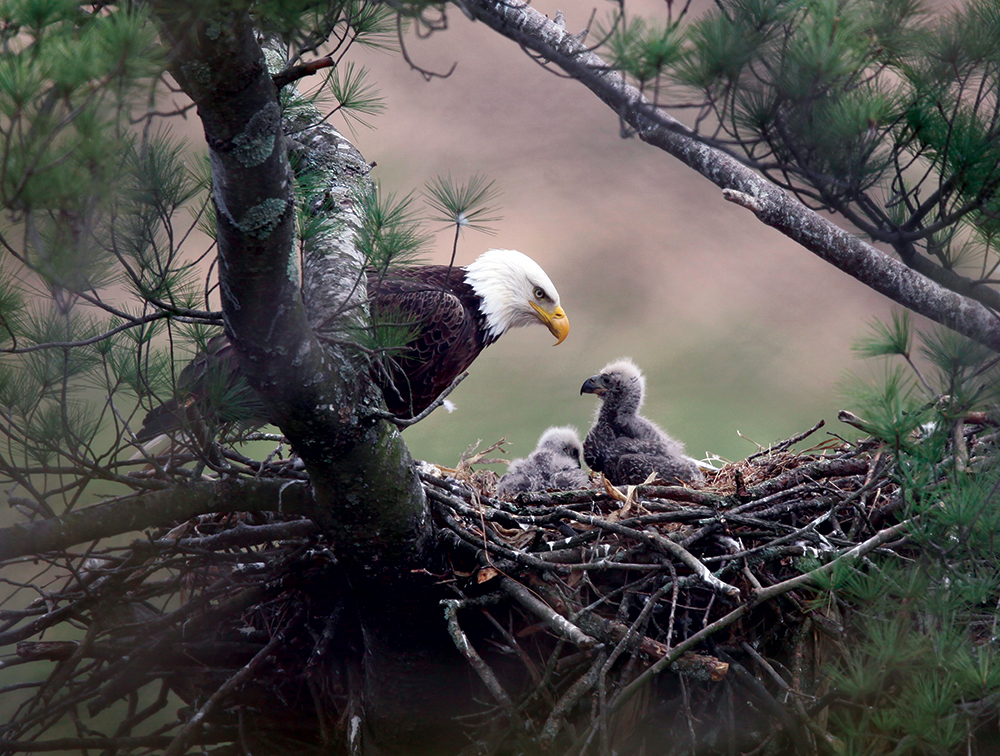
A recently hatched eaglet has a plumage of light grayish down. In about 10 days, the nestling’s first fluffy coat is replaced by a darker covering of down.
Pennsylvania Game Commission / Photo, Hal Korber
Young eagles generally fledge, or leave the nest on their own, between 8 to 14 weeks after hatching. Eaglets are considered to have fledged when their feathers and wing muscles are sufficiently developed for flight.
Adults may encourage an eaglet’s departure from the nest by circling the nest with food items. Juvenile eagles continue to grow and develop after fledging and are cared for by the adults for four to 10 weeks after leaving the nest. As is the case with most raptors, juvenile birds have the lowest survival rate. The longer a young eagle survives the greater are its chances of reaching adulthood. The average lifespan for eagles in the wild is believed to be somewhere in the range of 15 to 25 years. The oldest known eagle in captivity was 50 years old.
Bald Eagles in Pennsylvania
Only 40 years ago the bald eagle was in danger of extinction throughout most of its range and was virtually extirpated from Pennsylvania. A 1983 census found only three pairs of eagles nesting within the state. In June of that same year the Pennsylvania Game Commission instituted the Eagle Recovery Project in an effort to repopulate the species. A team of wildlife conservation officers traveled to the Canadian province of Saskatchewan to locate and capture eaglets for transport back to Pennsylvania for release.
The team made several such trips and were successful in acquiring many young birds. Before release, however, the officers had to make sure the eaglets were mature enough to survive on their own.
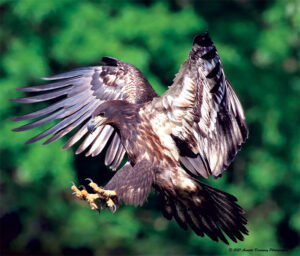
As the bald eagle matures its plumage becomes more variable.
Photo, Annette Devinney
Sean Murphy explains that the method of preparing young eaglets for release into the wild is generally referred to as “hacking.” The principle behind the practice is that bald eagles tend to return to the area from which they were raised and fledged after they reach sexual maturity. Hacking provides a controlled way to raise and release young eagles from an artificial nesting tower and increases the chances they will become long-term residents of the area as adults. The eaglets live in cages where they are fed and watched over until their feathers become fully developed.
During the period prior to release, the caretakers make a concerted effort to ensure that the young birds retain their fear of humans. To do so oftentimes requires creative thinking on the part of the surrogate parents. Such was the case with the original Pennsylvania brood in which the caretakers dawned eagle-faced hand puppets to feed and eventually fledge the young birds. Crazy as that may sound, it worked.
Today Pennsylvania has more than 300 pairs of nesting bald eagles and that number is increasing every year. In 2014 the bald eagle’s status within the state was changed from threatened to protected.
The criteria for removing the bald eagle from Pennsylvania’s threatened species list were specified in the Pennsylvania Game Commission’s bald eagle management plan, which called for delisting eagles if four principal criteria were met for five consecutive years: (1) at least 150 active nests statewide, (2) successful pairs in at least 40 counties, (3) at least a 60 percent success rate for known nests, and (4) productivity of at least 1.2 eaglets fledged per successful nest.
In the five years spanning 2008 through 2013, Pennsylvania’s bald eagles exceeded all these criteria, with 171 to 274 known nests located in 46 to 58 counties, success rates of 74 to 92 percent for known nests, and productivity of 1.3 to 1.8 eaglets fledged per successful nest.
Although no longer listed as endangered or threatened in Pennsylvania, the bald eagle is still offered some protection by the federal Bald and Golden Eagle Protection Act and the Migratory Bird Protection Treaty. In Pennsylvania, the bald eagle is also protected under the Game and Wildlife Code.
Bald Eagle Management in Pennsylvania
The mission statement of the Pennsylvania Game Commission’s Bald Eagle Management Plan is as follows: “To establish and maintain bald eagle populations in Pennsylvania and provide recreational viewing opportunities for the citizens of Pennsylvania.” To accomplish that mission, wildlife officers annually monitor eagle nests to gather information. They do so particularly during the nesting season to quantify population trends and nesting success. Such information enables the agency to stay up to date on species recovery and identifies any problems that may arise locally or statewide.

It will take about 5 years for the mature bald eagle to develop its white head and tail feathers.
Pennsylvania Game Commission / Photo, Jacob Dingel
Conservation officers work with landowners to protect both new and existing nests to ensure the safety of adult eagles as well as their offspring. The management plan also emphasizes the importance of educating the public about eagles.
Those wishing to observe and photograph bald eagles in Pennsylvania have ample opportunity to do so. Bob Mulvihill assures me that bald eagles can presently be found throughout the state and in areas where they have not nested in decades. He adds that along with the thrill experienced when seeing bald eagles in their natural setting comes the person’s responsibility of ensuring that their presence does not have a detrimental effect on adult birds or their offspring.
Although Mulvihill believes eagles can for the most part tolerate the presence of people attempting to snap a long-distance photo, he also states that nesting eagles are particularly sensitive to human intrusions or disturbances. Any behavior that causes a premature fledging can ultimately result in injury or death to an eaglet that cannot yet fly or defend itself.
Sean Murphy suggests that the best way to get up close and personal with our national bird without disturbing the parent eagles or eaglets is by surfing the internet to access one of the eagle nest webcams placed throughout the state. This is particularly true during the breeding season when eggs or eaglets are present. Through the lens of the webcam, a person can view all eagle activity — feeding, egg laying, hatching, sibling rivalry and the like — that occurs in and around the nest without any chance of disturbing the eagle family.
An informed public whose behavior around eagles is guided by science-based eagle etiquette lays the groundwork for continued recovery and generates optimism that at some point in the future virtually all Pennsylvanians will be able to observe a bald eagle within a short drive of their home. Based on my own experiences, I can verify that is a sight they will never forget.
Sidebar: Eagle Etiquette
The Pennsylvania Game Commission recommends the following “eagle etiquette,” behavioral guidelines to minimize eagle disturbances:
• Keep at least 1,000 feet from an active nest, roost or feeding area. Use optics like binoculars or a telescope to view the eagles at a distance.
• Stay quiet. If you must talk, whisper.
• Eagles are easily alarmed when they see humans nearby, so hide yourself behind your vehicle or boat when possible.
• Avoid sudden movements directly toward the eagles or their nest while on foot or when in a vehicle or boat.
• Do not purposely try to flush the eagles from the nest, because this may expose the eggs or young eaglets to cold or wet weather or possibly a nest predator. Flushing also causes the eagles to waste precious energy, particularly in cold weather, and may cause eagles to leave a nest that they are constructing.
• Be attentive, watching how the eagle reacts to your presence. If it acts agitated, vocalizes repeatedly, or starts moving away, you are too close.
• Respect restricted zones designed to protect eagle nesting areas. If you deliberately enter a restricted nest area, you are not only disturbing the eagle but also breaking state and federal laws.
• Respect the privacy of the landowner where the eagle nest is located. Avoid spreading word about the location of a new nest as it will attract people to nesting areas who may not follow eagle etiquette. If you unexpectedly stumble onto a nest, or hear an eagle vocalizing overhead, leave immediately and quietly.
Sidebar: Pennsylvania’s Wildlife Conservation History
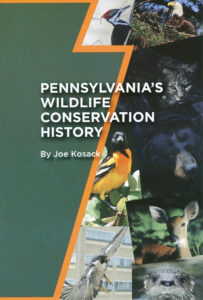 Recovery of the bald eagle in Pennsylvania is one of many conservation success stories resulting from the Pennsylvania Game Commission’s efforts to manage and restore several dangerously low or extirpated wildlife populations. At one point or another in the past, elk, black bears, bobcats and several lesser-known species presently thriving in the state have all suffered similar declines before being brought back from the brink of extirpation. A detailed analysis of these stories and much more can be found in the Game Commission’s new edition of Pennsylvania’s Wildlife Conservation History. The author, Joe Kosack, is an accomplished writer who worked for the Game Commission for more than 30 years.
The narrative begins with the founding of Pennsylvania in 1681; Kosack describes how rapid colonization of the land in the commonwealth resulted in the destruction and exploitation of its abundant natural resources, specifically certain wildlife populations. The book provides a comprehensive review of the Game Commission’s wildlife and resource management efforts beginning with the agency’s inception in 1895 and continuing to the present.
In addition to chapters covering the past quarter century since the previous edition was published, the 600-page, hardcover book includes a 200-page section of stories on a variety of conservation topics that have appeared through the years in Pennsylvania Game News.
Pennsylvania’s Wildlife Conservation History can be purchased at huntfish.pa.gov or by calling 1-888-888-3459.
Joseph A. Luxbacher, Ph.D., has more than three decades of experience in the fields of health, fitness and competitive athletics. He played soccer at the University of Pittsburgh and in the professional leagues and then returned to Pitt as the head men’s soccer coach, 1985–2015. Luxbacher is also an aficionado of environmental issues and has recently published articles on the subject, including “Repopulating and Managing Black Bears in Pennsylvania,” which appeared in the Fall 2022 edition of Pennsylvania Heritage.