
Pennsylvania Heritage at 50
Written by Kyle Weaver in the Features category and the Winter 2024 issue Topics in this article: Betty L. Seanor, Douglas H. West, Homer T. Rosenberger, Michael J. O'Malley III, Pennsylvania Heritage, Pennsylvania Historical and Museum Commission, Sylvester K. Stevens, William J. Wewer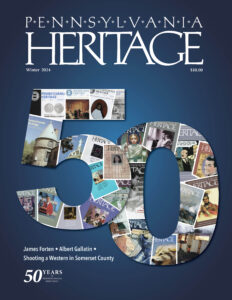 For 50 years, Pennsylvania Heritage has played a significant role in bringing the history of the Keystone State to a public audience. Like its parent agency, the Pennsylvania Historical & Museum Commission (PHMC), the magazine operates with the vision that “Pennsylvanians see history as relevant to their lives.”
***
I was only 12 when I first held an issue of Pennsylvania Heritage in my hands. It was a special Commemorative Bicentennial Edition, published in June 1976. I knew that significant moments of the American Revolution took place in Pennsylvania — from the signing of the Declaration of Independence to the transformation of the Continental Army into a disciplined fighting force at Valley Forge. But this magazine also emphasized history that unfolded in Hanover, Middletown, Hummelstown and Carlisle, places much closer to my home in Harrisburg. It was through the magazine that I discovered the unique history that existed on the state level, a relevant, more local one that could not be found in standard American history books.
From that point on, Pennsylvania Heritage became a recurring part of my life. Library visits always included a perusal of the latest edition. As an American studies major in graduate school, I referred to the magazine often, either as required reading or as a secondary source for Pennsylvania-related papers. Later, working as an acquisitions editor at Stackpole Books in the 1990s, I was assigned to develop a line of Pennsylvania titles. Inevitably, I reached out to PHMC and initiated several copublication projects with the agency. In the process, I met the longtime editor of Pennsylvania Heritage, Michael J. O’Malley III, who recommended some talented authors for the books. O’Malley also encouraged me to contribute some of my own writing to the magazine. Now, here I am, honored to have been appointed editor of Pennsylvania Heritage nearly a decade ago and writing about its history on the publication’s 50th anniversary.
***
The forerunner of Pennsylvania Heritage magazine was a small quarterly newsletter of the same name that PHMC first published in summer 1967. Essentially a house organ, it was four pages long, was illustrated with black-and-white photographs, and contained news articles about the work and activities of PHMC. It was expanded to eight pages for the second issue. Edited by PHMC’s public information officer, Joseph T. Kingston, the newsletter ran until December 1972, after 21 issues had been published.
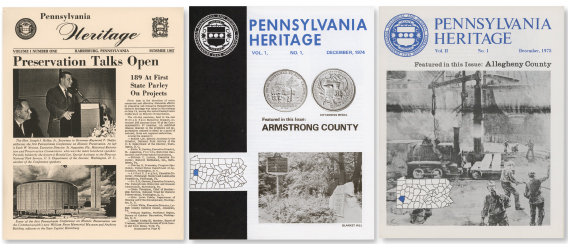
The first issue of Pennsylvania Heritage newsletter, Summer 1967; the first issue of Pennsylvania Heritage magazine, December 1974; and the first issue of volume 2 of Pennsylvania Heritage magazine, December 1975.
Sylvester Kirby “S.K.” Stevens was executive director of PHMC when the newsletter was launched. In the first issue, he wrote, “It has been thought for a long time that we needed some new vehicle through which the attention of Pennsylvanians might be called to many and varied historical activities that do not receive adequate coverage through existing media,” and he concluded, “I am reasonably sure we shall find it advisable to expand both the size and scope of the new publication in the near future.”
Stevens’ intuition proved to be accurate, although he had retired and then passed away before the first issue of Pennsylvania Heritage magazine was released in December 1974. It would be his successor as executive director of PHMC, William J. Wewer, who would follow through with launching a periodical that was not only larger in size and scope than the newsletter but also had the potential to reach a much broader public audience.
On August 4, 1974, a few months before the first issue of the magazine was published, Homer T. Rosenberger, a professional historian and PHMC commissioner who was a strong advocate for a new PHMC serial, wrote to Wewer: “You have done a consistent job of finding a way to continue a periodical in the wake of Pennsylvania Heritage.” He went on to say, “From what you tell me I think you have done a great job of finding an Editor.”
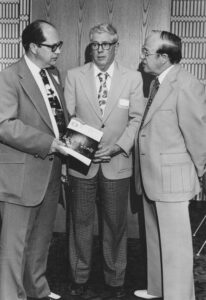
PHMC Executive Director William J. Wewer presents a copy of the June 1976 Commemorative Bicentennial Edition of Pennsylvania Heritage to Fred Long, president of the Blair County Historical Society, and Ernest C. Miller, president emeritus of the Pennsylvania Federation of Historical Societies.
Pennsylvania Heritage file photo
Betty L. Seanor was the editor hired to helm the new quarterly, which would break its connection to the earlier newsletter by starting fresh with volume 1, number 1. The first issue was modest: It had an 8-by-10 trim size, a black-and-white design with blue accents, and was self cover, meaning the same paper stock was used for both the cover and the interior leaves; however, at 24 pages, it was three times larger than its predecessor.
Wewer introduced the agency’s “new venture” on the first interior page of the issue, expressing his hope that the magazine “will provide a medium of communication for those persons interested in Pennsylvania history.” He noted that one of the magazine’s goals was to “recognize achievements in statewide historical activities” and hence the bulk of the articles were news items; however, they now covered not only the activities of PHMC but also those of county historical societies and other Pennsylvania historical organizations. In addition, two columns reported on news and events in the commonwealth related to the impending United States Bicentennial.
Also included in that first issue was a harbinger of what was to become a central focus of the magazine — stories about Pennsylvania’s past. As it turned out, editor Seanor composed that initial history piece, titled “This Quarterly’s Feature: Armstrong County,” which was the first in a series of county histories that would run in subsequent issues of Pennsylvania Heritage until the Fall 1991 edition, when the last of the commonwealth’s 67 counties was profiled.
Two more feature series were initiated in the next issue, March 1975 — one on women in history, starting with “Pennsylvania Woman as Politician: Cornelia Bryce Pinchot” by John Furlow Jr., and the other on ethnic history, “Of the Children, by the Children, for the Children” by John E. Bodnar.
Within less than a year, amid commonwealth budget restrictions, Seanor, Wewer, Rosenberger and other commission members met to discuss the possibility of expanding the periodical. Wewer followed up with a memo to Seanor on July 16, 1975, stating: “Please follow through with whatever arrangements are necessary for a thirty-two page magazine. The expenditure . . . is more than offset in value by the effects.”
In October, in a letter to Rosenberger, Seanor also recommended redesigning the cover. Rosenberger responded with approval, writing a few days later: “Keep on suggesting enlargement and special additions. This is the way to make Pennsylvania Heritage a much sought for quarterly. Only by proposing carefully thought-out ideas, in times of austerity as well as better times, will the quarterly develop.” In closing, he wrote, “Your four issues have been great, each better than the preceding. If you can keep on making each issue better than the previous one . . . we will pin an orchid on you!”
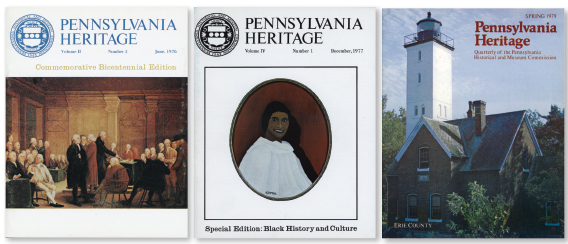
The Commemorative Bicentennial Edition, June 1976; Black History and Culture special edition, December 1977; and the Spring 1979 edition, with new cover design.
The first issue of the second volume of Pennsylvania Heritage, now expanded to 32 pages along with Seanor’s new cover design, appeared in December 1975. But it would be the June 1976 issue, the 64-page Commemorative Bicentennial Edition, comprising 12 feature articles on Pennsylvania history related to the American Revolution and the birth of the United States, that would signify the magazine’s growing emphasis on accessible stories about the commonwealth’s past. Sales of the issue would also indicate the magazine’s expanding popularity, as its print run immediately sold out.
In December 1977, another well-received special edition, Black History and Culture, was published with 14 features on African American history in Pennsylvania. Betty Seanor had set the wheels in motion for that issue but had earlier in the year departed for a position with the Department of Transportation. A state budget cutback kept the position vacant for the next year, but various PHMC historians carried on editorial responsibilities until 1978, when Douglas H. West was hired.
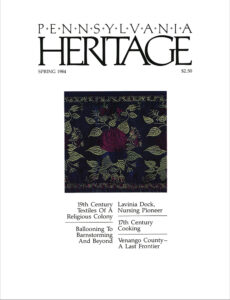
Pennsylvania Heritage, Spring 1984: “The next evolutionary step of the magazine.”
In the meantime, PHMC had been discussing ways to further develop the magazine and expand its audience. When West came on board, he immediately ushered in a more modern look for the magazine, with a full-color, full-bleed cover and a change to seasons for the issue dates starting with Spring 1979. New content included regular features on oral history and historic preservation. As circulation continued to grow over the next five years, discussions resumed at PHMC about new directions for the magazine.
Michael J. O’Malley III, who had joined PHMC in 1978, first as public information officer for the statewide historic preservation program and then as special features coordinator in the press office, was by 1983 appointed assistant editor of the magazine. He recalls: “I was privileged to be asked to sit in on meetings for a new design for Pennsylvania Heritage. Previous redesigns, in retrospect, seem minor, but at the time each and every alteration was considered to be of epic proportions. What Doug West and the agency had in mind at this time was really big. Really new. And really exciting!”
The Winter 1984 edition, the last in the older format and incidentally the 10th anniversary issue, carried a note announcing the forthcoming Spring 1984 edition as “the next evolutionary step of the magazine.” And, indeed, it was an advance. The physical package was expanded to 48 pages, the trim size grew to 8½-by-11 inches, and coated stock with a glossy finish was used to enhance the images, several of which were now in color. In terms of content, the history features now dominated, with this issue offering stories on flight in the commonwealth, textile manufacturing at Old Economy Village, Venango County (continuing the county series), nursing pioneer Lavinia Dock by journalist and noted women’s history collector Alice K. Marshall, and 17th-century cookery by up-and-coming food historian William Woys Weaver. Information about programs, events, exhibitions and activities of PHMC and other historical and cultural institutions in Pennsylvania was collected in departments that followed the features.
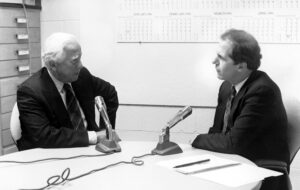
Popular historian David McCullough meets with PHMC Executive Director Brent D. Glass for an interview that was published in the Summer 1994 edition of Pennsylvania Heritage.
Pennsylvania Heritage file photo
The model for this new approach, both in content and form, was the popular, nationally distributed Smithsonian magazine, which first appeared in 1970. Tailored to a popular audience, its format of an eclectic assortment of articles spanning several eras in one issue, with numerous illustrations, had become influential in popular history and science. Smithsonian’s founding editor, Edward K. Thompson, later explained his vision in his 1995 memoir: “The magazine . . . would stir curiosity in already receptive minds. It would deal with history as it is relevant to the present. It would present art, since true art is never dated, in the richest possible reproduction. . . . Technical matters would be digested and made intelligible by skilled writers.” Pennsylvania Heritage adopted a similar approach.
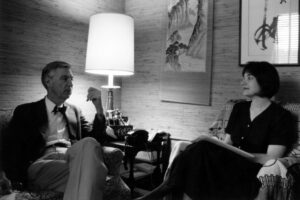
Fred Rogers, host of the long-running children’s program Mister Rogers’ Neighborhood, spoke with Pennsylvania Heritage editorial assistant Carrie L. Curtis for an interview that appeared in the Summer 1997 edition.
Pennsylvania Heritage file photo
By late 1984, O’Malley was promoted to editor of Pennsylvania Heritage, a position he would hold for the next 30 years. He remembers: “Our articles grew significantly longer and were now heavily illustrated. We gave the magazine currency by addressing issues. When we reviewed unsolicited manuscripts, we looked for new and unusual twists. When we commissioned articles, we emphasized that we needed untraditional angles, or ‘hooks.’”
In the early 1990s, O’Malley introduced a series of interviews with famous Pennsylvanians who would, as he explains, “share insights on their roles in influencing or interpreting the commonwealth’s — and in some instances the nation’s — heritage.” O’Malley began the series as interviewer with Doylestown native and Pulitzer Prize–winning author James A. Michener. “Once we published ‘You Can Go Home Again’ in the Winter 1993 edition,” O’Malley says, “nearly every individual we asked cheerfully agreed to sit for a discussion with staff members and me.” Among the luminaries interviewed in Pennsylvania Heritage over the decade that followed were David McCullough, Mike Schmidt, Fred Rogers, Dick Clark, C. Delores Tucker, Harold Denton and Kitty Carlisle Hart, as well as historians and museum professionals, artisans and scholars, senators and past governors of the commonwealth. Interviews remain a recurring staple of the magazine.

The Summer 2002 edition featured Daisy Myers’ first-hand account of her family’s struggles as the first African American residents in the suburb of Levittown in 1957.
But Pennsylvania Heritage also embraced the voices of lesser-known Pennsylvanians who had significant stories to tell. At the turn of the millennium, O’Malley initiated Pennsylvania Memories, a series of articles featuring the reminiscences of everyday individuals, sometimes regarding their work — such as coal mining, railroading and serving in the Civilian Conservation Corps — or their personal experiences during momentous events — including World War II, the outbreak of polio, the advent of rock and roll, and the nuclear accident at Three Mile Island. In the Summer 2002 edition, Daisy Myers relayed her family’s story in a feature about their 1957 move to Levittown as its first African American residents and the violent harassment they endured from many of their neighbors as the community moved toward integration.
Of these articles and the features that were published during his tenure, O’Malley remarks, “To me, each and every article made an impact. Most important, writers focused on their subject’s relevance to today’s readers. And that’s what makes each memorable in its own right.”
New regular departments appeared in this period, including A Place in Time,spotlighting a notable site listed in the National Register of Historic Places; Marking Time, highlighting the subject of one of the Pennsylvania Historical Markers installed throughout the state since 1914; Our Documentary Heritage, showcasing documents drawn from the collections of the Pennsylvania State Archives; Wish You Were Here, focusing on the story behind a particular postcard in the State Archives’ collection; Trailheads, noting activities, programs, exhibitions and events at PHMC historic sites and museums on the Pennsylvania Trails of History; and PHMC Highlights, covering other notable agency activities. All these departments continue in the magazine to this day and are authored by PHMC staff.
Around the time of the Spring 1984 issue, the magazine became a premium of membership in the Friends of the Pennsylvania Historical & Museum Commission, a nonprofit organization developed to support the programs of PHMC through fundraising, grant management, and community engagement. The Friends joined PHMC as copublisher of the magazine and, in 1997, changed their name to the Pennsylvania Heritage Society (later the Pennsylvania Heritage Foundation) to reflect that association — one that continues in the present.
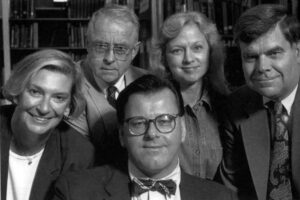
The editorial staff of Pennsylvania Heritage in 1994: clockwise from front center are Michael J. O’Malley III, editor; Suzanne McInerney, assistant editor; Louis M. Waddell, associate editor; Kimberly L. Krammes, photo editor (later art director); and Harold L. Myers, assistant editor.
Pennsylvania Heritage file photo
From the first issue until 1984, the editor was also responsible for design and layout of the magazine, but beginning with the Spring 1984 edition, those tasks were handled by an outside firm. By 2004, with advances in digital computers reducing the size and expense of hardware and making software more viable, an in-house art director position was created, and Kimberly L. Krammes (later Stone), staff photo editor since the Spring 1992 issue, filled the role, increasing the visual appeal and verve essential to any presentation of public history. After Stone’s retirement in 2013, Lauren Bennett was appointed art director, and she continues to refine the design with creativity and currency.
O’Malley recalls the positive notice Pennsylvania Heritage received through the years: “We took pride in the honors and awards — many of them first place — because they helped us navigate the rapidly changing technologies. Not only was Pennsylvania Heritage recognized by history, museum, arts and cultural communities but also by the communications, design, editorial, printing, graphics, writing and advertising industries.”
In the decade following O’Malley’s retirement in 2014 we have continued to build upon the remarkable precedent set for us in “telling stories, sharing history.” In that spirit, in 2020, we launched a Pennsylvania Heritage online archive of all the issues published since that very first one in December 1974.
***
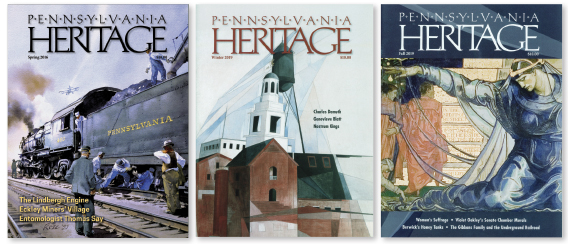
History helps us understand our world. State history narrows the focus down to the stories of the past that are related to the places we experience closer to home — the roads we travel, the buildings and landmarks we pass, the towns and landscapes we move through — as well as our traditions and practices and the diverse people we encounter. Looking back, not only at the achievements and triumphs but also the disasters and misfortunes, can give us a better perspective on who we are as Pennsylvanians, how we arrived where we are now, and where we may be going in times to come. As Pennsylvania Heritage reaches the 50-year mark, we remain committed to connecting readers to that relevant past.
Kyle R. Weaver has been the editor of Pennsylvania Heritage since 2014.