
Monument Man: Chester County’s John Gheen Taylor and His Memorials
Written by Spencer Larson in the Features category and the Summer 2025 issue Topics in this article: Birmingham Lafayette Cemetery, Birmingham Meeting House, Casimir Pulaski, cemeteries, Chester County, Gilded Age, Isaac Taylor, John Gheen Taylor, Joseph McClellan, Marquis de Lafayette, monuments, sculpture, West Chester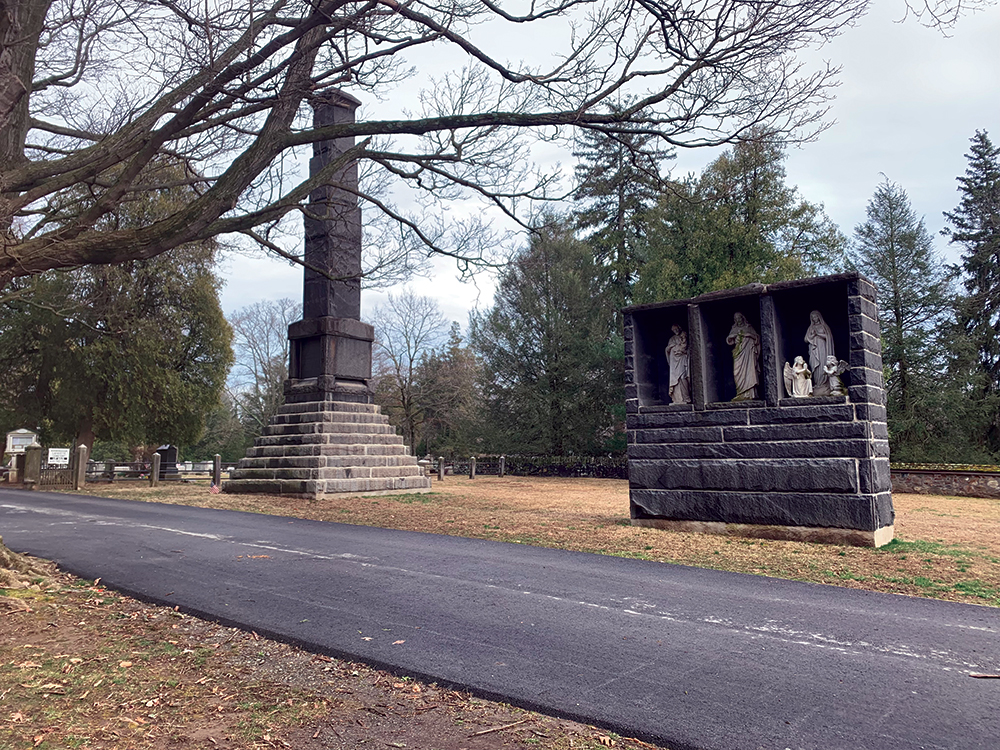
Two of John Gheen Taylor’s monuments stand along the paved road at the Birmingham Lafayette Cemetery in Birmingham Township, Pennsylvania
Photo, Spencer Larson
In Pennsylvania’s Chester County there is an old burial ground called Birmingham Lafayette Cemetery. While it may seem quiet outside the cemetery’s gates, behind them is a collection of monuments that speak loudly, telling a story that once captured the attention of the nation.
Between 1893 and 1913, a determined West Chester local named John Gheen Taylor made it his mission to erect certain monuments on the formerly Quaker grounds — to his family members and to historic military figures, especially foreign officers of the Revolutionary War. Taylor’s efforts made waves throughout Pennsylvania and the country, with the people of West Chester eventually referring to him as the “Monument Man” and distant newspapers calling him the great monument builder of the state.
A String of Losses and a Cemetery Election
Although little is known about Taylor’s life before he became the “Monument Man,” the available information can help shed light on his later actions. In short, Taylor lived a life that was first punctuated by loss and grief and later pervaded by an obsession over the memory of his lost ones.
John Gheen Taylor was born in 1832 in Chester County. Like many Pennsylvanians at the time, he spent his early years on the family farm. He attended the nearest meetinghouse, which for him was that of the Birmingham Friends. In 1842 Taylor’s younger sister Sarah passed away at age 8, when he was only 10. Given the proximity in age, it is easy to imagine that the death of his sister was deeply traumatic for the young Taylor.
Later in his life, Taylor married a woman named Hannah Jane Parker, whose family owned property adjacent to the Taylors’ land. The couple had a child in January 1864 and named her Rebecca Parker Taylor, or “Rebe” for short. Tragically, Rebe passed away in May of the following year, marking the second time that Taylor had lost someone extremely close to him. Unfortunately, it would not be the last.
Later in 1865, before Taylor had any time to process the death of his only daughter, his mother, Hannah G. Taylor, died. He must have felt that the grief he was experiencing could not be compounded any further, but sadly he was wrong. In March 1866 his beloved wife Hannah died, too. In the span of 10 months, Taylor’s entire immediate family was reduced to just himself and his father. The string of losses that he suffered in that period is paralleled by cases such as Edgar Allan Poe and Theodore Roosevelt, who also lost the women in their lives in a very short time frame.
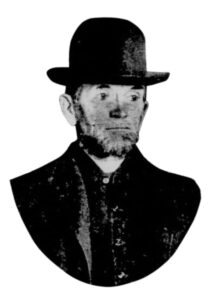
John Gheen Taylor, the Monument Man, circa 1904.
From New York Tribune, June 19, 1904, p.2
In 1874 Taylor moved off his farm and into the Turks Head Hotel in West Chester, where he worked as a private banker, broker and real estate agent, amassing an unprecedented fortune. For him, the 1880s were marked by the deaths of his aunts and uncles and the passing of his father, Thomas D. Taylor. By 1886 he had virtually no family left. There is no question that the losses Taylor experienced in the 1860s and 1880s had a lasting impact on his image of death, the afterlife, and what he would leave behind.
As members of Birmingham Friends Meetinghouse, many of Taylor’s relatives were interred in the Birmingham Hicksite Friends Burial Ground (later called the Birmingham Lafayette Cemetery). Taylor spent a great deal of his time at the burial ground, tending to the graves of his loved ones and pondering their memory. By the late 1880s he decided to expand on his family plot and commission a monument in their honor. Taylor also made plans to erect other memorials to Revolutionary War participants; however, they were not to be undertaken without a legitimate struggle.
Around that same time, board members of the Quaker burial ground took it upon themselves to improve the property in various ways. In 1890 they began resetting crooked stones, straightening rows, and even lowering some headstones to make groundskeeping easier. One of the stones they lowered was that of Taylor’s sister. They also removed the headstone over the graves of Taylor’s wife and daughter.
In response, Taylor had warrants issued for the arrests of board members Clement Biddle, Alban Seal, Lamartine Darlington and Joseph Seal. The warrants were issued under the Act of Assembly, which penalizes any person who shall willfully or maliciously destroy, mutilate, deface or injure any tomb, monument or gravestone. Taylor published a public criticism and filed a suit against the cemetery, which in turn reversed the low-gravestone requirement. The board members were hauled before the West Chester constable, but Taylor ultimately dropped the charges. The Philadelphia Inquirer referred to the ordeal as a “fever of excitement.”
After Taylor confronted the board members and called for their arrests, the board took to the newspaper columns to defend themselves. They said, “We intended to hurt no one’s feelings or do anyone wrong.” One director even wrote to Taylor that all they desired was “that the stone in memory of thy sister be so placed that it can be mown over.”
Taylor then replied in the Daily Local News: “The graves of our loved deceased are consecrated grounds. They may be humble and lonely marks, possibly a rose only, but whatever they may be they are the last tribute of affection we can pay to our loved and honored dead.” Taylor’s heartfelt response provides a deeper understanding of his mindset regarding the symbolism of grave markers and monuments.
Despite Taylor’s actions against the board members, he was not satisfied. As an article in the Cleveland Plain Dealer pointed out, Taylor “had no intention of abandoning his cherished idea. He saw that as matters stood, he could go no further, so he bided his time, worked slowly, and said little.”
Only one year after the gravestone lowering regulation, Taylor secured enough stock to obtain control of the cemetery. This gave him the power to influence others of the same thinking to run for positions in the cemetery governing organization. An intense election on January 5, 1891, concluded with Taylor and his supporters winning positions on the cemetery’s board of directors. Taylor was deemed as the new president of the board. An article from The Scranton Truth noted that Taylor succeeded in “ousting the ‘anti-tombstoners’ and electing a board whose ideas were in harmony with his own.”
Under Taylor, the organization’s name was officially changed to the Birmingham Lafayette Cemetery Association. In 1892 he and his allies also changed the exclusively Quaker cemetery to allow nondenominational burials, thus terminating its direct affiliation with the Birmingham Friends. Shortly after, Taylor re-engaged his plans and executed his monument-building frenzy.
Taylor’s Monuments
The first project that Taylor completed after his successful campaign was the memorial to his family in 1894. The structure is not only an ornate monument but also a tomb that houses the graves of John G. Taylor himself and his relatives. Newspaper articles clarified that Taylor commissioned it for $10,000 (equivalent in purchasing power to almost $358,000 today).
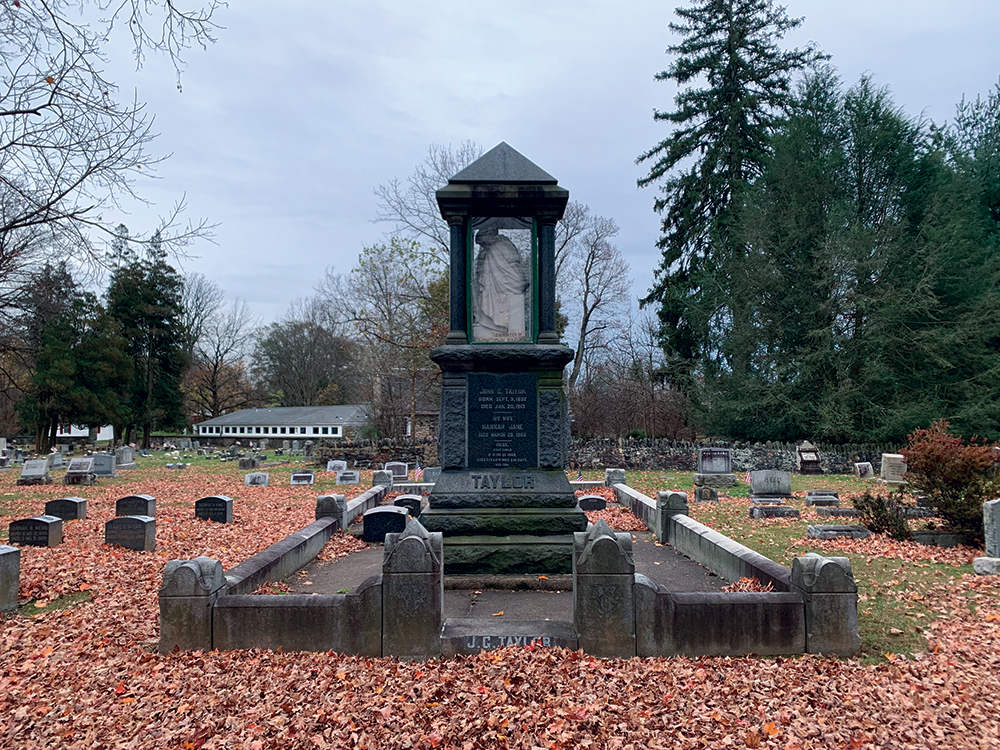
The elaborate Taylor family plot features a large memorial to Taylor’s wife, Hannah.
Photo, Spencer Larson
Perhaps the most striking and expensive feature of the Taylor family monument is its marble statuary — with one figure depicting Taylor’s wife Hannah and the other, their infant daughter Rebe. According to The Scranton Truth, the statues were carved by a “celebrated sculptor” in Carrara, Italy, who then shipped them to the United States for Taylor to incorporate into his project. The sculpture of Rebe is located over her grave. It depicts an infant innocently lying in bed and clutching a cross over her chest, a familiar icon for Victorian children’s grave markers.
The life-size sculpture of Hannah is even more telling, as it is the centerpiece of the monument. It sits in a granite pavilion composed of four smooth Tuscan pillars and a pyramidal canopy. The figure is posed kneeling, delicately resting her head on her hand and, in the words of the Bellefonte Democratic Watchman, “delineating the character of sorrow.” In her other hand is a wreath of flowers, a symbol of love, life and resurrection. Newspapers stated that the sculptor used a photo of Hannah as a reference to carve the statue, making it that much more intimate. Below the statue is a powerful epitaph addressed “Dear Jennie,” the nickname Taylor would likely call his wife.
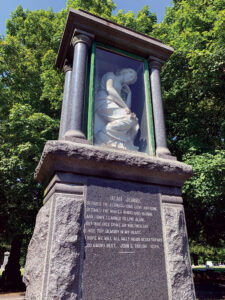
The monument for Taylor’s wife Hannah includes a full-scale sculpture and an engraved verse Taylor wrote in 1894 in which she is addressed as “Jennie.”
Photo, Spencer Larson
If Taylor’s only reasons for running and succeeding in the cemetery election were to preserve and expand on his family plot, it would not come as a surprise; however, when looking at what else he accomplished while in charge of the cemetery, it becomes apparent that he had other great plans in the realm of commemoration.
Taylor finished construction on his second monument one year after the completion of the memorial to his family. It was erected in honor of his distant relative, Col. Joseph McClellan, who fought under Gen. Anthony Wayne at the Battle of Brandywine in the Revolutionary War. The meetinghouse and cemetery property happened to be at the center of the conflict in 1777.
Taylor’s structure to McClellan, a granite sphere atop a square foundation, was unveiled on September 11, 1895, the 118th anniversary of the battle. On that same day, the Chester County Historical Society dedicated a terra cotta monument to Marquis de Lafayette just down the road, at the spot where the general is thought to have been wounded. That monument would later crumble during a violent storm. The Philadelphia Inquirer referred to the duel unveilings as “Brandywine Day,” with a staggering 7,000 people in attendance.
Although Taylor now had two impressive memorials under his belt and some decent publicity, he was not even close to being finished with his commemorative efforts. The third structure that he commissioned was to another one of his ancestors, and like Joseph McClellan, that ancestor also participated in the Battle of Brandywine. Completed in 1898, the monument honors Taylor’s great-grandfather, Col. Isaac Taylor, who fought in the 7th Pennsylvania Regiment and trained his Continental troops on the Taylor family homestead.
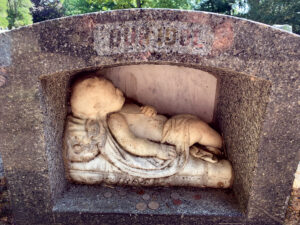
A sculpture of Taylor’s infant daughter Rebe was incorporated into the design of her headstone.
Photo, Spencer Larson
The monument consists of a large, polished granite sphere resting on a sturdy pedestal. It showcases Isaac Taylor’s role in American history, the legacy he left behind, and the pride of his descendants.
While construction on the Isaac Taylor memorial was nearing completion, John Taylor began to set his sights on other monumental undertakings. Like the Chester County Historical Society a few years prior, Taylor turned his attention toward honoring the Marquis de Lafayette, America’s hero from France who was wounded in battle near the cemetery and the person for whom the burial ground itself would be renamed.
It was not long before Taylor completed the base for his Lafayette monument. This is to be expected, given his sheer level of determination and ability to push his projects forward. So far, Taylor’s monuments were constructed entirely at his own expense and without outside assistance. With his Lafayette idea, however, he would attempt to do things differently and seek proper funding for the rest of the monument from the U.S. Congress.
Around this time, newspapers started to pay closer attention to Taylor’s commemorative efforts at the cemetery. His sudden rise in media popularity can be attributed to the large sum of money he was spending, the appropriation he sought from the government, and his plans to memorialize a prominent Revolutionary War figure.
In 1898 The Wilmington Daily Republican quoted Taylor: “If the Government will undertake the erection of this shaft, I shall deed the property over to it. I shall wait until spring to see what Congress will do, and if it does nothing, I shall go ahead.” Despite his uncertainties, Taylor remained prepared and determined.
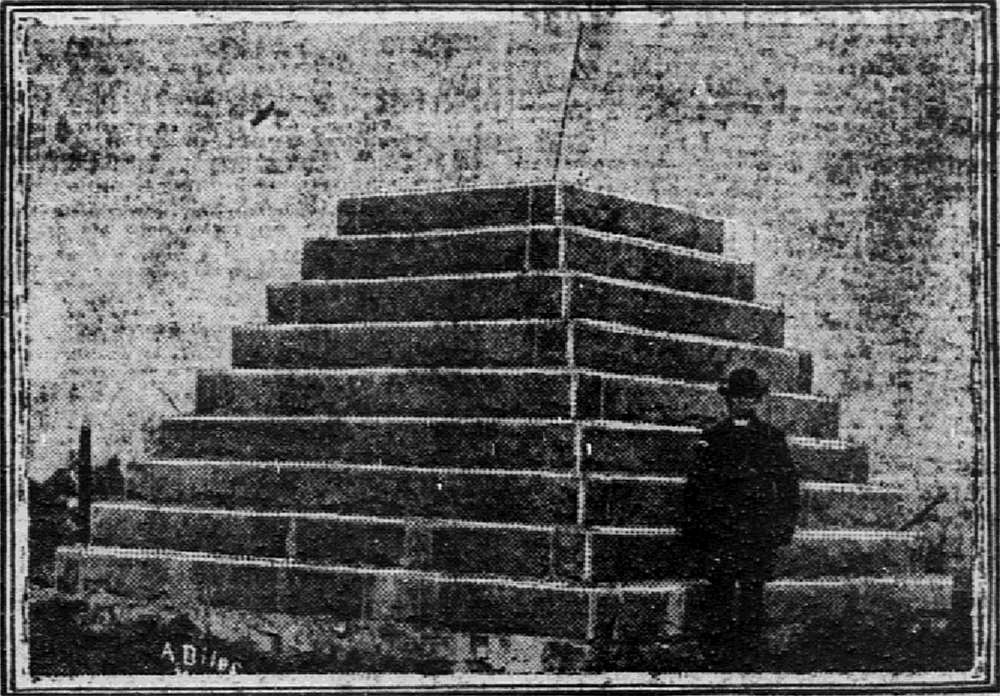
Taylor stands at the empty base of the Lafayette memorial, before the 45-foot pillar was erected.
From The Philadelphia Inquirer, June 23, 1900, p.4
The appropriation was never made. In 1900 The Philadelphia Inquirer published an article on Taylor’s state of progress with the monument. Titled “Lafayette Statue Base, Which May Never Be Occupied,” the article featured a photo of Taylor standing next to the vacant pyramidal foundation. It mentioned that he had already spent many thousands of dollars to erect the base for what was intended to be a very handsome statue of Lafayette; however, his inability to get assistance from Chester County and the state of Pennsylvania might force him to abandon his idea and leave the statue base unoccupied.
Despite the setback, Taylor managed to resume construction later that year and ostensibly complete the Lafayette monument. The word “complete,” however, does not exactly fit here because the 45-foot pillar is still missing its 12-foot bronze statue of Lafayette. Nevertheless, as it is, the structure is impressive and unparalleled in the area, especially given that Taylor funded the entire project by himself. The Kansas City Star of June 24, 1900, even went as far as to say it was the “finest memorial to Lafayette in the world.”
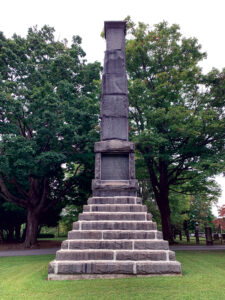
The Lafayette memorial stands today without the 12-foot bronze statue of the French military hero that Taylor planned to include in the design.
Photo, Spencer Larson
Taylor had plans to include life-sized busts of Gen. Casimir Pulaski, Gen. Henri de St. Simons, Adm. François Joseph Paul De Grasse, and Gen. Jean-Baptiste-Donatien de Vimeur, comte de Rochambeau, on the monument. Pulaski was a Polish officer, whereas the other three were of French origin. As a Bellefonte Democratic Watchman article highlighted, these men “were more or less identified with the Americans in their struggle for liberty.” Although the statues were never added, the names of the officers were, and the plan to honor this foreign handful illustrates that the monument was intended to paint a more inclusive picture of the participants in the Revolutionary War, a practice gaining significant popularity at the time.
While the dramatic height, impressive construction, and meaningful subject matter are the most impactful aspects of the Lafayette monument, the fact that it was an empty pedestal is among the most peculiar. As mentioned, Taylor planned to crown the monument with a bronze figure of Lafayette in military attire. The rendition was to face Osborne Hill, where the British positioned a cannon at the start of the battle. In 1904 the New York Tribune mentioned that the statue was then being carved; however, the legitimacy of this claim is uncertain.
In 1914 the Newark Post published an article titled “School Children Give Pennies,” which revealed a local effort to complete the monument one year after Taylor died. The article discussed how public schoolchildren of Chester County raised $220 in pennies to fund the Lafayette statue, and that if every student of the county contributed 1 cent each, the $8,000 required for the monument’s finishing touch could be met. Unsurprisingly, the total sum was never raised, and Lafayette’s pedestal remains empty to this day. It serves as a reminder that commemoration on such a grand scale has its limits when it is done by one individual.
In 1902 Taylor commissioned his final monument for the cemetery. A square structure, it is divided into three niches on its front upper half. In the middle niche is a life-sized marble statue of Jesus Christ, on the left is Lazarus whom Christ raised from the dead according to the Gospel of John, and on the right is the Virgin Mary with two cherubs. On the backside of the monument are two inscribed marble placards that have no biblical or familial ties. One is dedicated to Casimir Pulaski from the Battle of Brandywine, and the other is dedicated to Daniel Wells and Henry McComas, two Baltimore soldiers who became known as the “boy heroes” of the War of 1812. The inclusion of the biblical figures in Taylor’s final monument reflects his deep ties to religion and how memorializing his spirituality was just as important as remembering his family and local history.
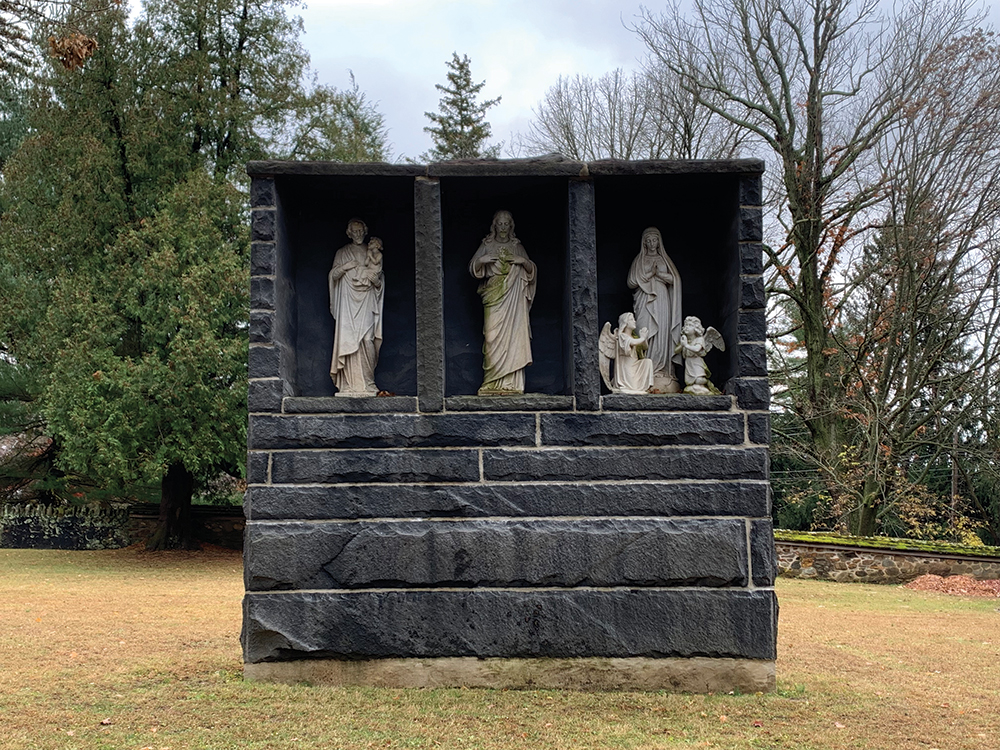
Taylor’s final monument at the cemetery, with Christian iconographic figures of Jesus, Mary and Lazarus, commemorates Polish military leader Casimir Pulaski, who fought at Brandywine, and War of 1812 “boy heroes” Daniel Wells and Henry McComas.
Photo, Spencer Larson
In 1907 Taylor drafted his final will and testament, and in 1913 Chester County’s Monument Man passed away at age 81. In his will, Taylor generously ordered all the net income from his handful of properties in West Chester to be given to the directors of the Birmingham Lafayette Cemetery Association to preserve and maintain his monuments, family burial plot, and greater cemetery property. In another section, Taylor mentions that if his death should occur before the completion of his monuments, his executors are to ensure the work is finished. He also gives instructions to erect a monument to the memory of Gen. Anthony Wayne if he did not do so in his lifetime. Even in Taylor’s last will, his devotion to the cemetery and his determination to memorialize come through as strong as ever before.
“Graveyard Hobby of a Keystone Man”
The main question that one is left with after hearing Taylor’s story is simply “why monuments?” The answers to this question emerge through the information presented by the media as well as the contextualization of Taylor’s efforts in the greater era of monument building.
Initially, most newspapers latched on to the idea that Taylor was expending his fortune to prevent the possibility of a contest over his will when “he too is numbered among the dead.” Journalists from Philadelphia to Kansas City wrote articles on Taylor with titles such as, “Devotes His Estate to Memorials” and “Spends Fortune in Monuments to Stop Disputes.” Although it likely made an attractive narrative for audiences at the time — and it even seems as though Taylor fed into some of these claims — the reality is that he had little family remaining and no one to “fight over his estate” by the time he was engaged in constructing his monuments.
Later, newspapers switched to portraying Taylor’s monument-building as a “peculiar fad” or “unusual hobby.” Some equated his expensive memorializing to the philanthropy of Andrew Carnegie. The Western Kansas World of July 12 1902, remarked, “instead of investing in schools or libraries, he is building monuments on the Brandywine battlefield.” In the Bellefonte Democratic Watchman, Taylor addressed his critics: “I am often told that I am crazy, and occasionally I find a person who endeavors to dictate how I shall spend my fortune. They don’t seem to take into consideration the fact that that is none of their business.”
A third explanation for Taylor’s commemorative efforts is that he was using his monuments, or the act of building them, as a means of coping with the extreme grief he experienced throughout his life. It is reasonable to assume that Taylor was never able to fully recover from the loss of his family. Therefore, he may have used his monuments to heal those wounds and remind himself of his “beloved deceased.” After all, as historian Andrew Butterfield has pointed out, “People build monuments not because they do not know what else to do, but because there are wounds so deep that only monuments will serve to honor them.”
According to The Scranton Truth, Taylor would go out in the morning, day after day, and linger by the sides of his monuments until the shades of evening drove him away. Perhaps The Philadelphia Inquirer put it best: “His whole heart and soul appear to be wrapped up in the ancient burying ground, and he will devote his entire fortune to it.”
In addition to what newspapers said, Taylor’s efforts can be understood through the broader contextualization of monument-building in Pennsylvania and the country. In the period after the Civil War, between the 1870s and the 1920s, Americans utilized monuments of all shapes, sizes and subjects to remedy the pain caused by years of internal strife.
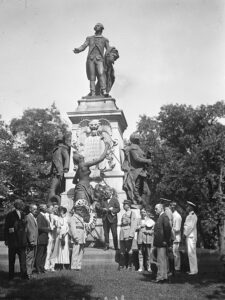
Memorials to Lafayette that were built around the time Taylor erected his monument include this statue installed in 1891 on the southeast corner of Lafayette Park in Washington, D.C. This 1922 photograph shows a committee of the Sons of Revolution placing wreaths during a ceremony.
Library of Congress Prints and Photographs Division
With that said, not all the monuments put up in that era were concerning the Civil War. Another development that contributed to the spike in memorials was the advent of America’s centennial in 1876. Centennial celebrations ushered in intense feelings of patriotism and a drive to remember and memorialize the Revolutionary War figures who helped shape the country, qualities that Taylor embodied to the fullest.
Along with being part of the healing process of the Civil War and the sentiments of the centennial, the era of monuments was also a result of major political, economic and social transformations that the United States was undergoing at the time. Author Katrina Gulliver, writing in The Washington Post, mentions that during the late 19th century, industrialization and urbanization transformed America’s landscape beyond recognition, while the end of slavery and increased immigration from Europe seemed to transform its people. Newer cities and towns that had grown with the arrival of railways and manufacturing wanted to mark the importance of local sons or establish their connections to greater, often national, historic events. This practice is apparent in John Taylor’s commissioning of monuments to his relatives Joseph McClellan and Isaac Taylor, as well as other Battle of Brandywine participants. Taylor used his monuments to establish a link between himself and his ancestors who had participated in a turning point battle of the Revolution, along with a connection between the Birmingham Lafayette Cemetery and America’s defining national conflict.
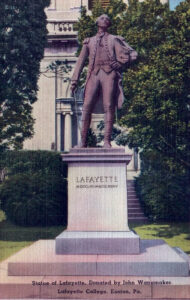
Daniel Chester French designed this statue of Lafayette that stands on a pedestal
designed by Henry Bacon at the campus of Lafayette College in Easton, Pennsylvania,
dedicated in 1921.
Private Collection
Taylor’s Lafayette monument was by no means the only one in existence at the time. In 1891 Congress erected a monument to Lafayette in the Lafayette Square section of President’s Park in Washington D.C. It features a bronze statue of the French general atop a base of American granite. On each face of the pedestal are other bronze statues — one of a female figure representing America on the south side, depictions of Comte de Grasse and Comte d’Estaing on the east, depictions of Comte de Rochambeau and Chevalier du Portail on the west, and two cherubs on the north. When comparing Congress’s memorial to Lafayette with Taylor’s (assuming that he was aware of the memorial in D.C.), it is easy to see how Taylor may have been inspired by not only the prospect of honoring Lafayette but also the idea of including lesser-known foreign Revolutionary War officers in his project. Furthermore, because Congress was responsible for the monument in Lafayette Square, it is understandable why Taylor sought financial support from them for his monument. His appropriation might have been denied because Congress felt that Lafayette had been sufficiently honored already.
After Taylor died in 1913, another memorial to Lafayette cropped up in Pennsylvania. In 1921 Lafayette College in Easton dedicated a monument in honor of the school’s namesake. Once again, the structure consists of a bronze statue of Lafayette on a pedestal-like foundation. The similar layouts of the Lafayette monument in D.C., the one at Lafayette College, and Taylor’s proposed monument, and the fact that they were all dedicated to the same person, show how Taylor’s commemorative efforts were not unique in design or subject matter but only in the sense that Taylor was the sole contributor to his projects. His drive to honor Lafayette and other Revolutionary figures fits into the broader context of memorialization that permeated Pennsylvania and the rest of the country at that time.
Mirrors and Windows
The most likely explanation behind Taylor’s monument-building frenzy is a combination of peculiar hobby, the excessive grief he experienced, and the environment of remembrance of which he was a part. Whatever Taylor’s actual reasons for commissioning his monuments may have been, a few things are certain. For one, Taylor’s monuments serve as mirrors that reflect the trend of commemoration that was prevalent in that era. They are products of a time when Americans used stone and bronze as remedies for their sorrow and as a way of remembering the past. In addition to being mirrors, these structures also act as windows into the heart and thought processes of a Gilded Age American. They showcase the people and events that Taylor held dear and the space they occupied in his mind. Finally, they serve as reminders for those who visit Birmingham Lafayette Cemetery of the rich history that this area holds and the determination of one individual to honor that history. The unique story of Chester County’s Monument Man is forever written in stone in that quiet cemetery on the heights of the Brandywine Battlefield.
Sidebar: Lafayette’s Grand Tour
In 1824, President James Monroe invited Gilbert du Motier, the Marquis de Lafayette — the last living major general of the Revolutionary War — to visit the United States as the nation’s guest and celebrate the Revolution’s 50th anniversary. What was initially planned as a three-month tour evolved into a 13-month odyssey across all 24 states. The enthusiasm for Lafayette was widespread, and the scale of the celebrations was unprecedented in American history. Wherever Lafayette traveled, he was greeted with parades, balls, special dinners and other events held in his honor. Americans produced an abundance of material culture for and during the tour, including ceramic dishes, pins, ribbons, clothing and other souvenirs, all bearing the name or likeness of Lafayette.
Lafayette’s tour also celebrated the patriots who fought alongside him. Fifty years after the war, Lafayette embodied a generation of heroes fading from living history into memory. He paid tribute to that memory by visiting the site where he was wounded during the Battle of the Brandywine and by laying the cornerstones for monuments to the Battle of Bunker Hill, Gen. Nathanial Greene, Count Casimir Pulaski, and Baron de Kalb.
It has been 200 years since Lafayette’s farewell tour, and the sentiments surrounding America’s hero from France and his 1824–25 visit have returned. Thanks to the efforts of the American Friends of Lafayette, a nonprofit organization dedicated to preserving and promoting the general’s memory, bicentennial celebrations are being held in the exact places where he stopped and in the precise order of his journey.
Further Reading
“All His Fortune In Monuments: Fad of the Man Who Has Erected the Finest Memorial to Lafayette in the World.” Kansas City Star, June 24, 1900. / “Erecting Monuments: A Chester Countian Spending a Fortune in a Cemetery.” Bellefonte Democratic Watchman, June 22, 1900. / “For Removing Gravestones: Warrants Issued for the Arrest of Prominent Friends in West Chester.” Philadelphia Inquirer, November 17, 1890. / “Graveyard Hobby of Keystone Man: Buys Control of a Cemetery That He May Beautify it with Marble.” Chicago Daily Tribune, September 11, 1904. / Gulliver, Katrina. “Americans Put Up Statues During the Gilded Age. Today We’re Tearing Them Down: Why the Gilded Age Was the Era of Statues.” Washington Post, July 26, 2020. / Harper, Douglas. “A Local Man Who Carved Love and Lore on Tombstones.” Daily Local News, 1990. / “Has a Queer Hobby: Pennsylvania Capitalist’s Fad is Erecting Monuments.” Daily Herald, July 31, 1902. / Heller, Allan M. Philadelphia Area Cemeteries. Atglen, PA: Schiffler Publishing, 2005. / “Lafayette Statue Base, Which May Never Be Occupied.” Philadelphia Inquirer, June 23, 1900. / “Mania for Rearing Costly Monuments: Man Secures Controlling Interest in Cemetery in Order to Continue Building Memorials Without Hindrance.” Cleveland Plain Dealer, September 11, 1904. / “A Monument for Lafayette.” Wilmington Daily Republican, November 26, 1898. / “Peculiar Fad of a Chester Quaker.” Scranton Truth, September 28, 1904. / “School Children Give Pennies.” Newark Post, June 24, 1914. / “Spending Riches on Costly Marbles to Beautify Old Burying Ground.” Philadelphia Inquirer, June 19, 1904. / “Spends Fortune in Monuments to Stop Disputes.” Chicago Daily Tribune, July 19, 1900.
Spencer Larson is a historian and artist from West Chester and program specialist at the Chadds Ford Historical Society. He graduated from West Chester University with an M.A. in history and a certificate in Holocaust and genocide studies. The author gives special thanks to historian and Birmingham Lafayette Cemetery board member Don McKay for inspiring this project and Dr. Anne E. Krulikowski for all the assistance along the way.