
Let There Be Light: Football’s First Night Game
Written by Bob Fulton in the Features category and the Fall 2023 issue Topics in this article: Albert Dunmore, electric lights, football, General Electric Company, George McGuire, George Walbridge, J. Gere Jayne, James Dunmore, Levi Sprague, Mansfield Fair, Mansfield State Normal School, Morton Jones, Samuel Edward Sprole, Thomas C. Jones, Wyoming Seminary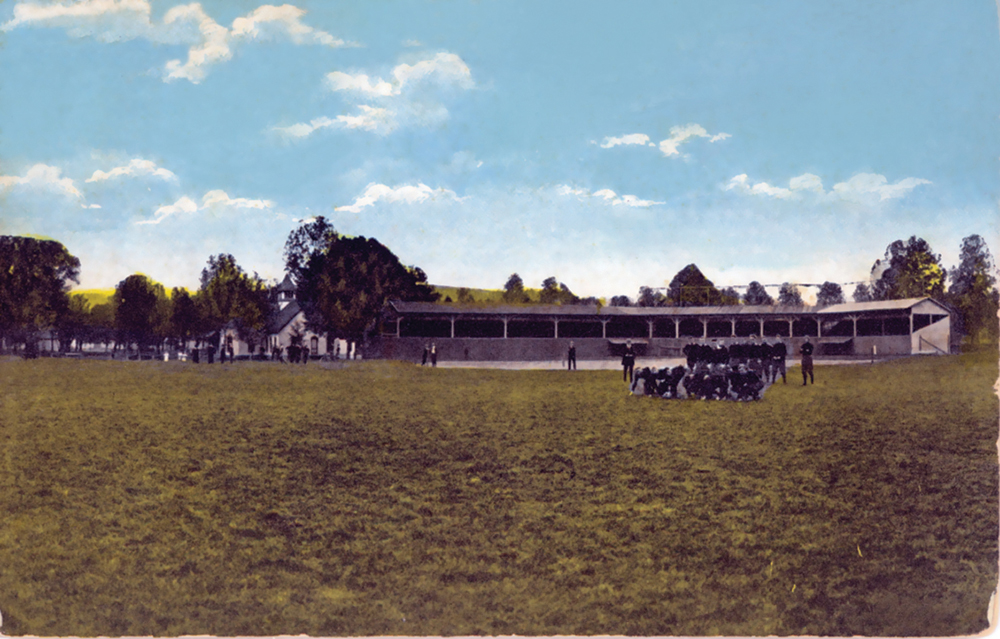
Smythe Park at Mansfield State Normal School in daylight in the era of the first “illuminated” night game.
Mansfield University Archives
On a pleasant autumn evening in 1892, Mansfield Normal School and Wyoming Seminary ushered football out of the dark ages by playing the greatest game never seen.
The schools clashed on September 28 in what is acknowledged today as football’s first night game, although the primitive illumination scarcely pierced the darkness. Not only did the thousands of fans at Mansfield’s Smythe Park strain to follow the action on the dimly lit field, but the players did, too.
“The lighting was so poor that the teams were often unaware which squad had the ball,” wrote Stan Heaps, who researched the game as a Mansfield University student in the 1970s. “Anyone in a uniform was liable to be tackled.”
What resulted was a chaotic exhibition that ended in a scoreless tie and fostered its share of acrimony and controversy. The indignant Wyoming manager, professor J.H. Race, made veiled accusations about unfair officiating and ineligible players and demanded a rematch in a letter sent to and published by the Mansfield Advertiser.
The humble birth of night football served as a midweek highlight of the Mansfield Fair, which drew visitors from throughout the region. Many came expressly to see the lights, powered by a generator delivered especially for the occasion. The Thomson-Houston Electric Co. dynamo weighed 4,300 pounds and featured miles — yes, miles — of copper wiring.
The resulting illumination, by modern standards, was weak. Yet the 1,500 citizens of Mansfield marveled at this wondrous spectacle.
Fact is, football wasn’t the attraction that Wednesday evening at the fair so much as the lights (and a postgame fireworks display). Artificial illumination was still a novelty outside of large cities in 1892. The “electrification” of Mansfield, as a university history book phrased it, would not take place for another five years.
The temporary lights at Smythe Park provided only faint illumination. A light pole situated in the middle of the field made conditions even more treacherous. Reports indicate that both of the officials and at least one player crashed into it.
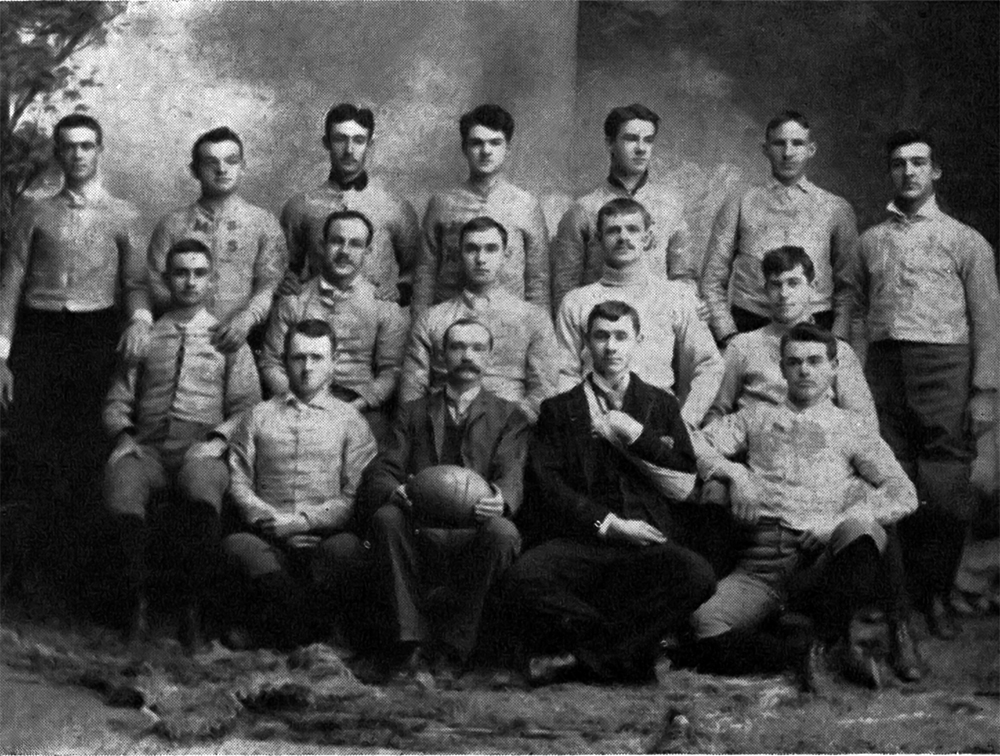
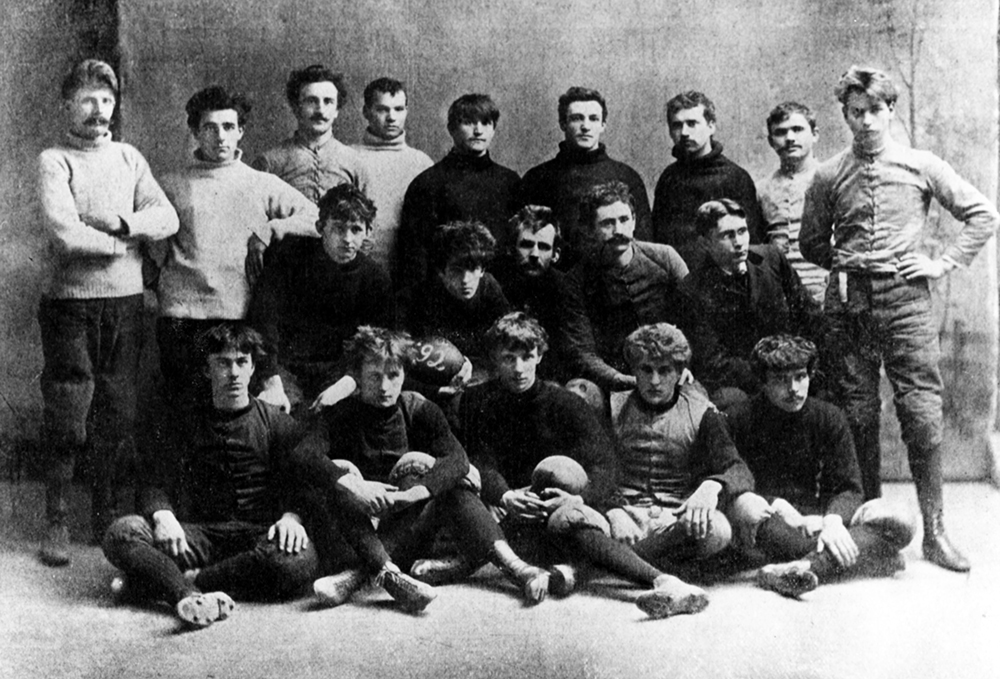
There are no known pictures of Mansfield’s 1892 football team, but this photo of the 1891 team includes many of the players who were present at the night game.
Mansfield University Archives
“They had four lights coming off the pole, which they had put right smack dab in the middle of the field, which came into play on several occasions during the course of the game,” said retired Mansfield sports information director Steve McCloskey, the foremost authority on the historic Wyoming–Mansfield showdown and member of a committee dedicated to saving and restoring the gatehouse through which long-ago fairgoers entered the grounds. “They strung incandescent lights across the grandstand, which gave practically no illumination to the field. So what you had, basically, were those lights in the middle of the field.
No wonder Race, citing the dangerous conditions, took his team off the field at halftime.
Thus, the first meeting between Wyoming — a college preparatory school — and Mansfield — then a two-year “normal” school, or teacher-training college — went into the books as a tie. In a sense, though, Mansfield could at least claim a moral victory. Where the Normals, as they were known, had taken up the game only the year before, Wyoming was an established program, dating to 1884.
What’s more, the Seminary team had finished the 1891 season with a 5-1 record and a reputation as perhaps the premier prep football team in the nation. Wyoming president Levi Sprague went to extremes to keep the program at an elite level, making occasional recruiting trips to nearby mines in search of strapping young lads to augment the Seminary roster. Wyoming became such a formidable foe that other schools in its class dodged the team from Kingston, located in Luzerne County across the Susquehanna River from Wilkes-Barre.
“Our boys have fairly proven themselves superior to all known school teams outside of the colleges,” noted the Opinator, the school’s newspaper. “The Seminary has been able to secure games with college consolidated and freshmen teams, but not with preparatory schools of its own rank.”
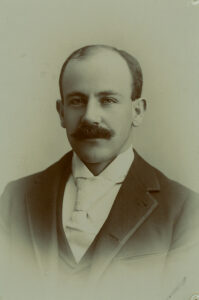
George Thomas McGuire, team captain and quarterback for Mansfield.
Mansfield University Archives
Scheduling an opponent of Wyoming’s caliber seemed a bit of a stretch for the fledgling Mansfield squad, which operated — as did many early college teams — more like a club that represented its school but without official sponsorship. Nor did the Normals have a coach. Team captains back then — Mansfield’s was quarterback George McGuire — functioned as de facto coaches, responsible for running practices, devising strategy, and calling plays.
Samuel Edward Sprole, an 1882 graduate of Syracuse University, served as the Normals’ manager, essentially a business manager and program organizer. Sprole would later work as a crayon manufacturer in Syracuse before transitioning to a no doubt less colorful occupation, government tax collector. He was a first-year professor at Mansfield in 1892.
Curiously, Sprole had no football background whatsoever. But one of the first meetings he attended at Mansfield was for the Young Men’s Athletic Association, which oversaw the baseball and football teams. Eager to quickly fit in at the school, Sprole volunteered to act as football manager.
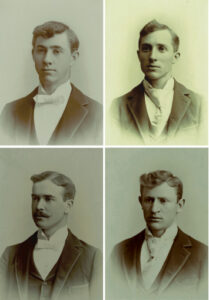
Several of Mansfield’s players who appeared at the night game went on to play football at Pennsylvania colleges including, top, left to right, brothers James and Albert Dunmore, who went to Penn State, and, bottom, left to right, Morton Jones and George Walbridge, who played for Lafayette.
Mansfield University Archives
Although the Normals were regarded as underdogs against Wyoming, they did feature a number of accomplished players, several of whom would later excel at major eastern schools. James and J.A. “Albert” Dunsmore, for example, continued their careers at Penn State, with James serving as the Nittany Lions’ captain in 1896. Morton Jones and speedy halfback George Walbridge would distinguish themselves at Lafayette, with the latter named to the prestigious Walter Camp All-America team in 1897.
The Normals, in addition to their obvious football prowess, were adept promoters. Searching for a way to draw attention to their season-opening game with Wyoming, they struck upon the idea of playing in conjunction with the fair and its new-fangled lights.
“You had a group of guys that got together and formed a football club the year before,” McCloskey said. “Very few people in this area had heard about the sport of football, and they were trying to make it a more popular event. They wanted to show off this new club they had. And the biggest thing around here was the Mansfield Fair, which proportionately was huge.”
Indeed, excursion trains jammed with fairgoers arrived daily from Williamsport, Scranton and Wilkes-Barre, as well as the New York cities of Elmira and Corning. The Mansfield Advertiser extolled the fair as one of the finest anywhere, and the throngs that attended validated that boast. On its busiest days, as many as 20,000 visitors packed the grounds.
“Ever on the alert regardless of expense for something new and novel in the way of special attractions and thoroughly alive to the best interests of its thousands of patrons the Mansfield Fair has justly come to be regarded as a leader among county agricultural, mechanical and industrial exhibitions,” noted the Advertiser. “Go where you will, north, south, east or west, its counterpart is nowhere to be found.”
Crowds flocked to the fairgrounds, drawn by agricultural and livestock exhibits, vaudeville acts, acrobats, highwire daredevils, performing bears, and death-defying parachute jumps from hot-air balloons — and, in 1892, electric lights.
The General Electric Co., formed earlier that year from the merger of the Edison Electric Light Co. and several other firms, created something of a stir throughout Tioga County by announcing it would showcase electric lighting at the fair.
“You can only imagine how marvelous this would be to people of that generation — the electric light was coming into their life,” McCloskey said. “They had heard about it, they had read about it. It was the buzz of all buzzes. They were really excited. And the fair used it as a promotional aspect — they were bringing in a generator and GE was providing lights to show rural folks what the future really looked like.”
Many had never seen electric lights. Nearly as many had never seen a game of football. The sport, as played in 1892, would be virtually unrecognizable to modern fans. Because legalization of the forward pass was still 14 years in the future, teams relied on the bone-crunching flying wedge, a devastating weapon in which the offensive players formed a “V” and drove upfield en masse, the ball carrier ensconced within a protective pocket.
The most effective means of neutralizing such an attack was to break through the wall of humanity, a feat that required either extraordinary strength or a few well-aimed blows with a clenched fist. Boxers and wrestlers were consequently prized additions to any roster. The odds against emerging unscathed from such a brutal activity were long, especially since the participants disdained any sort of padding short of growing their hair long.
The hazards of an already dangerous game were amplified by the midfield light pole and a playing surface pocked with holes and strewn with pebbles, butternuts, and what some accounts politely termed “animal residue.”
In this photo of Wyoming Seminary’s 1892 team, Thomas C. Jones appears in the front row, second from the left, and J. Gere Jayne is on Jones’ right. Jones and Jayne managed to move the ball 35 yards before the night game was called to an end.
Wyoming Seminary
The Normals deftly negotiated this veritable minefield on their first possession, marching almost to the Wyoming goal line before surrendering the ball on downs. The Seminary squad climbed out of the hole as Thomas C. Jones raced 25 yards and J. Gere Jayne followed with a 10-yard gain, but neither team threatened again until the final minutes of the half, when the visitors drove to the Mansfield 20 before stalling. When time ran out, Race decided it was imprudent to continue.
“The game was called at the end of the first half, as it was considered dangerous to play in such a feeble light and on such rough ground,” noted the Opinator account. “The boys all report fine treatment at Mansfield and a jolly good time.”
That last phrase likely elicited howls of protest from the Wyoming players, who considered it the 19th-century equivalent of fake news.
“As the scoreless half dragged on, bitterness built up between the squads, and the inadequate lighting was just one of the problems,” Heaps wrote. “The team from Kingston accused the Normals of using ineligible players, and the officiating was controversial.”
Race shared officiating duties that night with Dwight Smith, a Mansfield student who had suited up for the school’s 1891 team before an injury ended his playing career. Race was convinced Smith was favoring the Normals, judging by the tone of a letter he later sent the Advertiser, directed to Sprole. It read, in part: “Since you claim that your team won that farcical exhibition of foot ball given at Mansfield last Wednesday evening, I hereby challenge your foot ball team to meet the Wyoming Seminary team at West Side Park, Wilkes-Barre, Pa., Oct. 15, 1892, or on any other date prior that you may suggest. The referee and umpire to be competent men who have never had any connection with either school, and every member of each team to be a bona fide student of the school represented by such team.”
But no rematch took place that fall. The teams had to be content with their tie — and with securing a place in history as participants in football’s first night game.
Bob Fulton has written hundreds of magazine articles and five books, including Pirates Treasures: Facts, Feats, Firsts in Pittsburgh Pirates History. He resides in Indiana, Pennsylvania.