
Historic County Prisons in Pennsylvania
Written by Pamela Reilly in the Wish You Were Here category and the Fall 2024 issue Topics in this article: Addison Hutton, architecture and architects, Berks County, Bucks County, Eastern State Penitentiary, historic preservation, jails, James A. Michener Art Museum, John Haviland, Lancaster County, Molly Maguires, Montgomery County, Napoleon LeBrun, National Register of Historic Places, Norristown, postcards, prisons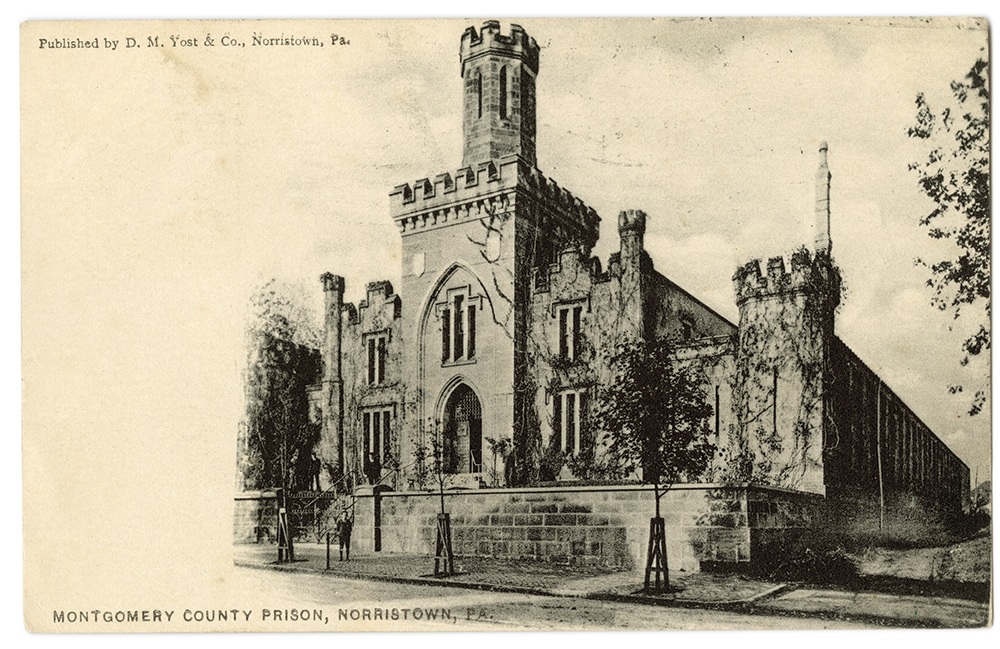
Montgomery County Prison, Norristown.
Pennsylvania State Archives, MG-213
This 1906 postcard shows the castle-like Montgomery County Prison in Norristown. It has stood guard over the city since it was first built on Airy Street in 1851. The building was designed by notable Philadelphia architect Napoleon LeBrun (1821–1901), who was also responsible for the 1852 Schuylkill County Prison and numerous churches, courthouses and other important public buildings.
LeBrun was influenced by English architect John Haviland (1792–1852), whose radial design for the Eastern State Penitentiary, built in 1823 in Philadelphia, was a groundbreaking innovation that drew international attention. Haviland took inspiration from buildings in England and Ireland to create fortress-style prisons that conveyed a sense of timeless governmental authority and strength and were intended to not only imprison but also reform prisoners through solitary confinement.
Haviland designed other castle-like prisons with crenelated parapets, Gothic arches and multiple towers, including the Dauphin County Prison (1841), the Berks County Prison (1848) and the Lancaster County Prison (1848). Similar castellated prisons were built throughout the state in the late 1800s, including several designed by Haviland’s son Edward (1823–1872): the Cumberland County Prison (1854), the Blair County Prison (1869), the Cambria County Prison (1870) and the Carbon County Prison (1870).
Historic postcards demonstrate that these public buildings were seen as local landmarks, set apart by their impressive architecture and role in the community. While many of these iconic prisons have not survived into the 21st century, others remain, either serving their original function or repurposed for other public uses.
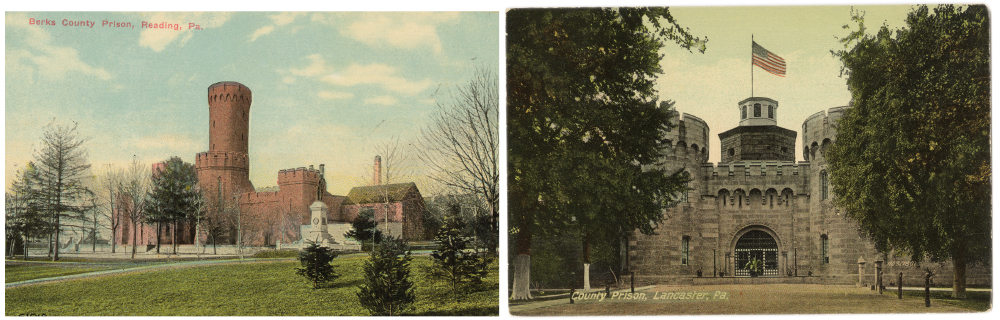
Berks County Prison, Reading, and Lancaster County Prison, Lancaster.
Pennsylvania State Archives, MG-213
Much like the European medieval castles they resemble, these monumental stone buildings offer both preservation challenges and benefits. The 1884 Bucks County Jail, designed by architect Addison Hutton (1834–1916), now serves as the James Michener Art Museum in Doylestown. While admired for their distinctive design, these historic prisons, because of their very function, have borne witness to tragic and unsettling events. The execution of 20 alleged members of the Molly Maguires, a secret society of Irish American labor activists in the anthracite coal fields, occurred at the Carbon County and Schuylkill County prisons in 1877, the Columbia County Prison in 1878, and the Northumberland County Prison in 1879. Preservation of these buildings allows the interpretation of difficult, yet important, elements of history.
Often designed by the top architects of their era, many historic prisons have been listed in or determined eligible for the National Register of Historic Places for both their architectural and historic significance.
Pamela W. Reilly has served as a historic preservation specialist in the Pennsylvania State Historic
Preservation Office.