
German Founders: The Muhlenberg Family and the War for Independence
Written by Lisa Minardi in the Features category and the Spring 2026 issue Topics in this article: American Revolution, Anna Maria Weiser Muhlenberg, Christopher Ludwick, Common Sense, Declaration of Independence, Frederick A. C. Muhlenberg, Henry M. Muhlenberg, John Peter Gabriel Muhlenberg, Pennsylvania Dutch (Pennsylvania German), Trappe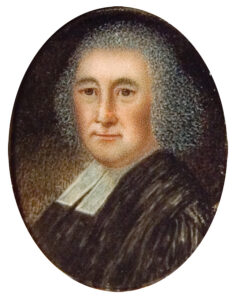
As war became imminent in 1776, Lutheran pastor Henry Melchior Muhlenberg, here in a circa 1780 portrait miniature, left Philadelphia with his family and resettled in Trappe, where he originally began his ministry three decades earlier.
Collection of a descendant
On July 2, 1776, Philadelphians were living on a razor’s edge. At the State House, the Continental Congress gathered to decide the colonists’ collective fate. Lutheran pastor Henry Muhlenberg (1711–87) recorded in his diary, “It is said that the Continental Congress resolved to declare the thirteen united colonies free and independent.”
Two days later, on July 4, he wrote, “Today the Continental Congress openly declared the united provinces of North America to be free and independent states.” On July 8, Muhlenberg joined a crowd gathered in front of the State House to hear the first public reading of the Declaration of Independence. He then fled the city, realizing that war was imminent and Philadelphia would be a major target.
On July 11, Henry Muhlenberg, his wife Mary, and their youngest daughter Sally moved about 25 miles northwest to the village of Trappe, in what is now Montgomery County. It was a homecoming of sorts, as Trappe was where Henry began his ministry after emigrating from Germany in 1742. After marrying Anna Maria “Mary” Weiser, daughter of Conrad Weiser, in 1745, the couple made Trappe their home until 1760 when they moved to Philadelphia. Now back in Trappe, they rode out the war and offered a place of refuge to family and friends. The war brought indelible change to both Philadelphia and the surrounding Pennsylvania countryside. Lives were lost, families uprooted, houses and churches destroyed. Through it all, the Muhlenberg family took an active role in both the American Revolution and the founding of the United States.
Henry Muhlenberg’s journals chronicle the rising tensions in Philadelphia well before the Declaration. By November 1775, he began thinking about seeking refuge away from the city. His son Frederick Muhlenberg (1750–1801), then living in New York where he served as pastor, also contemplated a move to the countryside. Henry lamented that he no longer had his farm in Trappe but found another property for sale there and promptly bought it. In June 1776, the family sent a wagonload of furniture up to their new house in Trappe, including a bed for Henry’s wife and a large chest filled with his manuscripts.
On July 2, Frederick arrived from New York with as many household goods as he could transport. Meanwhile, news spread throughout Philadelphia about the imminent Declaration. When independence was finally declared, the city’s printshops sprang into action, and on Friday, July 5, German printer Heinrich Miller’s twice-weekly newspaper Pennsylvanischer Staatsbote carried the announcement, making it the first in any language to break the news in print. Meanwhile Miller’s former apprentices, Melchior Steiner and Carl Cist, produced a complete German translation of the Declaration, which they issued as a broadside sometime between July 6 and 8.
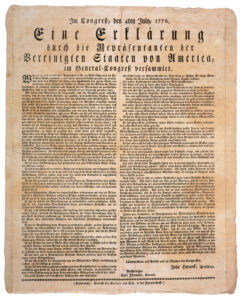
Eine Erklärung durch die Repräsentanten der Vereinigten Staaten von America, a German translation of the Declaration of Independence, was printed as a broadside in Philadelphia by Melchior Steiner and Carl Cist in 1776.
Deutsches Historisches Museum, Berlin
Most Pennsylvania Germans ultimately supported the American Revolution, but a sizeable number did so reluctantly or not at all. Many German immigrants were initially loathe to break the oaths of allegiance to the British crown that they were required to take when they arrived in Philadelphia. Others feared for their liberty and property rights should the Americans lose. Sectarian groups such as the Amish, Mennonites and Schwenkfelders were opposed to the war on religious grounds and were often fined, jailed or otherwise mistreated for their refusal to fight, pay war taxes, or take the oath of allegiance to the new government.
Some Pennsylvania Germans served as members of a “German Regiment” that was authorized by the Continental Congress on May 25, 1776, via a resolution “that one battalion of Germans be raised for the service of the United Colonies.” On June 27, the Congress clarified its order and resolved that “four companies of Germans be raised in Pennsylvania, and four companies in Maryland, to compose the German Battalion.” This German Regiment, the first ethnically specific U.S. military unit, was also one of the first in the Continental Army to serve for three years. Most of the Pennsylvania enlistees were from the city or county of Philadelphia. The German Regiment participated in significant action throughout 1776 and 1777, including the Christmas Day crossing of the Delaware River and battles of Trenton, Brandywine and Germantown as well as the winter 1777–78 encampment at Valley Forge. It was disbanded on January 1, 1781.
Many German-speakers also made enormous personal contributions to the war effort. One of Philadelphia’s staunchest patriots was Christopher Ludwick (1720–1801), who immigrated to Pennsylvania in 1754 and established a bakery and confectionary shop in the city. He later served in the United Company of Philadelphia for Promoting American Manufacturers, the Philadelphia Committee of Correspondence and, ultimately, the Continental Army as superintendent of bakers. After the bloody siege of Yorktown in 1781, he supplied more than 6,000 pounds of bread to the men of both armies — supposedly baked in a single day. A carved wooden mold owned by Ludwig reveals that he also continued the Germanic tradition of making a hard, pressed type of gingerbread; it has traditional motifs with a vase of flowers on one side and a woman in fancy dress on the other. Ludwick’s gravestone, at St. Michael’s Lutheran Church in Germantown, extolls him as “devoted to the service to his adopted country in the contest for the Independence of America.”
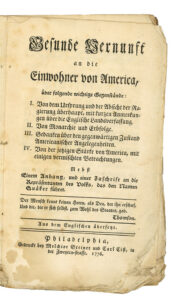
This German translation of Common Sense was printed in Philadelphia by Melchior Steiner and Carl Cist in March 1776.
American Philosophical Society
As a pastor, Henry Muhlenberg felt that he should remain politically neutral and “retain the liberty of praying for all men.” His position was derived from Article 28 of the Augsburg Confession, which prohibited ministers from interfering with the affairs of civilian government. This approach was modeled repeatedly by Muhlenberg, who did his best to refrain from publicly choosing sides throughout the war despite his sons’ growing involvement. Henry seems to have quietly held personal opinions that favored the war. In March of 1776, after reading a German translation of Thomas Paine’s Common Sense, he wrote to his son-in-law and fellow pastor, Emanuel Schultze, saying that “the young people are right in fighting for their God-given native liberty.”
First printed in English in Philadelphia and released on January 10, 1776, Paine’s incendiary pamphlet advocating for independence was translated into German within two months and published by Philadelphians Melchior Steiner and Carl Cist under the title Gesunde Vernunft or “Healthy Reason.” Henry also paid close attention to the war’s events; his journals contain details such as casualty numbers, battlefield outcomes, and transcriptions of speeches about the conflict. He frequently commented on atrocities suffered by the Continental Army at the hands of the British.
Muhlenberg’s public neutrality was severely put to the test by two of his sons. His eldest son, Peter Muhlenberg (1746–1807), had few if any qualms about mixing politics and religion. While serving as a Lutheran minister in Woodstock, Virginia, Peter became increasingly involved in various committees of correspondence and then went as a delegate to the Viriginia Convention held in August of 1774. On January 12, 1776, he accepted a commission as a colonel of the 8th Virginia Regiment and began raising troops among the Germans in the Shenandoah Valley. The regiment’s flag was lovingly preserved by his descendants; now faded, it was originally a salmon-colored silk.
According to popular legend, Peter Muhlenberg delivered a rousing farewell sermon to his Woodstock congregation on January 21, based on Ecclesiastes 3: 1–8, “to every thing there is a season, and a time to every purpose under the heaven.” In the most colorful versions of this story, after exhorting his congregation that “there is a time for all things — a time to preach and a time to fight, and now is the time to fight!” Peter threw off his clerical robe to reveal his military uniform underneath and promptly began mustering volunteers. An 18th-century clerical robe, which was preserved by generations of the Henkel family of Virginia, is said to be the robe worn by Muhlenberg on that fateful day.
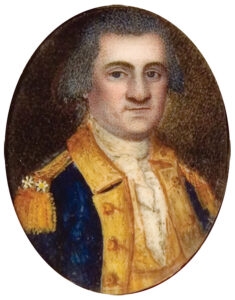
Lutheran minister Peter Muhlenberg in a circa 1780 portrait miniature.
Collection of a descendant
Such a radical act by a minister would have been shocking, yet no contemporary accounts survive to document exactly what transpired during Peter’s final sermon. Word of Peter’s enlistment reached his family back in Philadelphia by early March of 1776. The news prompted a heated exchange between Peter and Frederick, who disagreed with his brother’s decision to leave the ministry and become a soldier. After Peter accused Frederick of being a Tory, Frederick defended himself, making it clear that he supported the Revolution even though he remained a pastor: “I have always been as steadfast as you in our American cause . . . although I am not a colonel and do not take the field.”
Peter Muhlenberg served valiantly during the war and was promoted to brigadier general in 1777. During the Battle of Germantown in October 1777, a pair of brass-barreled pistols were stolen from the holsters when he briefly fell asleep due to exhaustion. He later advertised a reward for their return and recovered them.
Peter endured the winter of 1777–78 at Valley Forge, where the reconstructed log huts seen today are on the site of his brigade’s encampment. He played a key role in supporting Anthony Wayne’s assault at the Battle of Stony Point and then was sent to Virginia to raise another army for a southern campaign. In 1781 he commanded the brigade that took Redoubt 10 from Cornwallis in the siege at Yorktown. Peter was promoted to major general on September 30, 1783, and retired from the army shortly thereafter.
That same year, Peter was elected to the Supreme Executive Council of Pennsylvania and served as vice president under Benjamin Franklin through 1788. In 1787 he purchased the Trappe home of his elderly parents and moved in with his wife and children. Although Peter ceased to serve in the military after the war, it remained a strong part of his identity, and he chose to be shown in uniform once again about 1795 when his portrait was painted by John Trumbull.
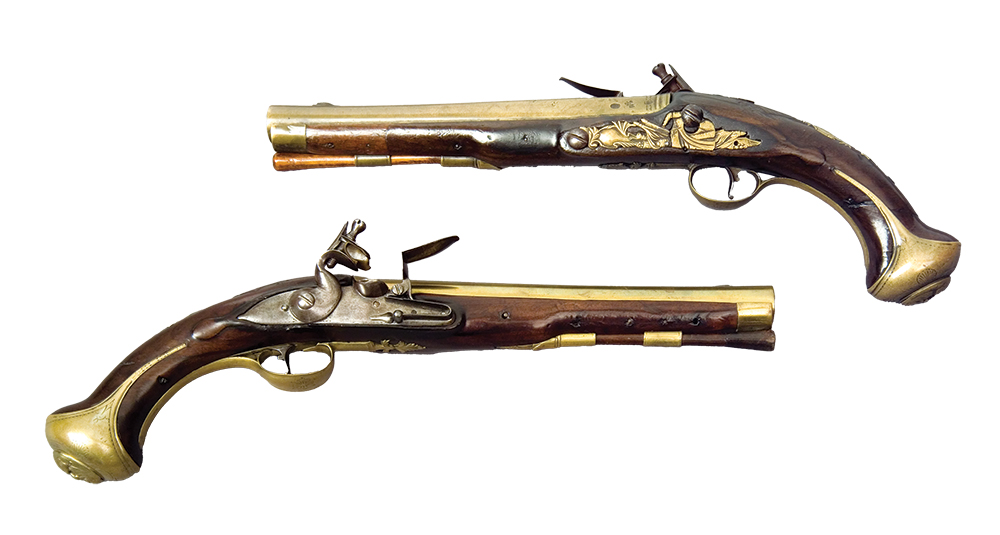
During his service in the Revolutionary War, Peter Muhlenberg carried these pistols, made in England, 1770–75.
Museum of the American Revolution
By 1779 Frederick Muhlenberg also left the ministry, but to enter politics rather than the military. Unable to find a regular call as a minister after fleeing New York and moving back to Pennsylvania in 1776, Frederick struggled to make ends meet and considered becoming a merchant. A different opportunity arose when his name was put forth as a candidate to fill a vacancy in the Continental Congress due to his fluency in both English and German. Frederick was elected on March 4 and promptly moved with his family to Philadelphia to take up office, after which he no longer served as an active minister. The next year, he was elected a member of the Pennsylvania Assembly and served as speaker through 1783. In 1784, he was elected the first president judge, register of wills and recorder of deeds for the newly formed Montgomery County. Three years later, Frederick was president of Pennsylvania’s convention to ratify the Constitution.
On November 26, 1788, Frederick and Peter were elected to the United States House of Representatives. They traveled to New York in March 1789 and waited for enough delegates to form a quorum. Frederick wrote to his friend Dr. Benjamin Rush in Philadelphia that his name was being suggested as speaker and indeed, on April 4, Frederick was elected by a vote of 23–7. The Pennsylvania Packet announced his election and referred to him as the “German gentleman” while the German-language Philadelphische Correspondenz proclaimed that “the blood of the grandchildren of our grandchildren will proudly well up in their hearts when they will read in the histories of America that the first Speaker . . . was a German, born of German parents in Pennsylvania.”
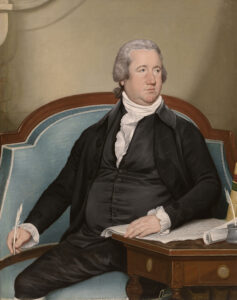
Frederick Muhlenberg was serving as the first speaker of the U.S. House Representatives when his portrait was painted by Joseph Wright in 1790.
National Portrait Gallery, Smithsonian Institution
Frederick and Peter filled their free time in New York with a whirlwind of social activities, including dinners with President Washington, afternoon teas, and travels about the city in Frederick’s carriage. As speaker, Frederick hosted a weekly gathering of the Pennsylvania delegation. William Maclay (1737– 1804), a senator from Pennsylvania, complained about these meals as affairs of excessive drinking, smoking and base conversation. In July 1789, Maclay wrote, “I had been pressed to dine with the Speaker in a Company of Pennsylvanians . . . I came away quite tired of the volatile Tattle of the Table.”
In July 1790, Frederick had his portrait painted by Joseph Wright. The painting shows Frederick in the act of signing House Bill no. 65, An Act to Regulate Trade and Intercourse with the Indian Tribes. As speaker, Frederick was also the first signer of the Bill of Rights. He served in the next three congresses and was speaker again during the Third Congress. During the Fourth Congress, there was heated debate over the Jay Treaty, negotiated by Chief Justice John Jay to avoid renewed conflict with England. The treaty was wildly unpopular with many Americans, but the new nation could scarcely afford another war so soon. After ratification by the Senate, the treaty went to the House, which dissolved into a committee of the whole and selected Frederick Muhlenberg as chairman. The committee’s vote was divided evenly, 49 for and 49 against, leaving Frederick to cast the tie-breaking vote. He opted in favor of the treaty, an action that ended his political career and nearly his life when he was stabbed by his own brother-in-law, Bernhard Schaeffer.
Frederick survived but was not re-elected. On January 8, 1800, he was appointed by Gov. Thomas McKean as receiver general of the Land Office. He moved with his family to Lancaster as it was then the state capital. On June 4, 1801, Frederick died of a stroke at the age of 51. Writing to President Thomas Jefferson, future U.S. Secretary of the Treasury William Duane commented that his death “produced a change in the political prospects in this state. . . . There is no other character among the Germans of talents and standing equal to the deceased.” This sentiment was echoed years later by President Franklin Delano Roosevelt. In 1942, on the bicentennial of Henry Melchior Muhlenberg’s arrival in Pennsylvania, FDR proclaimed, “Clergymen, soldiers, scholars, and statesmen, the Muhlenbergs have represented the best in our national life since the earliest days of the Republic.”
Sidebar: Celebrating America’s 250th in Trappe
To commemorate America’s 250th anniversary, Historic Trappe is debuting three major new initiatives this spring. Each project offers a distinct lens on the Revolutionary era. Founded in 1717, Trappe is located just 7 miles from Valley Forge and 25 miles from Philadelphia. It is also home to five historic sites connected directly to the American Revolution and the site of a Continental Army encampment in late September 1777, between the battles of Brandywine and Germantown. Historic Trappe will also host numerous living history events, lecture series, hands-on workshops led by expert artisans, and much more. On July 4, 2026, there will be a special reading of the Declaration of Independence from the balcony of the Muhlenberg House. Visit HistoricTrappe.org to learn more about upcoming events and museum hours.
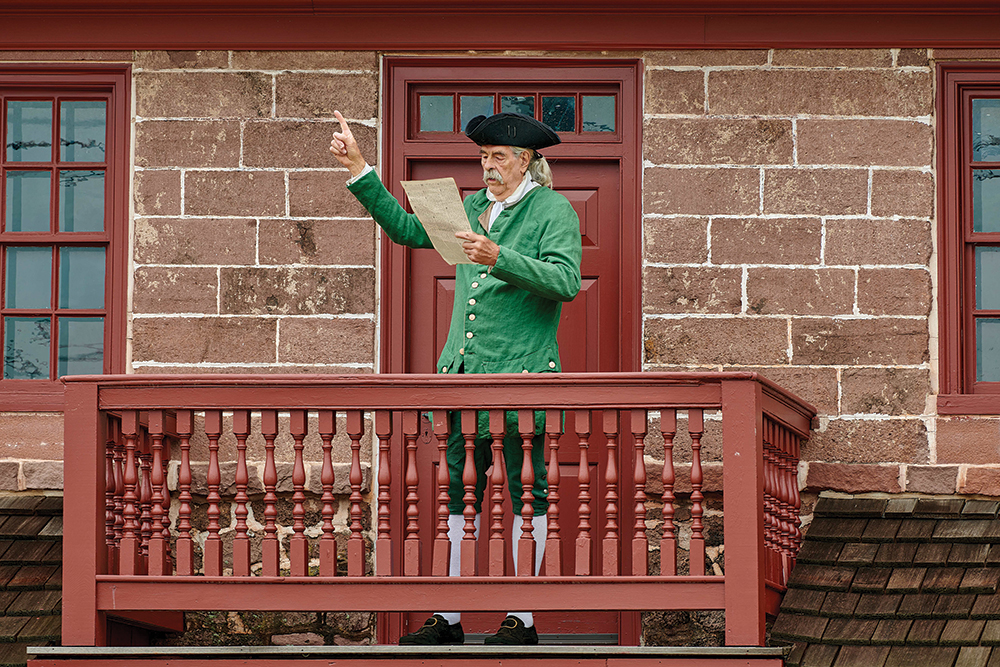
Volunteer Jim Reynolds reads the Declaration of Independence from the balcony of the Muhlenberg House.
Historic Trappe / Photo, Dave Holsten

Lead-glazed earthenware plate, attributed to Johannes Neis of Montgomery County, Pennsylvania, 1795.
Collection of Susan and Steve Babinsky / Photo, Gavin Ashworth
Window to Revolution: Pennsylvania Germans and the War for Independence is a landmark exhibition that explores the contributions of first- and second-generation German immigrants during the Revolutionary War. The exhibit will be presented at the Center for Pennsylvania German Studies, located in the Dewees Tavern. Highlights include Henry Muhlenberg’s original journals and various documents printed in German, family bibles, firearms, fraktur, furniture, and other domestic artifacts made by Pennsylvania German craftspeople. A key artifact is a redware plate made by potter Johannes Neis, who decorated it with a portrait of Washington in uniform, leaning on a cannon, basing the composition on Charles Willson Peale’s 1779 portrait of George Washington at the Battle of Princeton. Commissioned by the Supreme Executive Council of Pennsylvania for its council chamber at the State House (Independence Hall), the Peale portrait was wildly popular, with copies in demand before Peale even finished the original.
• Refugees in the Parlor is an innovative reinterpretation of the Muhlenberg House that explores how wartime upheaval transformed life on the home front. A combination of original and reproduction pieces will convey the crowded conditions that defined the Muhlenberg House during the 1777–78 British occupation of Philadelphia, when up to 32 family members sought refuge there in Trappe. The refreshed display includes furniture draped in linen sheets for safekeeping, storage trunks packed with clothing and other goods, and numerous beds to accommodate the influx of refugees. The kitchen will feature reproduction cookware and implements suited to feeding a large wartime household; visitors will learn how luxury items such as sugar, tea and coffee were nearly impossible to obtain without access to Philadelphia. Crates, barrels and other containers will also be added to the cellar to convey its takeover by the Continental Army for storage
The Muhlenberg House, built circa 1750–55.
Historic Trappe / Photo, Gavin Ashworth
• The Speaker’s House, home of Frederick Muhlenberg and his family from 1781 to 1801, will have its grand opening to the public in April 2026 following a comprehensive 25-year restoration. Rescued from demolition in 2001, the Speaker’s House restoration was an enormous undertaking supported by an extraordinary grassroots effort to restore this landmark to its original grandeur. Here, visitors can learn about the political legacy of Frederick Muhlenberg and his contributions to early American governance in a restored, nationally significant setting. Open hearth cooking demonstrations, hands-on programming such as the popular Kids Dig History! series, and living history programs are also offered regularly.
Lisa Minardi is executive director of Historic Trappe and a noted scholar of Pennsylvania history and material culture. She has produced numerous exhibitions, books and articles on Pennsylvania German art and culture, including Pastors & Patriots: The Muhlenberg Family of Pennsylvania and A Colorful Folk: Pennsylvania Germans & the Art of Everyday Life. She also serves as editor of Americana Insights, an annual volume series on traditional Americana and folk art, and as director of the Lutheran Archives Center at Philadelphia.