
Erie Maritime Museum at 25
Written by Amy Fox in the Trailheads category and the Spring 2023 issue Topics in this article: Battle of Lake Erie, Erie Maritime Museum, historic preservation, Pennsylvania Electric Co. (Penelec), Pennsylvania Trails of History, U.S. Brig NiagaraWhat do Google, Disney’s Mulan, and the Erie Maritime Museum have in common? They all debuted in 1998. June 12, 2023, marks the 25th anniversary of the day that Gov. Tom Ridge formally dedicated the building. The ribbon-cutting ceremony was the culmination of a series of living history demonstrations, lectures and musical performances that began on May 21, welcoming visitors to the first new PHMC museum in more than 20 years.
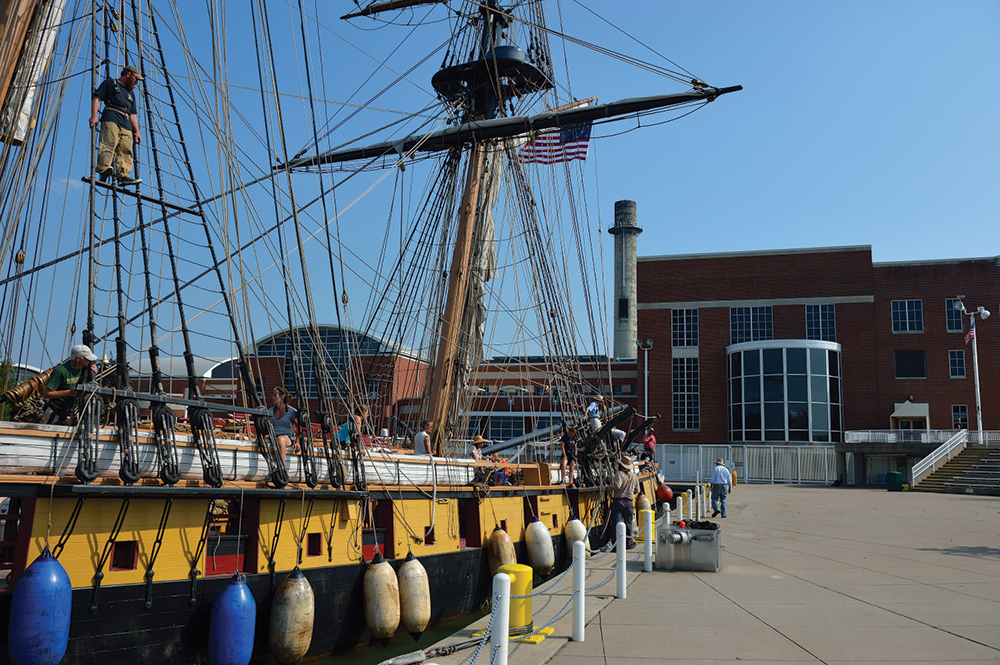
U.S. Brig Niagara docked at Erie Maritime Museum. The curved section of windows on the museum are an observation deck that allows museum visitors to view the ship in all types of weather.
Photo, Pennsylvania Historical & Museum Commission
Something Old, Something New
The Erie Maritime Museum is an example of what historic preservationists call “adaptive reuse.” The core of the museum was once a Pennsylvania Electric Co. (Penelec) steam generating plant, in operation from 1917 to 1991. New construction, designed by the firm Weber Murphy Fox, included a shared lobby with the adjacent Raymond M. Blasco Memorial Library (a new branch of the Erie County Public Library), an auditorium, and an indoor observation deck with floor-to-ceiling windows looking out at the reconstructed U.S. Brig Niagara when in port. Museum visitors can exit onto the ship’s plaza for a closer look. The plaza is also used for the annual remembrance ceremony for the Battle of Lake Erie, fought on September 10, 1813.
Remnants of the building’s original use include a steam turbine generator on the main exhibit floor (one of five once found in the building) and a 50-ton Cleveland Crane attached to the ceiling. The crane has been used on occasion to move cannon and other heavy artifacts that are on display in the galleries. The generator was refurbished in 2014 and the crane in 2015; museum volunteer and retired General Electric design engineer Rich Hall led the work, calling on former colleagues and other volunteers as part of the team. Museum staffer Linda Bolla wrote two guest posts for the weekly Trailheads blog with photos of the work in progress (“Generating History at the Erie Maritime Museum,” April 4, 2014, and “Brushing Up on Industrial History,” February 20, 2015.) The unobstructed interior space of the building allowed for some creative exhibiting in a relatively small footprint. A mast with full-size rigging helps visitors get a sense of the size of Niagara and similar ships without leaving the building or when the ship is away from port. The mock-up also supports hands-on activities for visitors as well as preliminary sail training for new crew members who need to “learn the ropes” before climbing into the rigging onboard ship.
When the museum opened, the second-floor mezzanine featured the prow of the USS Wolverine (originally USS Michigan), the U.S. Navy’s first ironhulled ship, and a series of banners representing the British and American ships involved in the Battle of Lake Erie. Later an exhibit on USS Michigan/Wolverine was installed to tell the story of its relationship to Erie.
“We Have Met the Enemy”
In addition to exhibits that place Niagara and the Battle of Lake Erie in the context of the War of 1812 and the burgeoning U.S. Navy, the live-fire exhibit provides a glimpse of the realities of wooden ship warfare in the late 18th and early 19th centuries. Creating this large exhibit piece was a long process that required several years of coordination among PHMC, the Pennsylvania National Guard (PNG), exhibit designer and fabricator Interpretive Solutions, the Flagship Niagara League, and the Army Imaging Center at Aberdeen Proving Ground in Maryland.
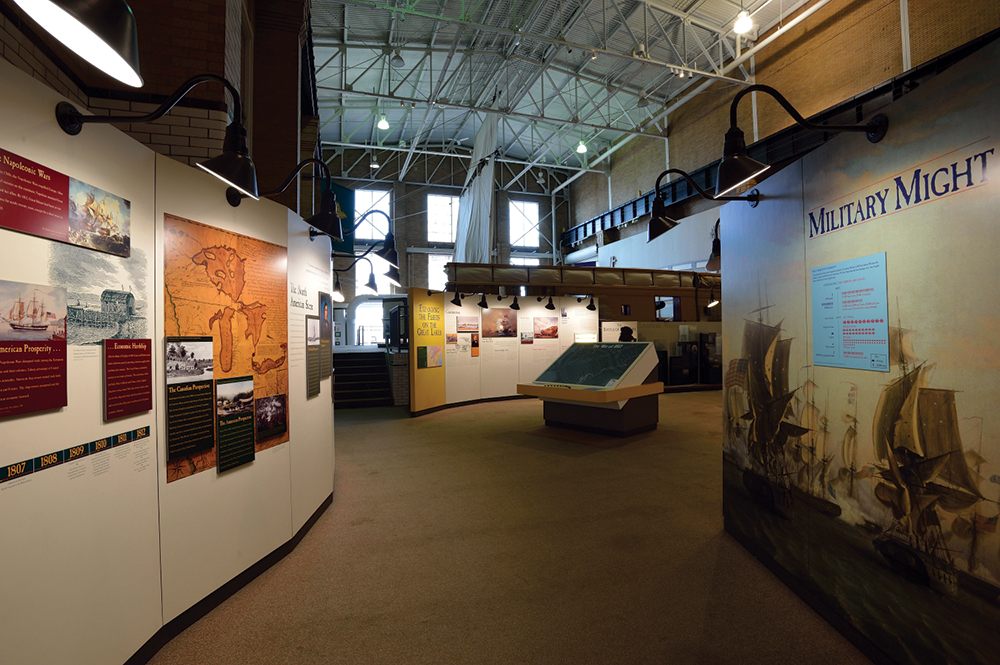
Erie Maritime Museum’s main floor exhibits create context for visitors on the War of 1812 and the origins of the U.S. Navy.
Photo, Pennsylvania Historical & Museum Commission
As PHMC staff members were working through official channels to secure the participation of PNG’s 112th Infantry Division, the Army Imaging Center, and the desired live-fire location at Fort Indiantown Gap in Lebanon County, the exhibit designers worked with a shipyard in Connecticut to produce a 20-foot replica section of U.S. Brig Lawrence, Commodore Oliver Hazard Perry’s original flagship during the Battle of Lake Erie. (He transferred to Niagara when Lawrence took too much enemy fire and achieved his victory over the British from there.) The completed section, built using the specifications for Niagara to be as true to life as possible, was delivered to Erie and then transported by PNG to the Gap a few days before the live-fire event was to take place.
The purpose of the live-fire effort was twofold: to create an exhibit component showing the effects of cannon fire on a wooden-hulled ship and to test the replica cannon that had been produced for the reconstructed U.S. Brig Niagara that would launch the following year. The ship’s gun crew were among those attending the experiment on February 1 and 2, 1998, and they were able to learn a great deal about how their historical counterparts would have needed to aim the cannon.
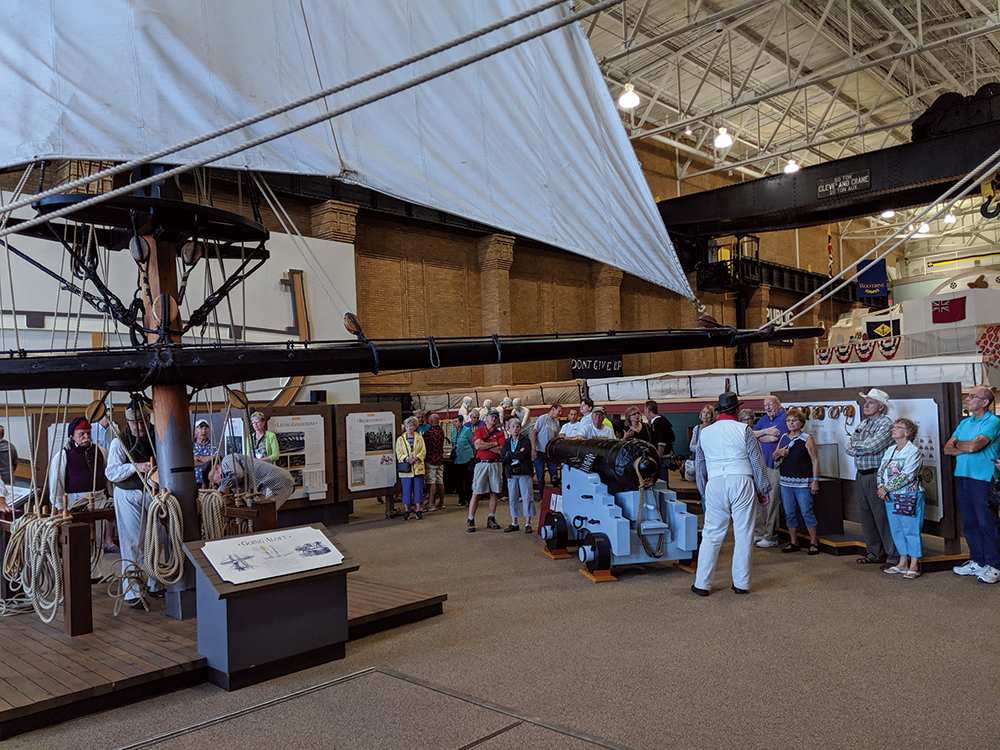
Museum visitors gather near the gun deck exhibit to view a demonstration of sail handling up close.
Photo, Linda Bolla
After some preliminary misses, the gun crew succeeded in hitting the replica and creating the severe splintering that was such a danger to sailors in seabased warfare on wooden ships. In a Harrisburg Patriot-News article, “Cannons take a shot at history,” Steve Snyder quoted Niagara captain Walter Rybka: “‘Historically, splinters could go a long distance,’ said Rybka, who noted that many sailors died from splinters.”
The film crew from Aberdeen Proving Ground captured the live-fire attempts with high-speed cameras, and the footage was edited into a video for museum visitors.
The replica hull was transported back to Erie where a reproduction gun deck and cannon were added. According to Linda Bolla, who worked on many aspects of the exhibit and other projects, first-person reenactors were photographed repeatedly running through the shipboard gun drill to help the exhibit fabricators create accurate mannequins to complete the scene. The reenactors, who included recruits from USS Fahrion, a U.S. Navy ship visiting Erie at the time, also conducted shipboard cannon drills for action sequences in the museum’s orientation film, She Sails.
The Museum Today
Over the past 25 years, the Erie waterfront has continued to develop around the Erie Maritime Museum, a vibrant part of what brings visitors and residents to the water’s edge. Day sails, tall ship festivals, music and art programs, school visits, changing exhibits, and compelling stories of Erie’s naval and environmental history make Erie Maritime Museum a must-see destination. Here’s to the next 25 years!
Amy Killpatrick Fox is a museum educator in PHMC’s Bureau of Historic Sites & Museums. She writes a weekly blog also called Trailheads.