
Commemorating Joseph Priestley’s Discovery of Oxygen
Written by Deborah Bernhisel in the Trailheads category and the Spring 2024 issue Topics in this article: Bowood House, Joseph Priestley, Joseph Priestley House, Northumberland, oxygen, Pennsylvania Trails of History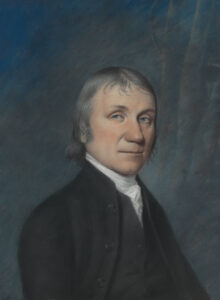
This three-quarter portrait of Joseph Priestley was drawn in pastel on paper by James Sharples ( c.1751-1811) in 1797, three years after Priestley arrived in America.
National Portrait Gallery, Smithsonian Institution
A theologian, educator, political theorist and scientist, Dr. Joseph Priestley (1733–1804) was a man of the Enlightenment. “By the age of 61,” Steven Johnson wrote in The Invention of Air, “Priestley had won the Copley Medal (the Nobel Prize of its day) for his experiments on various gases in his late thirties . . . published close to 500 books and pamphlets on science, politics, and religion . . . [and] helped found the dissenting Christian sect of Unitarianism.” In spite of this extraordinary resume, not to mention his impressive list of friends – Thomas Jefferson, John Adams and Benjamin Franklin among them – it is his discovery of oxygen for which he is best remembered. For that reason, the Joseph Priestley House in Northumberland, where Priestley spent the final decade of his life, is busy preparing for a year of special events commemorating the 250th anniversary of that discovery.
In 1774 Priestley was employed by William Petty, Earl of Shelburne, to maintain his library, educate his two sons, and advise him on topics being debated in Parliament. It was in his laboratory at Bowood House, the Shelburne estate in Calne, Wiltshire, England, on August l, 1774, that Priestley discovered the release of an unidentified gas that caused candle flames to burn brighter. Puzzled by a gas that behaved like nitrous air but was released by mercury calx, which did not produce nitrous air, Priestley continued his experiments, eventually identifying the gas as a more rarified version of common air, which he named “dephlogisticated air.”
That discovery, which he willingly shared with others, was not the result of a new experiment but rather, as Priestley described it, “the observation of events arising from unknown causes.” The only difference between his 1774 experiment and one he had performed in 1771 was the addition of an ordinary candle, that and his ability at the later date to observe that something “momentous” was taking place, something he was, at that point, unable to define.
An Event-Filled Year On and Off the Museum Grounds
Although Priestley’s residence in Northumberland did not begin until 1794, 20 years after his discovery of oxygen, his decade-long residence in the borough and nearly a century of Priestley descendants in the community have had an impact. Special Event Days at the Joseph Priestley House on Priestley Avenue continue to honor that legacy: Twelfth Night in January, Dr. Priestley’s Birthday in March, and Oxygen Day in August have long been annual events at the museum. More recent annual events include the Cemetery Tour (2021), the Herb and Native Plant Faire (2023), and Music on the Lawn from May to August (2022). These special events are coupled with teaching events throughout the year: Earth Day in April, History Camp in June, our museum presence during Northumberland’s Pineknotter Days during Fourth of July week, and an event for Scouts in September.
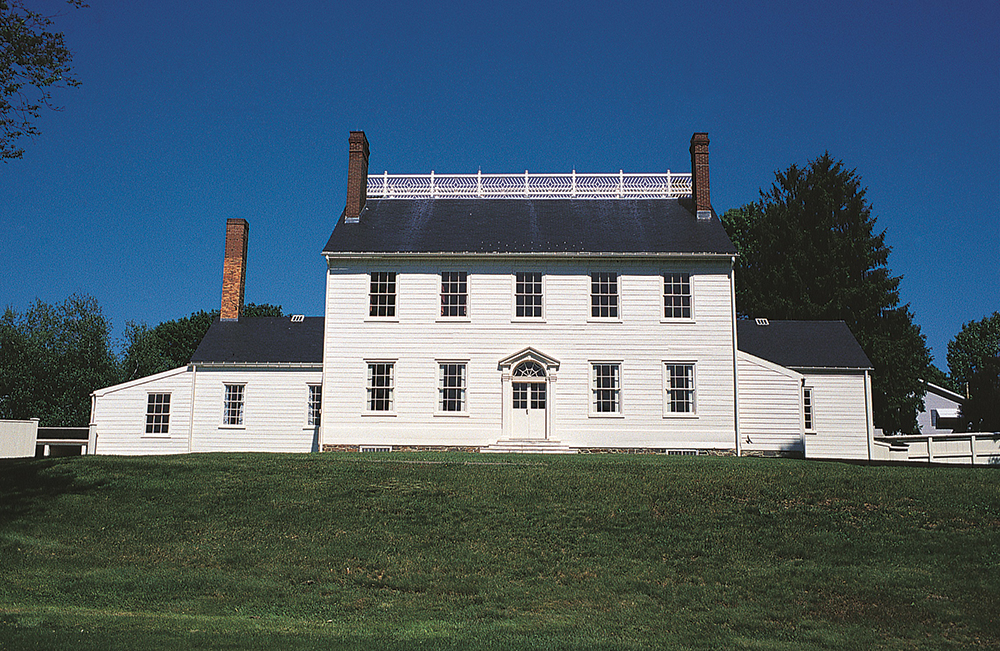
Joseph Priestley House in Northumberland.
Photo, Pennsylvania Historical & Museum Commission
With 2024 marking the 250th anniversary of the discovery of oxygen, the Friends of Joseph Priestley House Board added Afternoon Tea, hosted by Mary and Joseph Priestley, in February; a 16-day, England-based Priestley Tour (July 18–August 2); the Priestley Symposium at Bucknell University; and the 250th Anniversary of the Discovery of Oxygen Grand Gala Weekend, in place of the museum’s annual Oxygen Day, to emphasize this momentous moment in Priestley’s history.
The Birth of the Priestley Pilsner
In addition to the museum-sponsored events, two Northumberland businesses are collaborating in the creation of a limited-edition specialty beer, the Priestley Pilsner, a nod to the importance of the Priestley family to Northumberland. The brainchild of a collaboration between Craig Specht of W&S Beer Distributors and Derek Fisher of Pineknotter Brewing Company, the Priestley Pilsner is scheduled to debut in midsummer.
Creating a pilsner in honor of Priestley seems particularly appropriate for a celebration of Priestley the scientist, because he conducted some of his early “fixed air” experiments over the vats in a brewery near his home in Leeds. Of course, the result of that experimentation was the discovery of carbonization and the creation of seltzer water, not a limited-edition specialty pilsner.
Priestley Across the Pond
Incorporating a visit to England into the 2024 celebration of Priestley’s discovery of oxygen also seemed important, particularly since Priestley’s career-defining discovery occured at Bowood House in Calne, Wiltshire. Through the efforts of Friends Board vice president and Priestley House volunteer Harry Lewis, Priestley enthusiasts will be able to participate in an England-based Priestley Tour from July 18 through August 2, which will culminate with the 250th anniversary celebration of Priestley’s discovery of oxygen at Bowood House on August 1. Participants will also have the opportunity to stay at Bowood House during a portion of their time in England, thus experiencing firsthand the site of Priestley’s discovery of oxygen and the area he called home from 1773 until 1780, when he and his family relocated to Birmingham.
Joseph Priestley’s Scientific Legacy in Northumberland
In his six-volume publication Experiments and Observations of Different Kinds of Air (five volumes of which were written during his time at Bowood House), Priestley explained his discovery of oxygen as well as ammonia, sulfur dioxide, nitrous oxide and nitrogen dioxide. In this same work he also wrote, “In completing one discovery we never fail to get an imperfect knowledge of others.” It is perhaps this philosophy that led Priestley to continue his research in Northumberland. In fact, it was in his Northumberland laboratory where he added carbon monoxide (1799) to his list of discoveries.
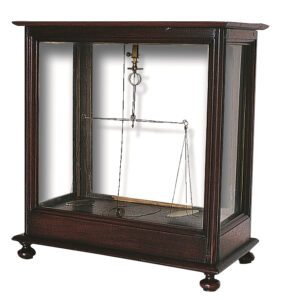
Among the original Priestley equipment on exhibit at the Joseph Priestley House is this balance scales that he used in his experiments.
Photo, Pennsylvania Historical & Museum Commission
Among the items on display in and near his laboratory in the Joseph Priestley House, visitors see artifacts relevant to Priestley’s interest in air: drawings from his book Inquiries into Different Airs, the balance scale he used in his experiments, a pneumatic trough, replicas of his furnaces, a sand bath, and a reproduction of an air pump (donated by the Franklin Institute of Philadelphia). Of special interest to those scientifically inclined is a reproduction of a burning glass, an instrument Priestley used in various gas-related experiments, including obtaining oxygen from mercury calx. Said one young visitor to the museum, “It was cool there was stuff he touched with his own hands there and things he actually used.”
For more information on Joseph Priestley House and the 250th Anniversary of the Discovery of Oxygen, visit joseph-priestley-house.org.
Deborah Bernhisel is a retired English teacher who currently volunteers at the Joseph Priestley House, where she writes and edits its newsletter.