
Clocks of the Cloister
Written by George Gehr in the Features category and the Spring 2024 issue Topics in this article: Abel Witwer, Benjamin Gorgas, cabinetmakers, Christopher Witt, clocks and clockmaking, Ephrata, Ephrata Cloister, Historical Society of the Cocalico Valley, Householders (Ephrata Cloister), Jacob Gorgas, Jacob Gorgas (younger), John Belsner, John George Hoff Sr., Joseph Gorgas, Lancaster County, Solomon Gorgas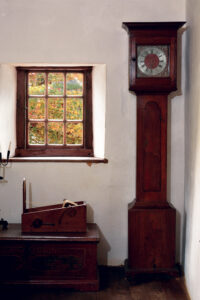
Displayed in the Bakery at Ephrata Cloister, a clock made by Hessian emigrant John George Hoff Sr. of Lancaster is housed in a case that was probably made by the Brothers around 1775.
Collection, Ephrata Cloister; photo, Pennsylvania Historical & Museum Commission
In 1732 German mystic Conrad Beissel (1691–1768) came to the region known as the Cocalico. This was an undeveloped wilderness where he hoped to find solitude with God. Soon, fellow seekers of God came to be with him. Together, they created the Camp of the Solitudes, which quickly took the biblical name “Ephrata.” Those on the outside called it the Ephrata Cloister.
This community grew rapidly and gained a reputation for their hard work, spiritual devotion, and productive lives. Ephrata soon became one of the leading spiritual and economic power hubs of the British Colonies. The community was highly industrious and became known for their music, illuminated fraktur manuscripts, and papermaking and printing operations.
One skill that is often overlooked when discussing the Ephrata community is clockmaking. In Colonial America, clockmaking was an elite craft. Boston and Philadelphia were recognized as the premier centers for quality American clocks; however, as an increasing number of immigrants made the long and difficult trip to the colonies, they found their way into many of the more rural areas. Lancaster County, Pennsylvania, was located some 60 miles west of Philadelphia. Still, as Stacy B.C. Wood Jr. and Stephen E. Kramer III noted in Clockmakers of Lancaster County and Their Clocks, the county had about 100 clockmakers from 1750 to 1850. Seven of these artisans were members of the Ephrata community.
Clockmakers typically concentrated on the clock movements and were given credit for the final product. Cases were left for joiners to make, and their efforts typically remained anonymous.
The society at Ephrata was engaged in many activities. They operated five mills, two printing presses and a woodshop. They were successful farmers and generally made whatever they needed. Considering this, it is not surprising to know that seven members of this religious community were clockmakers. All seven were Householders, or married members, rather than celibate, like the cloistered Brothers and Sisters of the community. Surprisingly, at least two Ephrata clockmakers may have created their own cases, as well.
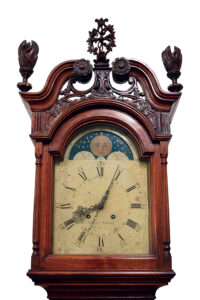
Ephrata Householder Jacob Gorgas made this 8-day brass movement clock, circa 1770, for his brother-in-law William DeShong, whose name is painted on the dial and his initials inlaid above the pendulum door of the Chippendale-style case.
Collection, Historical Society of the Cocalico Valley (Gift of William Fishburn); photo, Pennsylvania Historical & Museum Commission
Jacob Gorgas (1728–98)
Jacob Gorgas is the first known and most famous of Ephrata’s clockmakers. He was the son of John Gorgas, a renowned clockmaker in Roxborough, near Philadelphia, after emigrating from the Netherlands.
Jacob Gorgas and his wife, the former Christina Mack, became Householders at Ephrata upon moving to Lancaster County in 1765. They lived first in a stone house that still stands today on Sunset Avenue, just a block from the Cocalico Creek, on the opposite bank from Ephrata Cloister. In 1777 Gorgas built a new house, three blocks away, on the corner of Oak and Main streets.
Gorgas made his clocks at home. Wood and Kramer estimated that he made nearly 200 in all. They are of excellent quality and housed in fine cases that almost certainly were not built by the Brothers. It has been suggested that Gorgas was also a joiner and made his own clock cases; however, there is no evidence to prove this.
Gorgas made both 30-hour and 8-day movements. He used the anchor recoil escapement and a closed crutch fork.
Gorgas’ clocks are highly valued today, especially in Lancaster County. Two of his sons continued in the family business, beginning their careers in partnership with Jacob. Both later moved out of the immediate area.
In about 1770 Jacob Gorgas made a clock for his brother-in-law, William DeShong. It is a fabulous 8-day clock with intricate carvings. Gorgas signed the name “William DeShong” on the dial and engraved DeShong’s initials into the waist. The clock is on display at the Historical Society of the Cocalico Valley.
John Belsner (d. 1785)
Little is known about John Belsner. He is listed as a Householder at Ephrata, but there is no mention of a wife or family, nor any information about when he was born or where he lived in the area. Jacob Funk, also known as Brother Kenan, says in his notebook that Belsner “is a single person and lived near Ephrata.” There is a John Belsner listed on tax records as a clockmaker in Baltimore during the 1770s. If this is the same person, it is possible that his wife died in Baltimore, prompting him to move to Ephrata by 1781. This could explain the Ephrata Cloister records identifying him as a Householder.
Wood and Kramer attributed one 30-hour clock and two 8-day clocks to Belsner. In their book, they included a photo of one Belsner clock. It is in a plain, flat-topped painted pine case without quarter or hood columns. The clock has an 11-inch-square brass dial. The pendulum door is arched and there is a raised panel on the face of the base. The case is believed to be a product of the Brothers’ woodshop, as it matches their style of furniture. I have seen photos of three Belsner clocks made at Ephrata and they are all housed in simple cases.
Belsner used the anchor recoil escapement with a closed crutch fork. The pendulum is suspended with a thread loop.
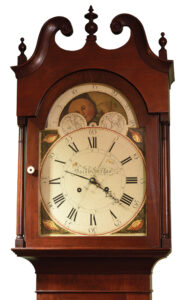
The younger Jacob Gorgas created this 8-day brass movement clock in 1813 and signed his name on the dial. The Federal-style case is made of cherry with walnut accents.
Collection, Dan Sweigert; photo, Pennsylvania Historical & Museum Commission
Jacob Gorgas (1760–1820)
Jacob Gorgas was a nephew of the Jacob Gorgas listed earlier, not a son. This has caused considerable confusion over the years. This Gorgas’ father, Joseph, was a brother to the elder Jacob. Joseph came to Ephrata in his early 20s and joined as a celibate Brother. In 1747 he returned to Roxborough, where he was raised, and by 1750 he married Julianna Anderson. When Joseph died in 1766, Julianna moved to Ephrata with her children, where she became a Householder. It is not known where she lived in the area. As a widow, she may have been somewhere on the Ephrata Cloister property, as was common, or she may have lived with her brother-in- law and family on Sunset Avenue. This may have prompted the elder Jacob Gorgas to build his new home in 1777.
This younger Jacob Gorgas was a farmer, but he also learned the clockmaking trade and made his clocks in Ephrata from 1786 to 1791. Where exactly in Ephrata is not clear. It is possible that he may have worked on the cloister grounds in what was known as the Clockmaker’s Cottage, though there is no documentation to support this. Likewise, there is no evidence that he worked with his uncle. By 1791 he moved to nearby Hinkletown and continued to make clocks there. Like his uncle, he made many fine clocks, both 30-hour and 8-day, which are highly valued today. Although many were flat tops, he also used the broken-arch pediment. It is unknown who made his cases.
One clock by the younger Gorgas, now in a private collection, features a Federal-style case, dated 1813. The case is cherry with walnut accent on the panel and door. The sleek broken-arch pediment is smooth and simple but attractive. The 8-day brass striking movement is typical of his work. Everything in this clock is original, including the wood pulleys. Like his other clocks, this one uses an iron pendulum cock with a thread loop. A common characteristic of Gorgas clocks is the removal of the arched segments at the bottom center of each plate; however, this one lacks that feature. It has four hands on the one center shaft, with a sweep calendar and a sweep seconds hand. It also has a false plate.
Another of his clocks is on display at the Historical Society of the Cocalico Valley. The case for this one is unusual. It is a Chippendale-style flat top with hood columns but no quarter columns on the waist or the base. It has a 30-hour movement.
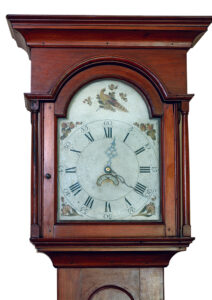
Thought to have been made by Benjamin Gorgas, this 30-hour clock is enclosed in a case that has a bonnet similar to the one housing the 30-hour clock made by the younger Jacob Gorgas.
Collection, George Douglas Gehr; photo, Pennsylvania Historical & Museum Commission
Benjamin Gorgas (1762–1836)
Benjamin Gorgas was a brother to the younger Jacob Gorgas. Like Jacob, his mother raised him as a Householder at Ephrata. Several sources identify him as a clockmaker in Ephrata during the late 18th century. Benjamin and his wife, Cathrina Gehr Gorgas, continued as Householders and later as members of the German Seventh Day Baptist Church, in which Benjamin became one of the original trustees. Nothing is known about his clocks. In the Journal of Lancaster County’s Historical Society, William F. Hartman indicated that Benjamin Gorgas made clocks with his brother Jacob in 1786–91, before Jacob moved to Hinkletown.
Lancaster County tax records show that Benjamin and Cathrina Gorgas were “inmates,” an archaic term for “renter.” The lack of land ownership suggests that they may have lived on the Ephrata Cloister property. By the time they were married in 1792, there were only a few celibates remaining and housing would have been available on the grounds.
I am aware of only one clock today that may have been made by Benjamin between 1790 and 1800, but there is no definite documentation to support this. There is, however, on the back of the dial of the clock a black “G” painted on a cream-colored circle. Could this be a way of denoting its maker? This clock is now in the possession of this author. Family tradition says it was owned by Benjamin Gorgas and likely made by him. It has been in the same family for six generations.
The clock has a 30-hour movement with a simple, flat-top case that has four hood columns but lacks quarter columns. It has a deadbeat escapement, open-ended pinions, and open crutch fork. One unusual feature is the use of only three plate pillars rather than four. The case uses butt-end joints with nails and wooden pegs, not unlike the clock cases made by the Sabbatarian Brothers at Ephrata. The bonnet is identical to the one in the younger Jacob Gorgas’ 30-hour clock, which houses his brother’s movement. A hole had to be made in the back of the hood to accommodate the chime bell.
Solomon Gorgas (1764–1838)
Solomon Gorgas, the son of the elder Jacob Gorgas, worked with his father and brother, Joseph, from 1787 to 1804. According to Wood and Kramer, the similarities in Solomon’s and John Belsner’s work suggests Solomon may have been apprenticed to Belsner. Solomon continued the shop after his father’s death in 1798; however, by 1804 he moved to Cumberland County. In addition to making clocks, he worked in retail and operated a tavern. He was also involved in politics, serving two terms in the Pennsylvania House of Representatives. Records at Ephrata Cloister indicate he was a Householder, though he only lived in the Ephrata area until he was 40 years old.
Solomon Gorgas used the anchor recoil escapement with a cock pendulum suspension and a closed crutch fork.
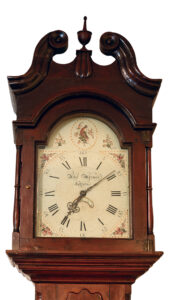
Only four clocks made by Householder Abel Witwer are known to exist. This 30-hour clock, numbered “4,” was constructed circa 1810.
Collection, Ephrata Cloister; photo, Pennsylvania Historical & Museum Commission
Abel Witwer (1767–1821)
Of all the clockmakers who were members of the Ephrata community, Abel Witwer is the only one known to have his shop on the Ephrata Cloister grounds. In Clockmakers and Watchmakers of Lancaster County, Wood identified Witwer as “one of the two remaining brothers” there. Records at Ephrata Cloister, however, list him as a Householder. One record found on Ancestry.com suggests Witwer never married, which might explain why he was considered by some to be a celibate Brother. The same posting, made by Witwer’s great-great-grandnephew, indicates he was a joiner (cabinetmaker). Thus, he may have made his own clock cases.
There is no clear evidence to prove if Witwer made his own clock cases, but if he did, it would explain why his output was sparse. Wood claimed Witwer’s clocks were of excellent quality. Only four can be confirmed today as his product. All are 30-hour movements. Unlike most clockmakers, Witwer signed his 30-hour clock dials.
A clock donated to Ephrata Cloister in 1987 by Jacob Rupp of Paradise, Pennsylvania, is numbered “4,” suggesting it was the fourth one made by Witwer. It is believed to have been built around 1810 and is a 30-hour movement, housed in a cherry case with a simple but elegant broken-arch pediment and scroll. The top of the bonnet and the feet had been cut off and were restored at the former Commonwealth Conservation Center in Harrisburg. The movement has open pinions, anchor recoil escapement, and a closed crutch fork with an iron-pendulum suspension cock.
One feature worth noting is the presence of only three plate pillars. This author has seen two movements by Witwer, including this one, and both used only three plate pillars. Most clockmakers in Lancaster County at that time used four plate pillars. John George Hoff Sr. used three pillars on some of his earlier movements but was not consistent. The clock that is thought to be made by Benjamin Gorgas also has only three pillars. He and Witwer were contemporaries, and both were Householders at Ephrata. Both went on to become trustees of the German Seventh Day Baptist Church, when that was organized in 1814, following the death of the last celibate member. The striking similarity in the use of three plate pillars is peculiar. Knowing how well acquainted they were with one another, living on the same property, one has to wonder if they may have worked together or, at the least, influenced each other.
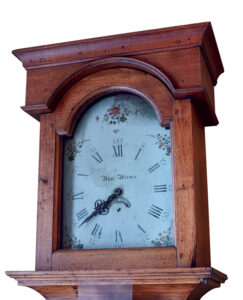
With his shop on the Ephrata Cloister property, Abel Witwer built this 30-hour clock and may have also constructed the flat-top case.
Collection, Historical Society of the Cocalico Valley; photos, Pennsylvania Historical & Museum Commission
The Historical Society of the Cocalico Valley has a nice collection of tall case clocks made by local artisans, including one by Witwer. It is an interesting flat-top clock with a 30-hour movement. The Chippendale case is a bit unusual, with wood that bears strong resemblance to chestnut. It is signed by Witwer on the white dial, which has some damage in the upper right section. It lacks columns on the bonnet, which adds to its simplistic appeal, but it features fluted quarter columns on the waist.
In their book, Wood and Kramer describe a clock made by Witwer from a private collection. The book includes photographs of the full clock, the dial, and the 30-hour movement. It uses an anchor recoil escapement and a closed crutch fork. Like the one at Ephrata Cloister, this clock has only three plate pillars.
The Progress newspaper from Clearfield, Pennsylvania, dated July 14, 1970, published an estate auction notice in Altoona for the late L.A. Hughes. The auction was scheduled for Friday and Saturday, July 17 and 18. The list of items to be sold includes many fine antiques, among them “an early grandfathers clock signed Abel Witwer.”
This author spoke with the auctioneer who sold the clock. He did not have any written records detailing it but recalled that it was in working condition and sold for about $1,500. No further information on this clock has been found.
Joseph Gorgas (1770-1841)
The final clockmaker associated with Ephrata Cloister, Joseph Gorgas, was the younger brother of Solomon. Joseph began making clocks with Solomon and their father, the elder Jacob Gorgas, in their shop on Main Street in the village of Ephrata. He worked there from 1792 to 1805 and is listed as a Householder on the Ephrata Cloister registers.
By 1805 Joseph Gorgas moved to Running Pumps, near Elizabethtown. He moved four more times in his life, beginning in 1818, ending up in Ohio. Two of his sons also became clock and watchmakers, extending the family trade to four generations. His clocks are rare.
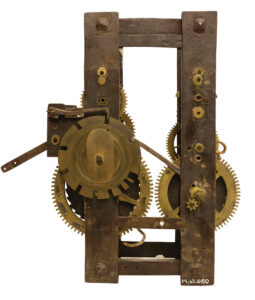
The movement of Ephrata Cloister’s “tower clock” is believed to have been made in 1735 by Christopher Witt and was originally mounted on a wooden frame with a wooden face in the 18th century, possibly on the tower of the Zion Monastery.
Collection, Ephrata Cloister; photo, Pennsylvania Historical & Museum Commission
The Tower Clock
The Ephrata community also had a tower clock. It was located in a building on Mount Zion, but it is unknown which one. Likely, it was in the Zion Saal, or Meetinghouse. The face of the clock is signed “W.C. 1735.” This may stand for Christopher Witt (1675–1765), a clockmaker from Germantown, as German initials were often shown reversed.
Christopher Witt arrived in Philadelphia in 1704 and became renowned as a clockmaker, mathematician and astronomer. He became a prominent citizen in Colonial America and began teaching the clockmaking trade to others. One of his students was Christopher Sauer who went on to make a tall case clock in 1735 that is now on display in the Library Company of Philadelphia. Witt was a Pietist who was a member of a religious group headed by Johannes Kelpius.
It is not clear when the Ephrata Sabbatarians purchased this clock, or if Witt even made it. It chimed on the hour but only had one hand — the hour hand. In the Ephrata community, it was less important to know the minutes, because daily activities were scheduled on the hour. By 1837 the tower clock was moved to the Academy building. According to Kerry Mohn, curator at the Ephrata Cloister, Joseph Clarence Zerfass moved the tower clock from the Academy to the Saron (the Sisters’ dormitory) in 1915, after getting it in working condition. The 1837 Academy bell was remounted on the roof of Saron at the same time. Zerfass scratched his initials on the lead back of the pendulum.
The tower clock is still a part of the collection at Ephrata Cloister; however, it is now kept in storage rather than on display. A reproduction dial with the original clock hand is currently on display in the Visitors’ Center.
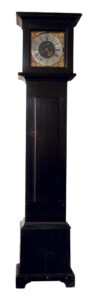
This John George Hoff Sr. clock, housed in a case built by the Brothers at Ephrata, circa 1770, is currently displayed in the Saron at Ephrata Cloister. The feet on the clock are held together with dovetail joints, an unusual feature for the Brothers but not exclusive to this product.
Collection, Ephrata Cloister; photo, Pennsylvania Historical & Museum Commission
The Brothers’ Woodshop
There is nothing in the Ephrata Cloister archives to suggest the Brothers engaged in the production of clock movements. That work was done only by the Householders listed here; however, the Brothers did make several cases in their woodshop that, in turn, housed some of the clocks. We have no idea how many clock cases they made, but we know of some. These share a few general traits.
Cloister clock cases were often made of poplar wood because it was abundant in the area. Although classified as a hardwood, poplar is perhaps the least dense and softest of the hardwood varieties. It has a light color and very little grain. Because it is soft it is easy to work with; however, it does not lend itself to intricate carvings or scroll work. The lack of grain and the light color of poplar means it is often painted when used in furniture or other areas that are readily visible.
Like most of their furniture, Ephrata Cloister clock cases tend to be simple and plain. The use of dovetail joints was uncommon, for example. Instead, the Brothers used butt-end joints held together with nails or wooden pegs. Also lacking in these cases are the fancy broken-arch pediments with scroll work, rosettes and other features, and it appears that most were flat tops. None of the cases had hood columns or quarter columns. There was, no doubt, some variation in these characteristics over the years.
It is not known how many clocks were owned by the Ephrata community. No records were kept indicating how many cases were made by the Brothers either. Ephrata Cloister museum educator Michael Showalter told me via email that clocks were rather common there. “Visitors are often surprised to see clocks. While they were valuable and not prominent in the wider English culture of Colonial America, Germans had lots of clocks. Germany and Switzerland have a long tradition of clockmaking, especially some of the very complex and impressive tower clocks like the ones that tell time, date, position of planets, etc. I don’t recall the exact numbers, but there are about 25 Householder estate inventories surviving from circa 1740–1805 and the majority of these list a clock as belonging to the individual.”
Today, there are four tall case clocks on display at Ephrata Cloister. The Witwer clock has already been discussed.
A circa 1770 clock currently in the Manuscript Room of the Saron has a case that is an outstanding example of the type made by the Brothers. Constructed of poplar wood, it is put together with buttend joints and nails. There are no quarter columns or hood columns. Molding trim is simple and mitered. It has a flat-top case, with a squared-off pendulum door. The black finish is likely a preservative, possibly added at a later time. The 30-hour clock movement was made by John George Hoff Sr. in Lancaster, circa 1770, though it is not signed. Hoff only began working in Lancaster in 1769. It has a brass dial that features Hoff’s trademark pewter spandrels.
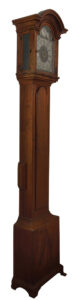
The 30-hour Hoeckers clock, displayed in the Saal at Ephrata Cloister, is housed in a case constructed by the Brothers with side ears, or pockets, to allow the pendulum to swing freely.
Collection, Ephrata Cloister; photo, Pennsylvania Historical & Museum Commission
Located in the back room of the Saal, the Hoeckers’ clock is also known as the Fahnestock clock because one of the Ephrata members, Casper Fahnestock, went to Germany in 1753 to visit his family and try to persuade others to come to Ephrata. While he was there, he bought this 30-hour movement from a clockmaker in Krefeld named Hoeckers. According to the catalog records at Ephrata Cloister, the hood is believed to be original to the movement. That could be, as the bonnet appears to be a bit advanced for the Sabbatarian woodshop. At the same time, the case and the bonnet appear to match extremely well, suggesting the Brothers may have made the entire case. The dial is brass with what appears to be a pewter chapter ring and spandrels. The hood sports an arched top with side windows. Ephrata Cloister catalog records indicate it originally had finials that no longer exist. The wood appears to be walnut. The one striking feature is that the Brothers made the waist too narrow for the pendulum to swing effectively, so they added little pockets, called “ears,” on the side of the waist, allowing the pendulum to swing freely. The pendulum door has an arch or “tombstone” shape to it.
In the upper floor of the Bakery, there is another tall case clock that is in fine condition. It is a flat-top clock with the name “George Hoff, Lancaster” engraved on the dial, made circa 1775. This is again John George Hoff Sr., and it is believed that the case was made by the Brothers. The dial has the exact same pewter spandrels as on the Hoff clock in the Saron’s Manuscript Room. The center of the dial is painted an attractive red; this was another signature of Hoff clocks.
The Value of Clocks at Ephrata
Many objects at Ephrata Cloister were carefully preserved, such as their music, the books and pamphlets they printed, their theology, and the stories of their interpersonal relationships. Sadly, few details were preserved to give us a glimpse into their industrial efforts. This rings true when it comes to the woodshop’s production of clock cases.
In many parts of the American colonies, the tall case clock was considered a luxury. It often was viewed as an elite symbol of success. The detailed craftsmanship and artistic design that was invested in the clock cases only serves to prove this point. In Ephrata, however, clocks were a utilitarian commodity. They enabled the community to maintain their disciplined schedule of work, mingled with prayer and meditation. The simple cases built to house these mechanisms, therefore, are not surprising. One could conclude that the clocks were to be clothed in a standard, modest garb much like the Brothers and Sisters themselves.
Further Reading
Gehr, George Douglas. “The Mystery of Benjamin Gorgas.” Watch & Clock Bulletin 63, no. 452 (July/August 2021): 238–241. / Wood, Stacy B.C., Jr. Clockmakers and Watchmakers of Lancaster County, Pennsylvania. Lancaster, PA: Lancaster County Historical Society, 1995. / Wood, Stacy B.C., Jr., and Stephen E. Kramer III. Clockmakers of Lancaster County and Their Clocks, 1750–1850. New York: Van Nostrand Reinhold, 1977.
George Douglas Gehr is a retired pastor from Ephrata. He serves on the boards of the Historical Society of the Cocalico Valley and the Ephrata Cloister Associates and is also a tour guide at Ephrata Cloister.