
Carved from Our Roots: The Folk Art Sculptures of Marshall D. Rumbaugh
Written by Patrick Donmoyer in the Features category and the Fall 2025 issue Topics in this article: Alice Welsh Jenkins, civil rights, Dallas (Luzerne County), folk art, Hope Cumming Horn, Marshall D. Rumbaugh, Pennsylvania Dutch (Pennsylvania German), Pennsylvania German Cultural Heritage Center, Phillip Bentham, sculpture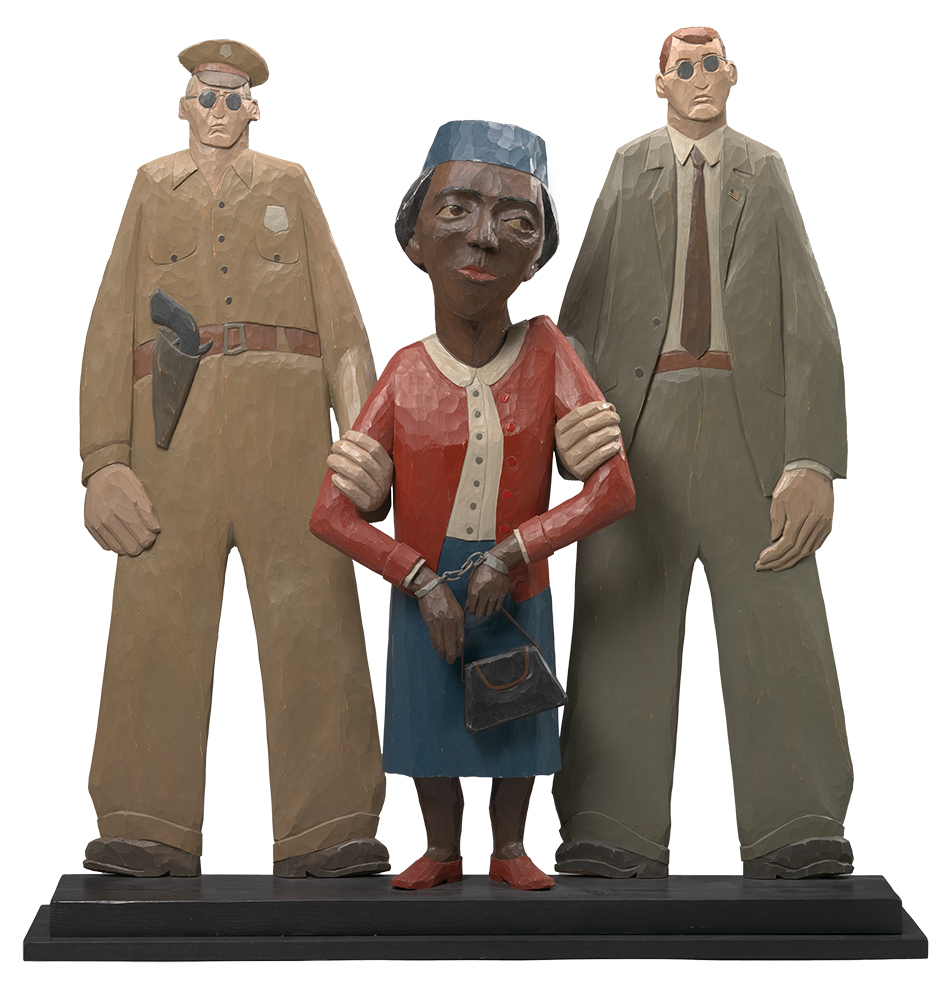
Rosa Parks, carved and painted limewood, 1983.
Carved in his distinctive folk-art style, Marshall D. Rumbaugh’s celebrated sculpture of Rosa Parks is one of his many works dedicated to leaders of the Civil Rights Movement.
National Portrait Gallery, Smithsonian Institution
A steel mallet rings like the chiming of a bell, as the delicate petal of a tulip unfolds under the sculptor’s chisel from the surface of the limestone. The fluidity of his hands, the tempo of the mallet, the precision of the chisel — all seemed effortless, as a visitor to the museum asked Marshall Rumbaugh how he learned to carve stone. “Well,” he said modestly with a broad smile, “I’ve been carving wood for 35 years and was ready to try something a little different.”
Blending a profound love of American folk art with his formal training in modern and traditional sculpture, Marshall D. Rumbaugh (1948–2023) is best known for carving polychromed figural works celebrating diverse American heroes. He grew up in the 1960s as the Civil Rights Movement transformed America, and his inner compass was shaped by this human pursuit of justice in times of brazen inequality. His sculptures elevated the voices and deeds of activists, revolutionaries, abolitionists, and an international pantheon of poets, saints, philosophers and musicians whose deeds uplifted the human spirit.
Rumbaugh’s national recognition as an artist began in 1983, when he produced a sculpture of celebrated Black activist Rosa Parks, who in 1955 refused to move from her seat for a white male passenger on a bus in Montgomery, Alabama, igniting the Montgomery bus boycott. Created in anticipation of the 30th anniversary of this momentous event, Rumbaugh’s sculpture depicted Parks as a courageous hero, escorted by two police officers towering over her as she casts a sideways look of determination in the face of injustice.
In Rumbaugh’s distinctive folk-art style that deliberately exaggerates features of the figures, Rosa Parks’ head is larger than life, emphasizing her significance and thoughtful defiance of unjust authority. Meanwhile, the heads of her arresting officers are so small as to seem far away, a visible indicator of their distance from the humanity of others under the oppressive system of segregation in the era of Jim Crow laws. This sculpture, carved from limewood in shallow relief and painted in multiple colors, was purchased for the permanent collection of the Smithsonian Institution’s National Portrait Gallery in Washington, D.C., and was included in the museum’s first international exhibition in 1987, which traveled to Hong Kong, Sapporo and Tokyo.
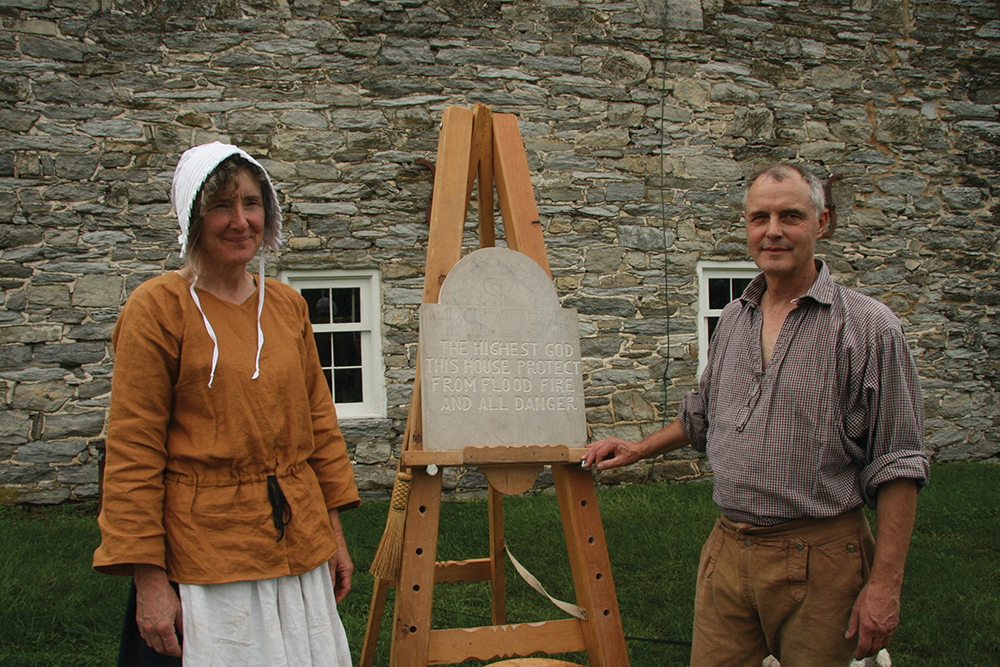
Marshall and Anne Rumbaugh exhibit a stone carving in this photograph taken at Heemet Fescht at Kutztown University in 2010.
Pennsylvania German Cultural Heritage Center, Kutztown University
A long-time resident of Dallas in Pennsylvania’s Luzerne County, Rumbaugh also carved a diverse range of figural, geometric and functional works of art that explored his Pennsylvania Dutch roots. Although descended from two generations of prominent doctors in Luzerne County, Rumbaugh’s inclination towards history and an appreciation for rural life was inspired by stories of the family farm in central Pennsylvania, where his great-grandparents Cleophas and Elizabeth ran a farm near Millerstown, Perry County. Echoes of this interest appear in the form of carved butter molds, painted chests, and polychromed carvings of rural figures in the Pennsylvania countryside.
Despite international acclaim and the abiding local appeal of his work, Rumbaugh did not initially set out to become a practicing fine artist. After graduating from Syracuse University with degrees in history and art history in 1970, he spent two years abroad, cataloging artifacts from ancient and medieval archaeology sites for Britain’s National Trust. While in the United Kingdom, he took a course in archaeological drawing that launched his first formal experiences with producing works of art, connecting his deep understanding of documenting antiquities with technical drawing skills that would serve him throughout his career. At this time, he also studied at West Dean College under celebrated English woodcarver and sculptor Phillip Bentham (1934–1981), an experience that instilled his love for the medium of wood carving.
After returning home to the United States, Rumbaugh turned his full attention to the study and practice of art, developing a distinctive style in both figural sculpture and impressionist painting. He briefly studied at Wilkes College with watercolor artist Alice Welsh Jenkins (1910–78) and later at the Everhart Museum in Scranton under sculptor and painter Hope Cumming Horn (1920–2001). Best known for her figural and modern sculptures as well as trompe l’oeil still life paintings in egg tempera, Horn mentored Rumbaugh for more than 10 years and nurtured the development of his unique approach to figural sculpture.
In 1982 Rumbaugh returned to Europe, but this time to Germany, where he studied under master carver Herbert Schneider (1928–2023) of Oberammergau, a pilgrimage destination in the Bavarian Alps. Renowned for the Passion Play performed every 10 years since 1634, Oberammergau is a town celebrated for its robust tradition of carved wooden nativities and biblical figures that are sold to visitors on pilgrimage. Under Herbert’s instruction, Rumbaugh learned the German techniques of figural carving characterized by bold composition, economy of form, and restrained precision. This experience would later inform the carved nativities that he produced at his home studio in Pennsylvania.
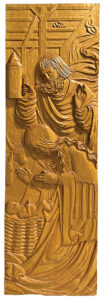
The Nativity, carved lindenwood, 1982.
Pennsylvania German Cultural Heritage Center, Kutztown University
While in Germany, Rumbaugh also explored the techniques of renowned masters of the late Gothic and early Renaissance periods, and his training included copying celebrated altarpieces such as St. Paul by Tilman Riemenschneider of Würzburg, the Mourning Virgin by Hans Leinberger of Altbayern, and The Nativity by Swabian sculptor Hans Thoman, also known as the Master of Ottobeuren.
Rumbaugh’s interpretation of The Nativity relief from the Altarpiece of the Abbey of Ottobeuren is faithful to the original in composition, gestures and style; however, Rumbaugh took liberties in reimagining the piece in a number of significant ways. The infant Christ, who is surrounded and examined by cherubs in gowns in the original relief, now looks directly into the eyes of his mother, as the heavenly hosts were not included in Rumbaugh’s rendition. A curious lump reminiscent of a soldier’s helmet, which crested Mary’s headpiece in the original, has been more gracefully articulated. Surprisingly, given Rumbaugh’s love of geometric patterns and ornament, he chose to omit the star and embroidery running along the borders of Mary’s mantle. The handling of the punched tin lantern conveys a sense of continuity between the late Gothic artist’s work and Rumbaugh’s interest in Pennsylvania Dutch traditional arts. The Nativity was exhibited along with St. Paul in 1985 at Misericordia College in Dallas.
Rumbaugh continued his work at the Hope Horn Studio after his return from Germany, honing his distinctive style with a combination of gothic European and modern American influences. Leaving chisel marks as evidence of the artist’s process was part of how he remained true to his medium of working in wood. The rich gestural qualities of his textures and expressions appear as echoes of his German training, but the overall smoothing, slight elongation of features and simplifying of the forms is reminiscent of the work of his American mentor, Hope Cumming Horn. Rumbaugh’s work continued to reflect these influences in varying degrees throughout his career, bringing a level of refinement and sophistication to the work he produced in a characteristically Pennsylvanian folk-cultural spirit.
It was during this time that Rumbaugh produced his sculpture of Rosa Parks, as well as another activist, writer and hero of the Civil Rights Movement, James Meredith. As the first Black student to attend the University of Mississippi in 1962, the determined Meredith symbolically climbs a staircase in Rumbaugh’s sculpture while a series of white figures, including a federal judge, watch him disapprovingly. A gunman hides among them, referencing an assassination attempt during Meredith’s March Against Fear in the summer of 1966, which culminated in more than 15,000 participants completing the 220-mile march from Memphis, Tennessee, to Jackson, Mississippi. Rumbaugh reflected on his sculptural explorations of these contemporary heroes and their struggles to overcome injustice in efforts to “try to capture some intrinsic element of the higher self in each subject” — emphasizing that their struggles were of benefit to the whole of humankind.
In the years that followed, Rumbaugh became a highly prolific sculptor, producing detailed carvings of American visionaries like John Chapman (Johnny Appleseed) and Helen Keller. The latter sculpture features Keller seated and smiling while clutching a blooming rose to her breast. Her teacher and lifelong companion, Anne Sullivan, stands behind her with a hand on her shoulder while holding a rosebud in the other hand. Rumbaugh explained that this sculpture was meant to symbolically depict some measure of the spiritual connection between the two women as teacher and student, symbolized by the potential of the bud and blossoming of the flower.
Other sculptures from this period include portrayals of literary masters such as Robert Frost, Leo Tolstoy, Emily Dickenson and Henry David Thoreau. Rumbaugh’s sculpture of Thoreau, produced in 1987, depicted the author dressed in a waistcoat and seated on a ladder-back chair with his memoir open on the ground and a garden hoe in hand. His gaze is peaceful yet distant, with eyebrows raised thoughtfully to frame a stylistically elongated face, as if observing a world beyond the viewer. This work received awards from several institutions, including the National Academy of Design, Allied Artists of America, and the National Sculpture Society.
Rumbaugh’s folk-art sculptural language is clearly articulated in the form and composition of Thoreau, simplifying and lengthening the body to emphasize the figure’s expressions and symbolic elements. Although sometimes referred to as “naïve art” when created by untrained, self-taught artists, Rumbaugh’s approach is rooted in a cultural self-awareness and a preference for the aesthetic qualities of simplicity, humility and expression of shared humanity.
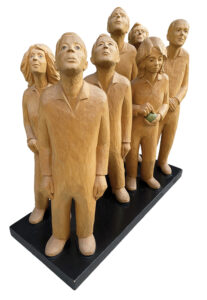
The Challenger Seven, carved lindenwood, 1987.
Photo, Patrick J. Donmoyer
Rumbaugh’s other notable sculptures from this era include the expressive figures of folk singer Pete Seeger laughing with his banjo and Russian Nobel laureate Aleksandr Solzhenitsyn wearing a red scarf tight around his neck while holding a copy of his celebrated memoir Gulag Archipelago, describing his experiences in Russian prison camps. Never one to waver in depicting complex and tragic human events, Rumbaugh carved the seven astronauts killed in the Space Shuttle Challenger disaster of 1986. Five figures stand with their faces inclined toward the sky as if watching the event take place, while schoolteacher Christa McAuliffe looks down and her fellow crew member Gregory Jarvis looks directly at the viewer. This sculpture was displayed as part of a membership exhibition in the gallery of Misericordia College in 1987.
That same year, the Scranton Public Library unveiled Rumbaugh’s wood sculptures depicting characters from stories by Hans Christian Andersen and Beatrix Potter at the entrance to the newly dedicated Children’s Library. His work is also featured in the Back Mountain Memorial Library in Dallas, the Weinberg Library at the University of Scranton, and the Stettler Learning Center at Wyoming Seminary. His institutional works also include a finely carved wreath for the judge’s bench for the Luzerne County Courthouse Annex.
Although Rumbaugh’s works had always included religious themes and imagery, the relatable humanity conveyed in his sacred figures led to a wide range of commissions at monasteries and churches, as well as religiously affiliated organizations and educational institutions. Locally, Rumbaugh was commissioned to carve the crucifix and Stations of the Cross in the chapel at King’s College in Wilkes-Barre, as well as a sculpture of the founder of the Congregation of the Holy Cross, Basil Moreau, at the college’s administration building, dedicated in 2007. Years prior, in 1989, King’s College honored Rumbaugh’s father, Dr. Marshall U. Rumbaugh, with a commissioned sculpture of Thomas Merton, the celebrated Trappist monk, mystic and theologian of the Abbey of Our Lady of Gethsemani in Bardstown, Kentucky.
Rumbaugh’s works also extended beyond the walls of churches and institutions and into public-facing humanitarian organizations such as the St. Francis of Assisi Kitchen, a community-supported meal center in Scranton, where Rumbaugh donated his sculpture of St. Francis and the Wolf of Gubbio in 1990. The wall-mounted sculpture carved in shallow relief depicts the tonsured patron saint of animals soothing the ferocious wolf that terrorized the Italian village of Gubbio with a mere gesture of his hand. This story resonated with Rumbaugh not only because of his appreciation for the land and its creatures but also because the saint’s legend is a metaphor for the potential for inner transformation even in the midst of intense circumstances.
In 2003 on the Feast of the Assumption of the Virgin Mary, the Roman Catholic Society of St. John dedicated an elaborate sculptural installation by Rumbaugh at the entrance of the converted barn that served as the focal point for the monastery in Sohola Township, Pike County. Rumbaugh’s installation features a carved figure of St. Joseph holding the infant Christ, surrounded by a sophisticated archway depicting the carved biblical scene of Gabriel’s annunciation to the Virgin Mary. Eve, tempted by the snake, picks an apple from within the branches of an intricate border depicting the Garden of Eden.
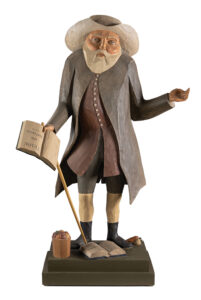
Benjamin Lay, carved and painted lindenwood, 1982.
Collection of Patrick Bell and Edwin Hild / Photo, Christian Giannelli
Although most of Rumbaugh’s high-profile commissions of sacred art were for Roman Catholic institutions in the Northeast, his work explored the many fruitful branches of Pennsylvania spirituality. The values of Pennsylvania Quakers as peacemakers and activists appealed to Rumbaugh, and he created works to celebrate Quaker leaders and visionaries, such as Pennsylvania founder William Penn, who initiated peaceful negotiations with the Lenape inhabitants of eastern Pennsylvania and created the legal precedent for cultural and religious tolerance in North America.
Rumbaugh also would go on to carve the likeness of radical Quaker abolitionist Benjamin Lay, who stood little more than 4 feet and preached in the streets of Philadelphia on the moral disgrace of slavery. Rumbaugh’s carving was based on an original painting of Lay, commissioned from artist William Williams by Benjamin Franklin.
Since 1976, Olde Hope Antiques, a gallery specializing in Early American decorative arts with locations in New York City and New Hope, Pennsylvania, has represented and collected Rumbaugh’s work. In 2022, their New York gallery presented a major exhibition of his sculptures, Carved from America’s Story: The Sculpture of Marshall Rumbaugh, featuring the stories of unsung heroes of American history who made a difference in the lives of others in their pursuit of justice, cooperation and reconciliation.
In one striking piece carved in deep relief, Jacob and Hannah Leverton, stationmasters on the Underground Railroad from Maryland, welcome a young girl with a lantern and assist her in escaping her enslaver. Rumbaugh’s commentary on the piece explains that, due to heavy fines, the Leverton family lost a significant portion of their farm after it was discovered they were assisting families escaping slavery. When Jacob died shortly thereafter, Hannah went on as stationmaster and is believed to be the woman who assisted Harriet Tubman in her escape to freedom in 1849.
The exhibition also featured carved sculptures of diverse heroes of the American Revolution, including Mary Ludwig Hays, also known as Molly Pitcher, who took her husband’s place operating artillery for the Continental Army in the battle of Monmouth, New Jersey, in 1778. She is depicted holding the cannon tamper, coated in tar, and a pitcher of water that earned her namesake. Rumbaugh also honored the Irish Quaker Lydia Darragh who warned the Continental Army of an impending British surprise attack at Whitemarsh in 1777, as well Haym Salomon, the Jewish businessman and member of the Sons of Liberty, who raised the money necessary to sustain Washington’s troops in preparation for the battle of Yorktown in 1781.
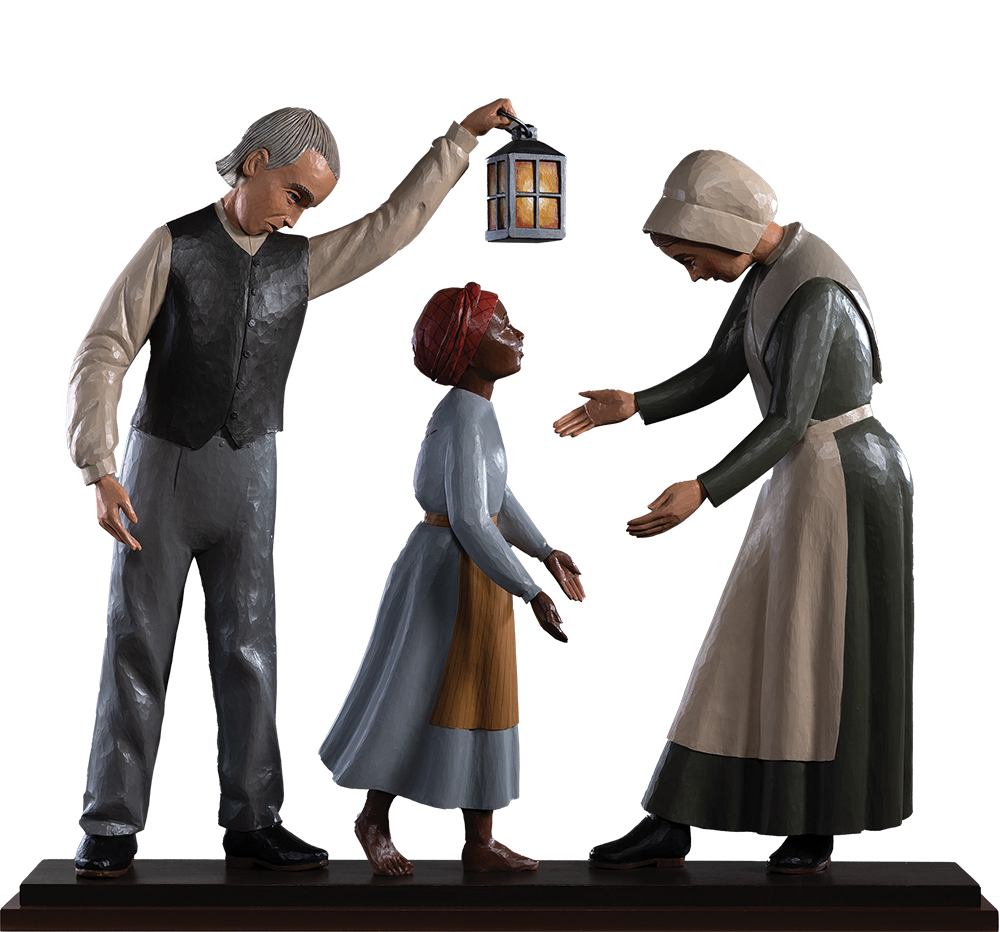
Jacob and Hannah Leverton, Stationmasters on the Underground Railroad, carved and painted lindenwood, 2022.
Olde Hope Antiques / Photo, Christian Giannelli
Although many of the narratives featured in Carved from America’s Story are of Pennsylvania origin, there is perhaps none so quintessentially folk-cultural in nature as the sculpture of Mountain Mary, the legendary healer of the Pennsylvania Dutch. Drawing upon his experience with Gothic altarpieces carved in deep relief, Rumbaugh depicts the healer Anna Maria Jung as the American equivalent of the European saint’s legend. Rather than the classic references to martyrdom that accompany most Roman Catholic representations of sacred people, Mountain Mary holds emblems representative of her legendary relationships with the land and the animal kingdom — a sheaf of wheat in her apron and a single mourning dove she cradles in one hand as if listening to a secret. This piece was acquired by the Pennsylvania German Cultural Heritage Center at Kutztown University and included in the 2023 exhibition Mountain Mary: Contemporary Visions of the Sainted Healer, featuring historic and contemporary works of art and artifacts exploring the life and legacy of the legendary healer.
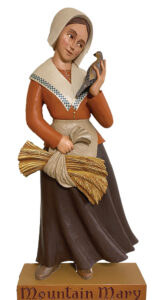
Mountain Mary, carved and painted lindenwood, 2022.
Pennsylvania German Cultural Heritage Center, Kutztown University
In keeping with his dedication to themes of justice and civil rights throughout his career, Rumbaugh created two sculptures for the newly opened Harriet Tubman Museum in Cape May, New Jersey. In one of these sculptures, Rumbaugh depicts abolitionist and Underground Railroad conductor Tubman with rifle in hand, as a scout and spy for the Union army, accompanied by two soldiers from the Union’s Black regiments. In another sculpture in the same gallery, Rumbaugh depicted the prolific Underground Railroad conductor William Still of Philadelphia, who assisted more than 600 enslaved people to freedom.
After a series of significant exhibitions in 2022 and 2023, Rumbaugh donated his personal collection of carvings to the Pennsylvania German Cultural Heritage Center, which he designated as the institutional repository for his art. The donation consisted of 57 works covering a broad range of styles and periods of the artist’s life, including his studies of the European masters, Alpine chip carving, decorated miniature blanket chests and painted cabinetry, figures of Lancaster County’s Plain communities, butter molds, and his carved date stone samples. The Marshall Rumbaugh Collection includes a number of personalized gifts that he had created for his parents Dr. Marshall U. Rumbaugh and Bebe (Riley) Rumbaugh, including a decorated folk-art candlebox featuring the images of his parents in a classic Pennsylvania Dutch depiction of Adam and Eve in Paradise.
In his early career, Marshall Rumbaugh created exquisite examples of Pennsylvania Dutch folk-art furniture in miniature scale, which he supplied to museum stores at the Museum of American Folk Art and the Philadelphia Museum of Art. The blanket chests were each accompanied by Rumbaugh’s descriptions of their significance as dower chests, made as gifts for women who brought the chests to their new homes after marriage. He decorated these miniature chests with traditional folk-art forms, as
well as contemporary designs based on quilt patterns. He also created a series of raised panel cupboards that featured trompe-l’oeil seasonal landscape paintings as if windows into the Pennsylvania countryside.
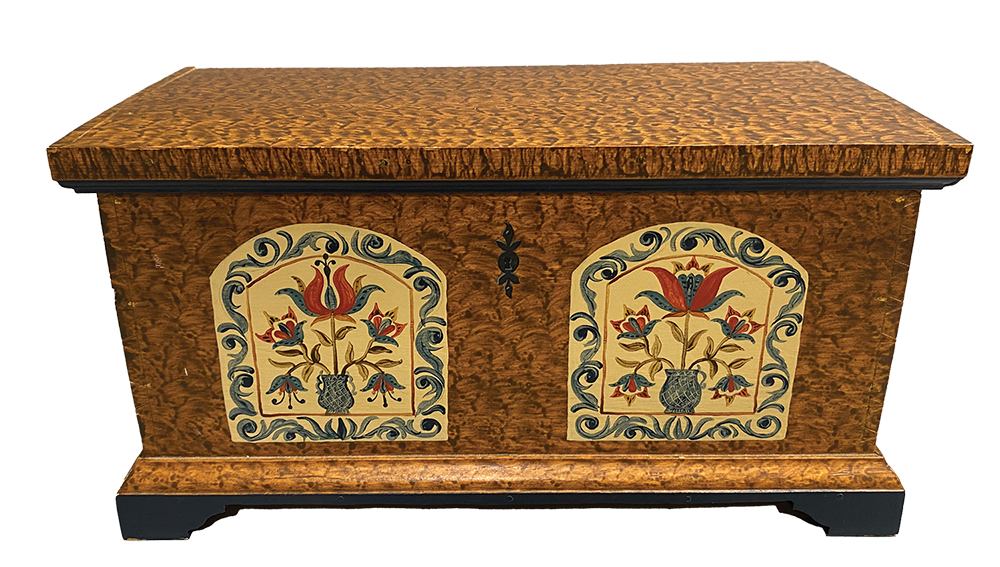
Miniature Pennsylvania Dutch blanket chest, painted pinewood, 1989.
Pennsylvania German Cultural Heritage Center, Kutztown University
Throughout his artistic career, reflected in the Marshall Rumbaugh Collection, the artist returned time and again to exploring the humanity of Pennsylvania’s unique folk culture. Through carvings of historical figures such as Mennonite Pioneer Hans Herr and Sisters of the Pietist Ephrata Community, as well as members of the Plain Communities of the Amish and Mennonites, Rumbaugh emphasized the identities of Pennsylvania’s diverse cultural and religious groups, while emphasizing personal and individual aspects in each figure through unique expressions, humorous exchanges, and social relationships. His explorations in religious iconography and depictions of sainthood of the Gothic period enabled him to democratize divinity on a human scale in his Pennsylvania carvings.
One figure of an elderly Amish woman conveys humor through a sidelong glance, emphasizing the humanity and relatability of her character. Embodying the beliefs of her community, her sectarian head covering and attire sets her apart from broader American Society. Emblematic of Pennsylvania Dutch cultural values, Amish Woman expresses an air of confidence, resilience and competence that defies the stereotypical expectations for women in American society. Rumbaugh’s experiences living in the Brubaker Valley of northern Lancaster County no doubt informed his view of the dedicated women that hold the Plain communities together through careful maintenance of tradition, work and good humor.
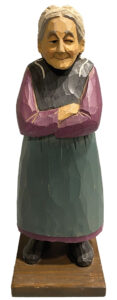
Amish Woman, carved and painted lindenwood, circa 1990.
Pennsylvania German Cultural Heritage Center, Kutztown University
Marshall Rumbaugh demonstrated his carving at folk festivals throughout eastern and central Pennsylvania, specializing in a wide range of chip-carved butter molds in pine, walnut and lindenwood. Mainstays of a woodcarver’s income in early Pennsylvania, the creation of culinary molds used for butter and cheese, as well as pastries and gingerbread are among the most elaborate demonstrations of Pennsylvania Dutch carving traditions and increased the salability of butter and cheese at farmer’s markets. Rumbaugh’s traveling display included a traditional market butter box that he created after a Pennsylvania original, including a series of partitions and drawers to keep molded butter safe in transport to market.
Rumbaugh demonstrated at the Goschenhoppen Folk Festival, Warrior Run-Fort Freeland Heritage Days in Turbotville, Union County Historical Society’s Rural Heritage Days, Charter Day at the Conrad Weiser Homestead, Heemet Fescht at the Pennsylvania German Cultural Heritage Center, and the Fall Festival at the Lands at Hillside Farms in Shavertown, where he also assisted with farming activities including driving the Clydesdale draft horses.
Around 2007 Rumbaugh expanded his sculptural repertoire to include carvings in limestone and slate, which he embellished with paint in the manner of early Pennsylvania date stones, house blessings and gravestones. Over several years, Rumbaugh created a series of samples of his stonework that he brought with him when he and his wife Anne participated in local folk festivals. Although he primarily produced these works in stone by commission, he also demonstrated historic carving techniques as part of gravestone preservation workshops for local organizations such as Old Zion Royer’s Reformed Church, near Rumbaugh’s Lancaster County residence in the Brubaker Valley.
Rumbaugh passed away suddenly of natural causes on July 23, 2023, at the age of 75, leaving behind a legacy of nearly five decades of woodcarving and collaborating with organizations and other artists throughout the region. His passing occurred just nine days after donating his personal collection of artistic works to the Pennsylvania German Cultural Heritage Center. His original intent was to document each work of art through oral histories about his process, motivations and influences, culminating
in a retrospective exhibition of 50 years of woodcarving in 2025. Instead, the Heritage Center mounted the exhibition Carved from Our Roots: Selected Works of Marshall D. Rumbaugh that ran from June 29, 2024, to April 4, 2025, honoring his life and work through the art that he maintained in his personal collection.
Rumbaugh’s carvings are a testament to his dedication to elevating the transformative stories of ordinary people whose extraordinary deeds revealed a common humanity in pursuit of a better world. Through his iconic portrayals, dynamic compositions, and devoted attention to detail, his works embody his sacred and contemporary influences, depicting the folk-cultural stories of American communities with reverence and compassion. Although Rumbaugh’s tools have been laid to rest, his artistic vision continues wherever his sculptures continue to speak of a better world just within our reach.
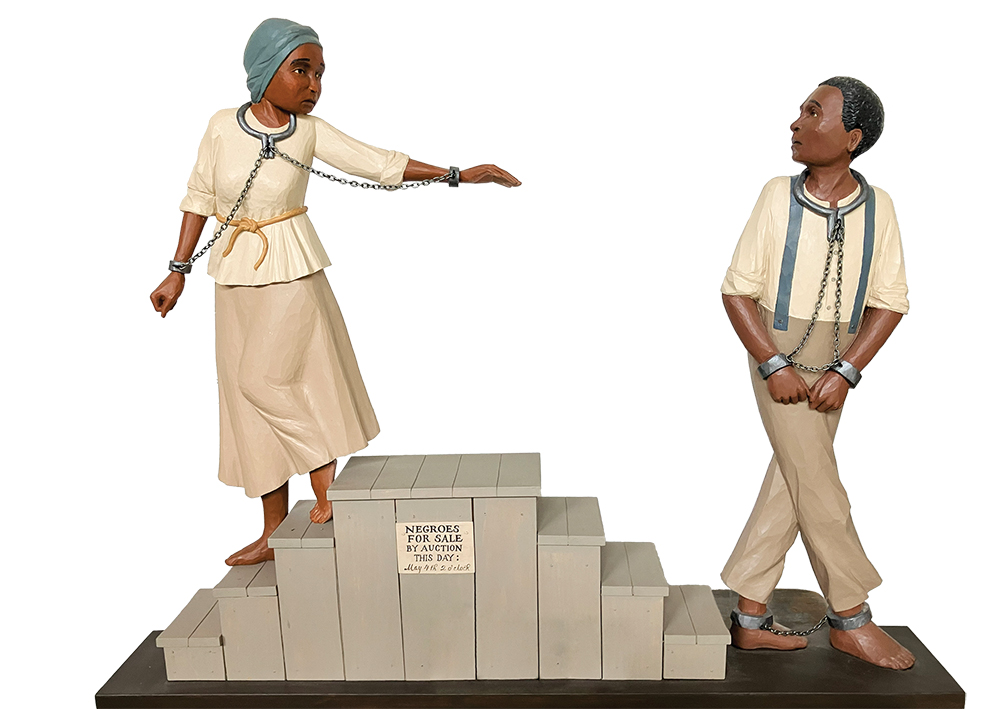
Auction, carved and painted lindenwood, 2023.
Courtesy of the Family of Marshall D. Rumbaugh
The virtual exhibition Carved from Our Roots: Selected Works of Marshall D. Rumbaugh can be accessed on the Pennsylvania German Cultural Heritage Center’s Digital Folklife Portal.
Patrick J. Donmoyer, director of the Pennsylvania German Cultural Heritage Center at Kutztown University, is a regular contributor to Pennsylvania Heritage and the author of several books, including Powwowing in Pennsylvania: Braucherei and the Ritual of Everyday Life and Hex Signs: Myth and Meaning in Pennsylvania Dutch Barn Stars.