
Captured: Axis Prisoners of War in Pennsylvania
Written by Richard Holl in the Features category and the Winter 2025 issue Topics in this article: Bedford Springs Hotel, Camp Reynolds, Germans, Indiantown Gap Military Reservation, Italians, Japanese, Laurence C. Thomas, Letterkenny Army Depot, Pine Grove Furnace POW Interrogation Camp, prisoners of war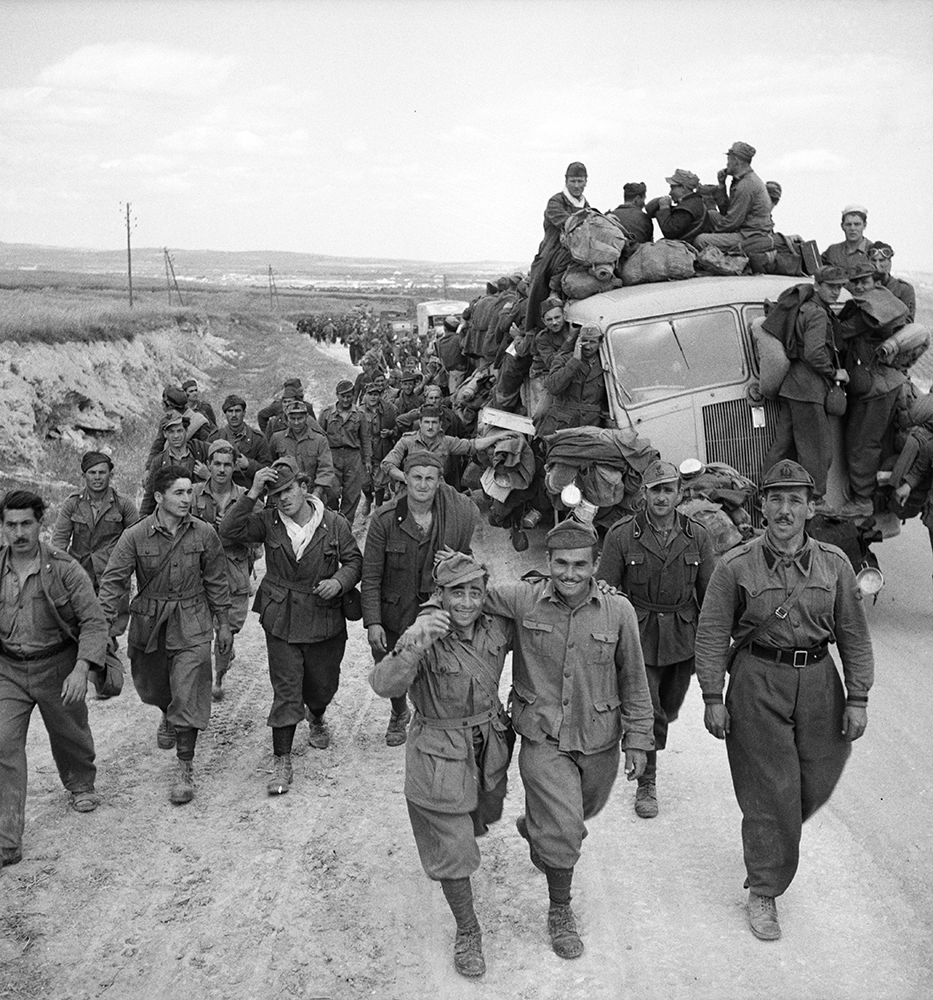
At the conclusion of the Tunisian Campaign in May 1943, about 267,000 German and Italian soldiers were captured as prisoners of war. Some of these men were detained in prison camps throughout Pennsylvania. Here, Axis prisoners are being moved out of the city of Tunis following the conflict.
Library of Congress, Prints and Photographs Division
During World War II, the United States government built the largest, most complex prisoner of war program in American history. By 1944 more than 425,000 Axis prisoners of war (POWs) lived in hundreds of camps across the U.S. The Office of the Provost Marshal General (OPMG), the War Department agency in charge of the prisoner of war program, authorized the use of German, Italian and Japanese POWs as a source of labor to aid the American war effort. Aware of fighting between Nazi and anti-Nazi prisoners inside American POW compounds, the OPMG started a political re-education plan designed to impress the prisoners with the virtues of democracy while condemning authoritarianism.
Like all states, Pennsylvania participated in the World War II prisoner of war experience. Twelve POW base camps and 18 branch camps dotted the Keystone State, including Camp Reynolds, Letterkenny Ordnance Depot, Bedford Springs Hotel, and Pine Grove Furnace Camp. The number of Axis POWs in these installations peaked at about 18,000. The vast majority of these men were Germans captured in North Africa and Italy in 1942–43, with a much smaller contingent of Italians and only a few hundred Japanese.
Located in Mercer County, Camp Reynolds began as a U.S. Army base. The military added a POW facility to the complex and prisoners of war arrived in 1944. Most were Germans though some Italians appeared. The POWs at Camp Reynolds fared well. Meals included such items as porridge with honey, milk, beef, fish, bread and butter, grapefruit, and coffee. A day’s food intake often exceeded 3,000 calories, which meant that some POWs actually gained weight. Prisoners worked eight to 10 hours a day on various chores inside the camp with break periods. They played soccer and ping-pong. They listened to radios and watched movies. A prisoner orchestra formed, and theatrical plays were put on. Religious services were available for both Catholics and Lutherans.
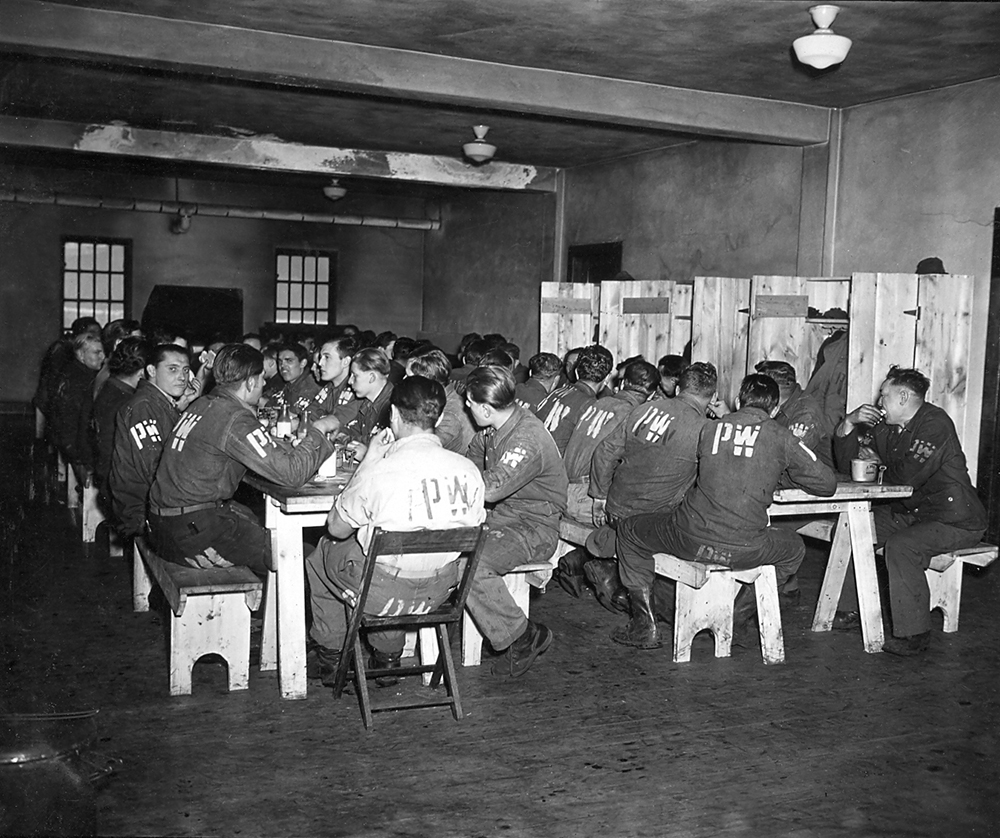
Prisoners of war at Camp Reynolds in Pymatuning Township, in Pennsylvania’s Mercer County, gather in the mess hall for a meal.
ACW Productions
Captives at Camp Reynolds worked on nearby Pennsylvania farms, at lumber mills, and at various other sites. Frank Barney, who lived in Girard, Erie County, hired 100 German prisoners to help him harvest potatoes. POWs picked tomatoes, grapes and other produce. A branch camp at Sheffield in Warren County, an offshoot of Camp Reynolds, housed Germans who cut, split, peeled and stacked pulpwood. POWs also performed general labor at the Meadville Iron Works and the National Radiator Co.
German prisoners of war who lived at Indiantown Gap Military Reservation encountered an environment similar to that at Camp Reynolds. The food was plentiful and sometimes tasty. Recreational and cultural opportunities existed for all prisoners who were interested, including access to books in a library. The Indiantown Gap prisoners dug potatoes, and more than 100 Germans found themselves at Masland & Sons in Carlisle helping with the production of war-related goods such as parachutes and U.S. Navy clothing.
A prisoner of war camp at the Letterkenny Ordnance Depot in Franklin County, near Chambersburg, holds a unique distinction: It hosted 1,200 Italian POWs, more than any other single installation in the United States. Taken captive in Tunisia and Sicily after crushing defeats at the hands of American and British forces, the Italians arrived at Letterkenny beginning in May 1944. By that point, Italy had signed an armistice with the Allies and switched sides in the war. Still officially designated as POWs, the Italians enjoyed a special status.
Italian prisoners of war under American supervision received the best treatment of any single group of POWs during World War II, whether on the Allied side or the Axis side. The Letterkenny POWs consumed food tailored to their national taste, including various types of pasta and sauces, and plenty of it. They took in fresh air, dribbling soccer balls in open spaces or jogging around the interior perimeter of the camp. They read books and lounged in front of radios and motion picture screens. As collaborators now, they loaded trains with munitions, shipped mail to Europe, and were not overworked. American camp commanders permitted family members living in Pennsylvania or other states to visit them. The autonomy of the Italian captives extended far enough that more than a few managed to establish intimate relationships with American women. Italian POW Elio De Angelis, for example, fathered a child by Betty Jane Gilbert.
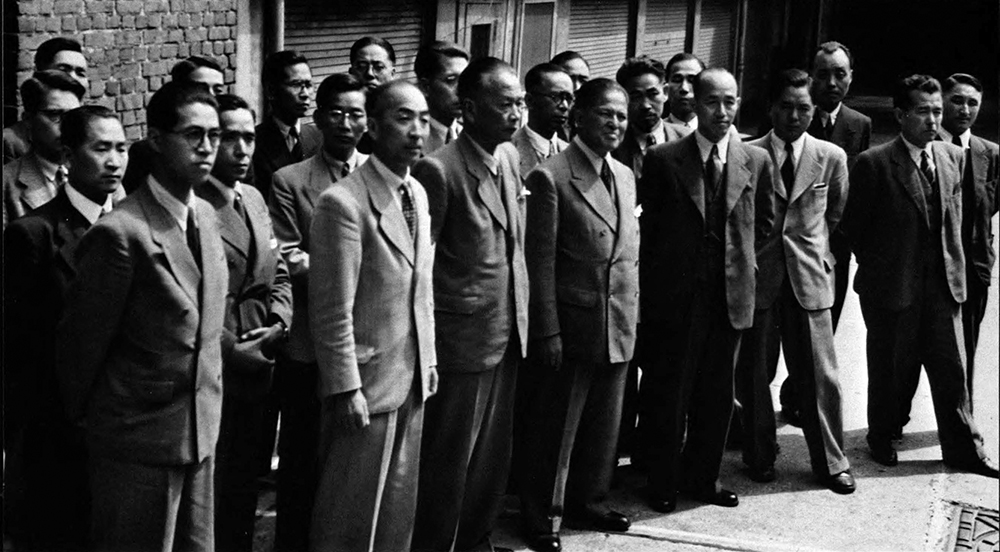
The first Japanese diplomats to arrive at the detention center at Bedford Springs Hotel included Gen. Hiroshi Oshima, the Japanese ambassador to Germany.
U.S. Army
A total of 200 Japanese diplomats, embassy staff, and their family members were sent to the Bedford Springs Resort & Spa, residing there in 1945, from midyear to November. The group included Gen. Hiroshi Oshima, the Japanese ambassador to Germany. Officials from the U.S. State Department wanted Oshima and the others for prisoner exchanges with Japan. Locals jumped to the conclusion that the Japanese personnel had been placed in the lap of luxury and had access to the resort’s amenities. The State Department assured those concerned citizens that this was not the case. The Japanese prisoners were allowed to walk up and down inside the stockade but could not use the pool and golf course.
One last facility deserves attention. Not a normal prisoner of war camp, the Pine Grove Furnace installation in the Michaux State Forest (open from 1943 to 1945) served as an interrogation center for about 25,000 German and Japanese POWs. Unlike the regular camps, where prisoners stayed for months or years, the German and Japanese soldiers passed through the Pine Grove Furnace camp in a matter of days or weeks. U.S. military intelligence officers at Pine Grove questioned these enemies rigorously, trying to extract valuable information about the Axis war effort. The intelligence officers asked the prisoners about troop movements, gun placements, and development of new weaponry.
Although Axis prisoners of war in Pennsylvania managed to escape occasionally (and all were eventually recaptured), committed no sabotage, and provided the American war effort with valuable labor, one sinister development took place under the noses of American camp commanders. A fierce ideological
struggle broke out inside the camps, pitting Nazis against anti-Nazis. While a minority of prisoners were devoted, hardcore Nazis, others were anti-Nazis, and a large group of men in the middle just wanted to stay out of harm’s way. It was true, however, that the ardent Nazis came to the forefront, launching an intense campaign of harassment against the anti-Nazis within the American camps.
The Pine Grove Furnace POW Interrogation Camp, established on May 20, 1943, was a first-stop facility for assessing prisoners on their value as sources of intelligence. After a few days, the prisoners were sent to other camps based on the assessment.
Adams County Historical Society, Gettysburg, Pennsylvania
Capt. Laurence C. Thomas (promoted to major in February 1945) commanded the POW camp on the Gettysburg Battlefield and the interrogation camp at Pine Grove Furnace.
Nazi POWs demanded that all the German prisoners of war conform to National Socialism. These stalwart Nazis made it clear in no uncertain terms that all Germans had a duty to venerate Hitler, give the Heil Hitler salute, respect the swastika flag, and follow other doctrines at play within the Third Reich. POWs who flaunted these rules were at high risk of punishment.
Nazi ringleaders at Camp Reynolds and Camp Sharpe in Gettysburg threatened anti-Nazis on many occasions. A Nazi prisoner known only as “Paul B.” indicated that he belonged to the Gestapo and had killed many disloyal Germans back in the fatherland and would “just as soon kill some more here.” While at the camp hospital, “Herman H.” screamed that all Jews should leave, presumably because they were not worthy of medical assistance. An anti-Nazi interviewed by an American officer stated matter-of-factly that the camp spokesman for all German prisoners at Camp Reynolds was a Nazi who had made it known that one of his goals was to clean up the anti-Nazis. An anti-Nazi said that the Nazis at the camp, if not foiled by the Americans, would kill all their opponents.
At Camp Sharpe, commanding officer Capt. Laurence C. Thomas discovered that certain of his prisoners were members of the SS out to shut up anti-Nazis one way or the other, and he dealt with the menace by sending these individuals to a camp in Oklahoma composed entirely of Nazis.
Turmoil inside the POW camps in Pennsylvania surprised many camp commanders, who waited too long to act, but an official response was finally forthcoming. Early in 1944, the U.S. War Department ordered “all camp commanders to post a notice informing prisoners that if they felt their life was endangered, they should report directly to an American officer and request protection.” The Nazis in Pennsylvania certainly used threats to intimidate the anti-Nazis, including warnings that word would get back to Germany that these men were traitors and that their family members should face reprisals. Anti-Nazi POWs endured beatings, and even murder cannot be ruled out. Many POWs in Pennsylvania complained about Nazi persecution and turned themselves over to American officers.
One authority estimates that 300 anti-Nazis suffered from “forced suicides” while in U.S. POW camps during World War II. Most of these murders were committed in the American Southwest, but it is fair to say that at least a few must have occurred in every part of the country. In Pennsylvania, two prisoner hangings aroused concern that they might be murders arranged by Nazis, and other instances of suspicious deaths may have been overlooked.
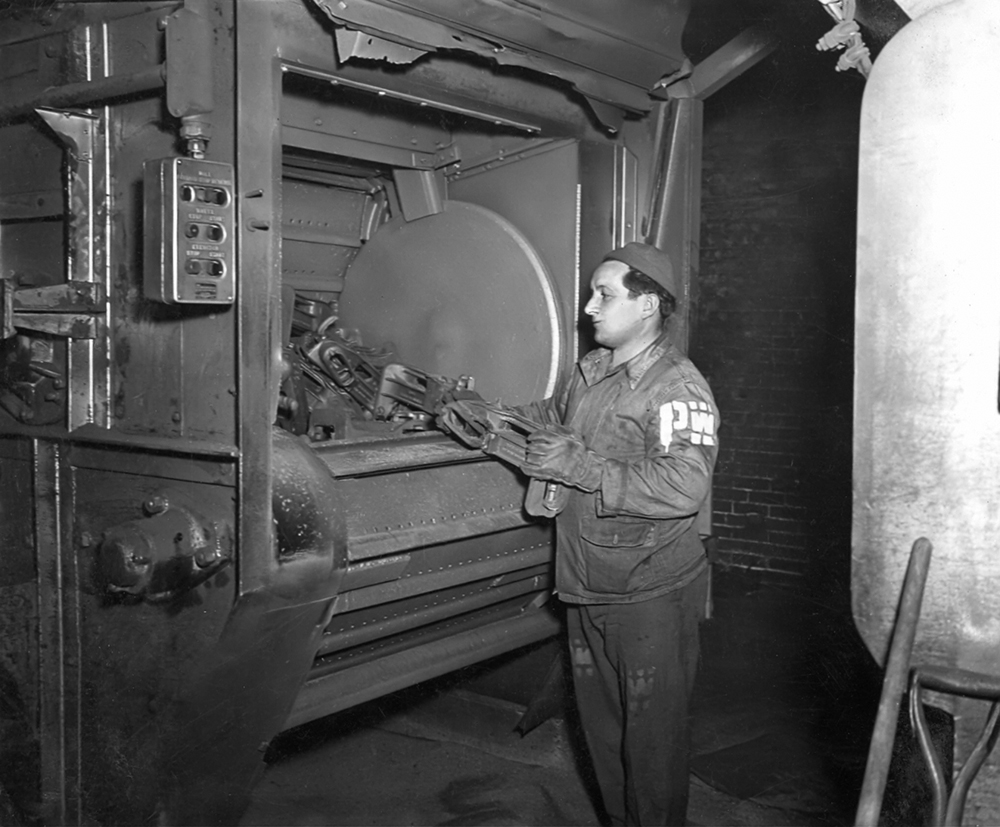
POWs at Camp Reynolds worked at nearby farms and industrial plants. Here, a prisoner operates machinery at the Meadville Iron Works.
ACW Production
Perhaps not coincidentally, the two hangings occurred at Camp Sharpe and Camp Reynolds. Thirty-eight-year-old private George Hartig was found hanging from a rafter on the second floor of the Adams Apple Products Corp. in Aspers. Hartig had been out of Camp Sharpe on a work detail doing general labor and never returned. An American guard at Camp Reynolds discovered German POW Heinrich Dresch strung up from the rafters of an empty barracks.
Investigation concluded that both deaths were self-inflicted, but the Dresch fatality in particular is reminiscent of forced suicides in the Southwest. He was alone inside a barracks, with Nazi POWs in charge of the inner workings of the camp. American guards witnessed several Nazi prisoners lurking nearby. Dresch was only 22 and the usual causes for suicide, including boredom, homesickness and shame from Germany’s defeats, seem insufficient explanations for what happened. The date of death might also be instructive. Dresch died in May 1945, just days after Germany’s surrender. Perhaps the demise of the Third Reich so embittered the Nazis at Camp Reynolds that they took it out on Dresch.
The truth is that no proof exists to state conclusively whether Hartig and Dresch perished at the hands of the Nazis, but the official finding of suicides can’t be proven either and became the standard American default position in cases with uncertain outcomes. Logic suggests that with so many Nazi and anti-Nazi POWs in Pennsylvania and so much unsupervised time that the chances for a forced suicide for at least a few anti-Nazis were not only possible but indeed likely.
A re-education program for the Axis prisoners of war became a necessity because of the outburst of Nazism in the camps and for the simple reason that the American people demanded it. Though it was deemed impossible to change the political and ideological views of the most zealous Nazis, the opportunity to reshape the thinking of the middle group of prisoners and the anti-Nazis proved too good to pass up. American leaders believed that the majority of German POWs could be gradually turned away from notions of hereditary monarchy, entrenched aristocracy, and despotic leadership to an affinity for representative government.
The Special Projects Division of the Office of the Provost Marshal General spearheaded the American re-education campaign. Because the Geneva Convention of 1929 banned compulsory measures designed to alter the political ideas of prisoners of war, the Special Projects Division implemented a voluntary program euphemistically known as “Intellectual Diversion,” a massive multimedia effort to ween the prisoners from totalitarianism and install in them democratic values. Of course, the reeducation program was “voluntary” in name only and constituted the American version of political and ideological reindoctrination.
Officers in charge of the re-education program set up history, government and politics, and other classes for the POWs, which used books, pamphlets and films to get across basic points. Teachers stressed that the German past contained many examples of authoritarianism, practiced by leaders such as Frederick the Great, Otto von Bismarck, and Kaiser Wilhelm II. Growing up in this environment, where the education, training and experiences of these men put special value on obedience and respect for hierarchy, instructors noted that POW behaviors were understandable no matter how counterproductive.
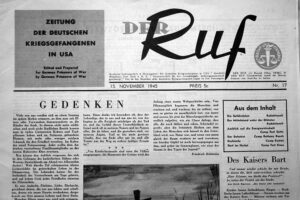
The German-language newspaper Der Ruf was a publication of the Special Projects Division of the Office of the Provost Marshal General, distributed to POW camps with the intention of advancing democratic ideals among German POWs.
National Archives
Few instances of democratic action could be found in German history, but the Weimar Republic constituted an exception to the rule and showed that the German people could adapt to a republican government. Officers and teachers emphasized the “wrong turns” and “dead ends” that Germany had taken, as well as its brief flirtation with democracy, while noting the importance of representative institutions to America’s progression from colony to superpower. Individualism, personal responsibility, and the principle that ultimate governmental power should be lodged in the hands of the people rather than elites were scary ideas for the uninitiated but in the long run offered Germans a much better future than groupthink and dictatorship. The American re-education program wished to send home a large cadre of German democrats who would help remold the political and cultural contours of postwar Germany in such a way that the nation would no longer pose a threat to world peace.
The Special Projects Division published Der Ruf (The Call), a newspaper that reported on the German home front, including military and political events. American news received attention as well. The contrast between American and German performance on the battlefield in 1944–45 was made clear. Hitler’s increasingly erratic behavior received attention and the horrors of the Holocaust were revealed.
Nazis, anti-Nazis and political moderates in American POW camps knew that Der Ruf came from higher authority. Some prisoners read Der Ruf while others did not. In the spring of 1945, one German POW at Camp Reynolds said Der Ruf “is well liked — it has nice articles about Germany and America.” But when an American officer asked if any POWs would be willing to contribute their own articles to the newspaper, another prisoner said, “we have decided to wait a bit before doing that . . . one has to be careful when writing.” The truth is that many Nazi prisoners considered Der Ruf American propaganda, and they often snapped up the papers and destroyed them.
The re-education program made little headway. While a few German prisoners — anti-Nazis, moderates and opportunists — were converted to democracy, most were not. After World War II ended, a group of German POWs traveled home as newly minted proponents of republicanism, but other factors loomed much larger in the democratization of postwar western Germany. The death of Hitler, the removal of Nazi elites, the Allied occupation, and the rise of new, democratic political parties transformed West Germany into a constitutional republic. At best, the converted POWs provided a bit of reinforcement to the new politics of West Germany, but democracy would have emerged there anyway.
Final Allied victory over the Axis in early September 1945 ended the American prisoner of war program. In November 1945 Japanese diplomats and their dependents at Bedford Springs traveled by train to California and by airplane to Japan. The last German POWs at Camp Reynolds departed for Europe on January 17, 1946. German POWs left the Gettysburg area on April 2, 1946. By midyear 1946, the rest of the Pennsylvania POWs were gone.
The U.S. government conducted the biggest, most ambitious prisoner of war program in the history of the country from 1942 to 1946. Pennsylvania participated in this venture, housing and processing thousands and thousands of prisoners, representing each of the Axis nations. German and Italian POWs served as a valuable source of labor at a moment when great numbers of Pennsylvania men were away fighting in Europe and Asia and many Pennsylvania women worked in war plants. Regrettably, friction between Nazis and anti-Nazis in Pennsylvania led to threats against anti-Nazis, intimidation, beatings and the probable execution of a small number. Camp commanders addressed terror in the camps by separating Nazis and anti-Nazis and employing re-education. Expectations for reindoctrination of a truly large number of German POWs proved unrealistic and their influence on postwar Germany slight. Successful at many levels, though not all, the best thing that can be said about the Pennsylvania prisoner of war program is that it returned so many German, Italian and Japanese captives home alive and well, whereas the same could not be said about POWs held in many belligerent nations.
Further Reading
Billinger, Robert D. Hitler’s Soldiers in the Sunshine State: German POWs in Florida. Gainesville: University of Florida Press, 2000. / Conti, Flavio G., and Alan R. Perry. Italian Prisoners of War in Pennsylvania: Allies on the Home Front, 1944–1945. Madison, NJ: Farleigh Dickinson University Press, 2016. / Gansberg, Judith. Stalag: U.S.A.: The Remarkable Story of German POWs in America. New York: Thomas Y. Crowell, 1977. / Hook, Jim. “An Ocean Apart for 70 years, Sons of Italian POW Meet for First Time.” Chambersburg Public Opinion, April 25, 2017. / Keefer, Louis E. Italian Prisoners of War in America, 1942–1946: Captives or Allies? New York: Praeger, 1992. / Krammer, Arnold. Nazi Prisoners of War in America. New York: Stein and Day, 1979. / Lassiter, Angela. “The Men Behind the Swastika: German POWs in Northwestern Pennsylvania.” Thesis, Shreyer Honors College, Pennsylvania State University, 2020. / Metcalf, Patrick L. “The Pine Grove Prisoner of War Camp.” Cumberland County History 17, no. 2 (Winter 2000): 118–130.
Richard E. Holl served as a professor of history at Hazard Community & Technical College for more than a quarter-century and now works as a freelance writer. He is the author of Committed to Victory: The Kentucky Home Front During World War II.