
Cameron County Courthouse
Written by Elizabeth Rairigh in the A Place in Time category and the Fall 2023 issue Topics in this article: Amos S. Wagner, Cameron County, Cameron County Courthouse, Emporium, National Register of Historic Places, Romanesque Revival style, Simon Cameron, World War I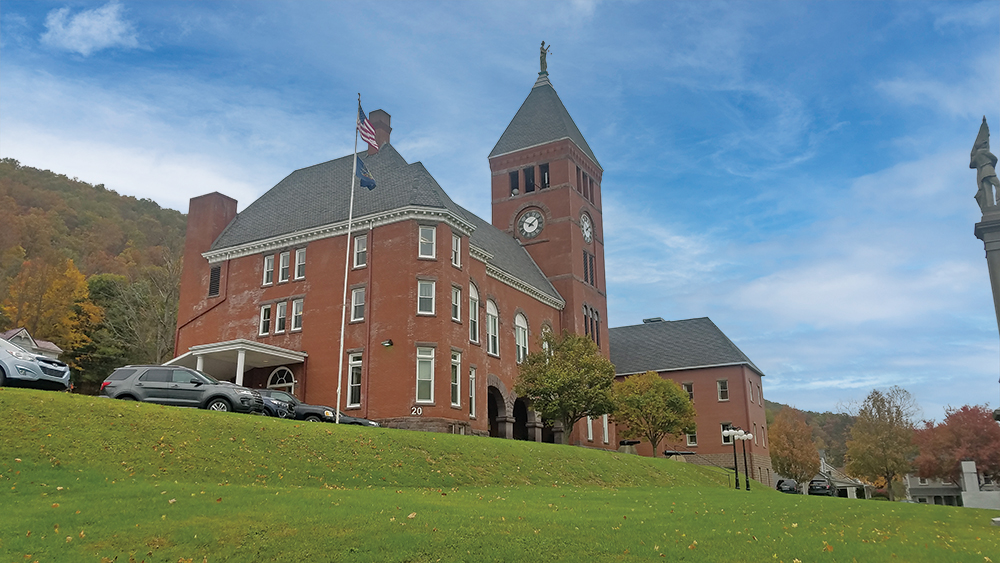
Cameron County Courthouse, Emporium.
Photo, Pennsylvania State Historic Preservation Office
Situated on a large rectangular site on high ground in the Borough of Emporium, the Cameron County Courthouse is significant as an architecturally sophisticated Romanesque Revival–style brick building designed to function as the governmental seat of justice in Pennsylvania’s Cameron County.
The courthouse was designed by Amos S. Wagner (1840–1899) and built by John W. Kriner in 1890. Wagner was a prominent architect from Williamsport, known for his use of the Romanesque Revival style. He also designed what is now the Rogers Gymnasium at Lock Haven University, as well as the Hart Building, four churches, a high school, and the city hospital in Williamsport.
Cameron County was created in 1860 and named for U.S. Senator Simon Cameron, later President Abraham Lincoln’s secretary of war. The Borough of Emporium, first settled in 1810, became the new county’s seat of government on October 13, 1864. The first courthouse was constructed on the present courthouse grounds around this time.
On May 6, 1889, the county commissioners began discussing how to improve or replace the old frame courthouse. Initially they considered moving back the original building 40 feet and constructing a brick-and-stone addition with a clock tower to the south. A fire in early 1890, however, settled the matter, and it was decided that the old fire-damaged building would be demolished and replaced with a new brick courthouse.
Constructing the new courthouse required substantial fundraising efforts. Emporium residents donated $5,000, an impressive amount for a population of about 1,000 people.
The courthouse interior features many intact wood and plaster ornamental elements, as well as the original judge’s bench. The courthouse bell was a gift from Simon Cameron himself. Distinguishing characteristics of the exterior include a central clock tower, atop of which stands a large statue of Lady Justice holding a scale and a sword with gems. Uniquely, the statue is blindfold-free, indicating that the Justice at the Cameron County Courthouse would see all. This is one of only six Justice statues in the United States that does not wear a blindfold.
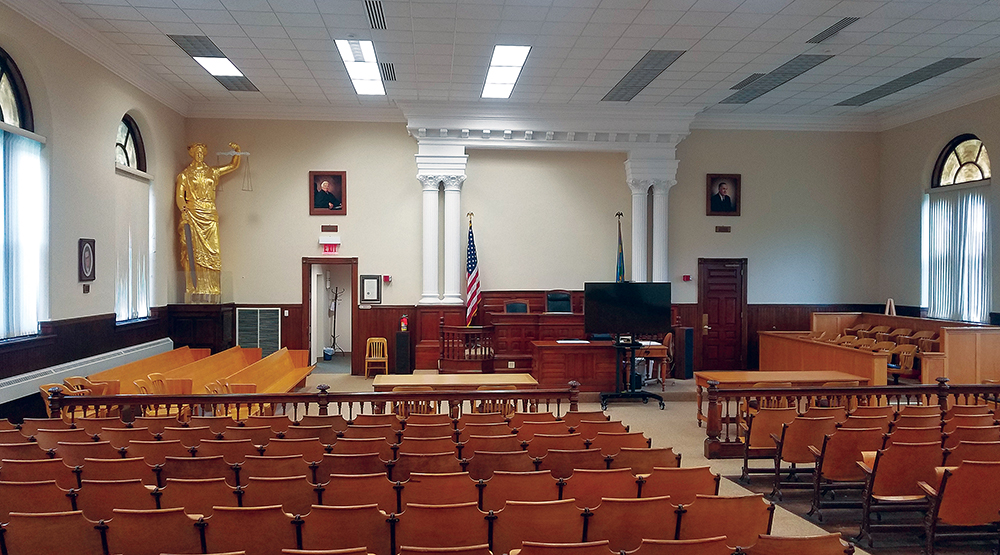
Cameron County Courthouse interior.
Photo, Pennsylvania State Historic Preservation Office
A World War I monument stands on the courthouse grounds honoring, as an attached plaque states, “the men and women of Cameron County who answered their country’s call to service in the World War.” Taking the form of a U-shaped square enclosure with benches and an Art Deco–style post-and-lintel doorway, the monument lists the names of more than 250 servicemembers from the county.
The Cameron County Courthouse was listed in the National Register of Historic Places for its architecture. The building retains a good level of integrity to convey its historic use as a county courthouse, and it remains a prime example of late 19th-century Romanesque Revival–style government architecture. It is the first and, currently, the only National Register listing in Cameron County.
Recent listings in the National Register of Historic Places include S.L. Allen & Co. Building, Philadelphia; Blumenthal Brothers Chocolate Factory, Philadelphia; Girard Commercial Historic District, Girard, Erie County; Hyson Schools Historic District, East Hopewell Township, York County; Lehigh Valley Transit Station, Perkasie, Bucks County; Mellon Park, Pittsburgh, Allegheny County; Midland Cemetery, Swatara Township, Dauphin County; Scranton Electric Building, Scranton, Lackawanna County; Star Carpet Mill, Philadelphia; Walnut Street Bridge, Hellertown, Northampton County; and Zion Baptist Church and Educational Annex, Philadelphia.
Elizabeth Rairigh is the division chief for Preservation Services and the National Register coordinator in the Pennsylvania State Historic Preservation Office.