
The Appleseed of a Nation
Written by Don Sarvey in the Features category and the Fall 2024 issue Topics in this article: apples, Emanuel Swedenborg, Franklin (Venango County), Henry W. Shoemaker, John Chapman (Johnny Appleseed), Lansing Wetmore, Venango County, Warren, Warren County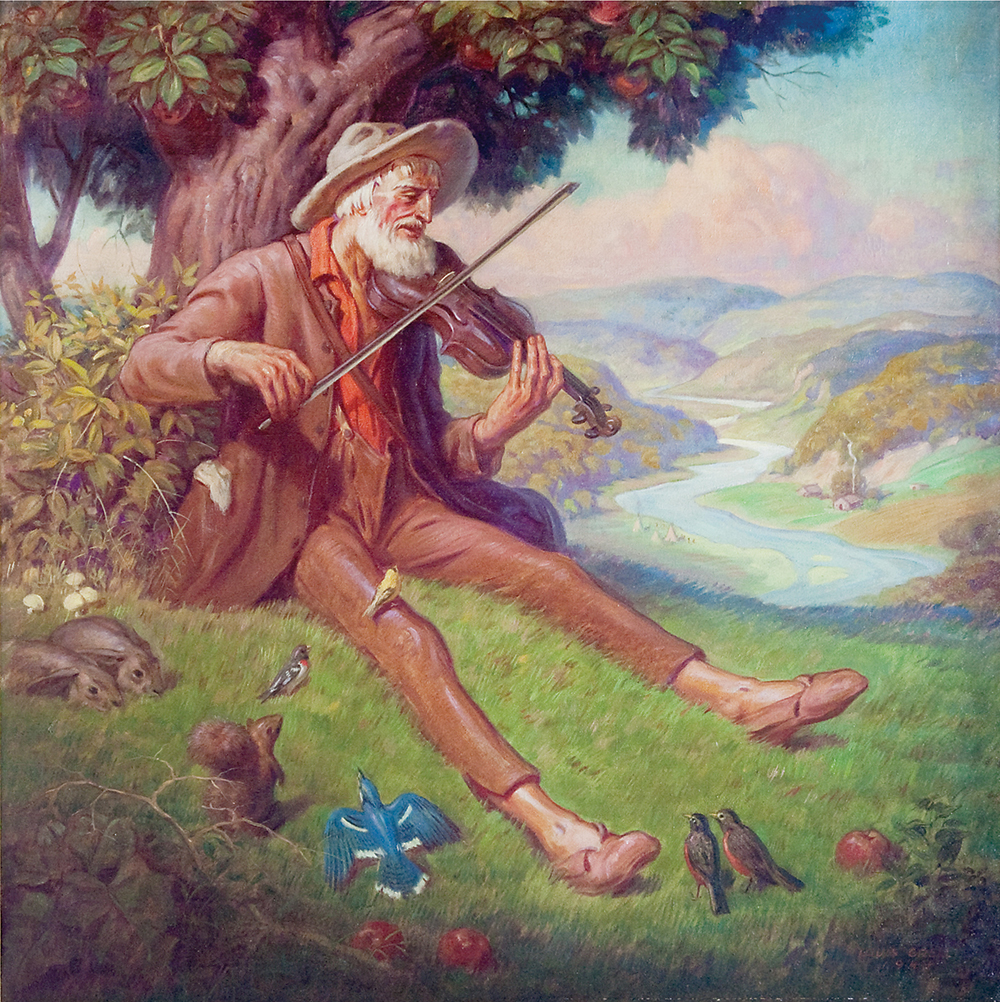
Chicago Tree Studio muralist and portrait artist Louis Grell (1887–1960) rendered his vision of Johnny Appleseed in this 1944 oil-on-canvas painting.
Courtesy of Richard Grell
In an article in The Atlantic magazine in 1862, Henry David Thoreau observed that it’s “remarkable how closely the history of the apple-tree is connected with that of man.” He wrote, “The cultivated apple-tree was first introduced into this country by the earliest settlers, and it is thought to do as well or better here than anywhere.” He presented to his readers the image of a westward-bound emigrant “marching steadily toward the setting sun with the seeds of the apple in his pocket, or perhaps a few young trees strapped to his load.”
He could have been and perhaps was describing Johnny Appleseed, real name John Chapman (1774–1845), the legendary character who spread apple seeds and planted orchards that supplied apples mainly for making hard cider and alcoholic apple jack. In this manner, Chapman helped nourish a fledgling frontier — a frontier that, at the time, went through Pennsylvania.
We can be forgiven if we confuse Johnny Appleseed with colorful but fictional figures of the time such as woodsman Paul Bunyan, cowboy Pecos Bill, or steelworker Joe Magarac, but Chapman was a real person. Quite real. And quite eccentric. He was like an early flower child; he might have been America’s first hippie.
The character Johnny Appleseed seems to have been especially kind and innocent, and as a result he holds singular appeal to children, which is why to this day, as we come to the 250th anniversary of his birth, he is still featured in stories and picture books, school plays and pageants.
William Kerrigan, a professor of history at Muskingum University in Ohio, is an authority on Johnny Appleseed, having written the book Johnny Appleseed and the American Orchard: A Cultural History. He pointed out that Johnny Appleseed remains “a staple of elementary school education” because he “embodies the positive characteristics we want our nation to be associated with,” those characteristics being kindness, usefulness and generosity. “The core of his appeal is kindness,” Kerrigan said, adding that this stands in counterpoint to the violence often associated with other legendary figures of his time, such as Davy Crockett and Daniel Boone.
An article in the Pittsburg Dispatch in 1891 described John Chapman as “a man who harmed nothing and no one, but who added his mite [sic], in a humble way, to the pleasures of the generations that came after him.”
By various accounts, Chapman was born in 1774, 1775 or 1776 in Massachusetts, either in Boston, Springfield or Leominster. The accepted version is 1774 in Leominster, which means we are celebrating his 250th birthday this year.
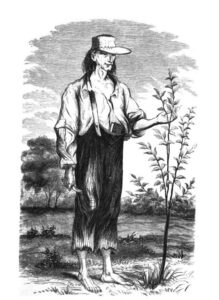
In much of the folklore about Johnny Appleseed, he is described as wearing a tin mush pot for a hat and a coffee sack for clothes. His attire was perhaps more as it appears in this drawing, published in 1863.
From H.S. Knapp, A History of the Pioneer and Modern Times of Ashland County (Philadelphia: J.B. Lippincott, 1863)
It was said that Chapman’s father was a Continental Army soldier who fought in the Revolutionary War. The young Johnny became a roaming, rootless man and a bit of a religious zealot. He got his nickname because he carried with him a satchel of apple seeds collected from cider mills and left in his wake fledgling apple orchards.
The Scranton Tribune in 1894 recalled him as “one of the quaintest, queerest and most original characters that ever trod the trackless wastes of the western wilderness.” The story lauded Chapman as “the pioneer orchard planter of the west” who took care to never harm any living creature.
Over the course of his life, Chapman traveled from Massachusetts to New York State and into Pennsylvania’s Wyoming Valley and then westward to Warren and Venango counties and then on into Ohio and Indiana. He died and was buried in Fort Wayne, Indiana, in 1845.
According to Kerrigan, Chapman’s sojourn in Warren County prompted an account by a local historian, a judge, that helped create the narrative of Johnny Appleseed, the story of the character whose mantle he assumed for the rest of his life. In effect, Kerrigan said, “the Pennsylvania chapter was the most interesting part of his life.” It was in Pennsylvania that John Chapman the man was transformed into Johnny Appleseed the character and legend. In that sense, though Johnny Appleseed was not a native son of Pennsylvania, perhaps he could be considered an adopted son.
The judge, Lansing Wetmore, told how John Chapman, “a tall stalwart Yankee,” started out “bare footed and alone” with “a sack of choice apple seeds” along with his “blanket, rifle and tomahawk” to make a November 1797 journey from the Wyoming Valley “to the headwaters of the Allegheny, 100 miles from where he started.”
The account, which was provided by Michelle Gray of the Warren County Historical Society, was originally delivered by Judge Wetmore in a speech to the Warren Lyceum and published in the Warren Ledger newspaper in March 1853.
The judge told how Chapman encountered a deep snowfall on his way across the mountains and fashioned foot coverings from part of his “blanket coat” and then heated beech twigs to make crude show shoes. “After a little practice [he] pursued his lonely way through the wilderness of Potter and McKean counties and arrived in Warren about the first of December.”
The following spring, the judge related, Chapman selected a spot for an apple nursery along the Big Brokenstraw Creek and planted the seeds he had carried with him. But Chapman failed to make a living from this enterprise and in time moved on. “The demand for fruit trees being quite limited and unable to obtain a livelihood by his favorite pursuit, [Chapman] went to Franklin, [in Venango County] where he sowed another nursery, and after a few years left for Indiana.”
Chapman’s sojourn in Venango County is memorialized by an official state historical marker in Franklin that was dedicated in 1982. In remarks for the unveiling ceremony, then Pennsylvania Historical & Museum Commission executive director Larry E. Tise noted that “the evidence indicates that John Chapman established his very first nurseries in the Warren area and near here — and his presence both in Franklin and along French Creek [which flows into the Allegheny River at Franklin] is substantiated by original records dating from the period.”
Tise remarked that Chapman “conformed to the standards of neither his time nor ours for conventional success, yet he made an impression on both his contemporaries and later generations that few of us can emulate. The name Johnny Appleseed has become enshrined among horticulturists, school children, and admirers of his high-minded individualism — which, though decidedly eccentric, was peculiarly suited to the ways of the shifting frontier upon which he felt at home.”
Stories of Johnny Appleseed and apple trees he may have planted abound, many untethered to historical documentation. For example, did Chapman make a side trip to Clinton County on his way across Pennsylvania? Henry W. Shoemaker, Pennsylvania’s first state folklorist, writing in 1953, claimed that an apple tree planted by Johnny Appleseed once stood near where he lived in Clinton County, but there seems to be no independent verification for this. Shoemaker referred to a “folktale story” that Johnny was the offspring of a character called “Jew Chapman” and a half-Native American woman named Marianne LaGrille. Shoemaker acknowledged that this story was “set off against the conflicting claims of others.” As Simon J. Bronner noted in his Shoemaker biography, Popularizing Pennsylvania, the legend you hear from Shoemaker “may just be the work of his imagination.”
There is also a story that places Chapman living in a cabin in Pittsburgh in the 1790s, but in a footnote in his book, Kerrigan notes that “no corroborating evidence survives” for such a claim; however, he cautions that just because something can’t be proven as true doesn’t necessarily mean it’s untrue. “There are so many great stories and myths [about Johnny Appleseed] there is probably room for additional research on his Pennsylvania experience,” he said in an interview.
Years after Chapman’s death — which reportedly resulted from typhoid fever — stories about him continued to circulate and the legend continued to grow.
An account published in 1888 in the York Gazette but datelined Mansfield, Ohio, contained an interview with a Dr. Bushnell (no first name given) who purportedly had been personally acquainted with Chapman.
“He used to come to my house when he passed through this part of the country,” Dr. Bushnell said. “He was a small wiry man” — at odds with the description of Chapman as “tall” given by Judge Wetmore — “with thin lips, dark face and long dark hair. His eyes were black and sharp and piercing. He had a pleasant smile but his face was usually sober and as to his dress it was as fantastic and dilapidated as you can imagine. It was made up of cast-off garments which he had gotten in exchange for apple trees or seeds, and he cared nothing at all for appearances. I have seen him at times when his chief garment was a coffee sack with a hole at the top for his head to pass through and one at each side for his arms. He never wore shoes except in the coldest of weather.” It was oft-repeated in stories that he wore a “tin mush pot” for a hat.
![According to Harper’s New Monthly Magazine, "It was [Chapman's] custom, when he had been welcomed to some hospitable log-house after a weary day of journeying, to lie down on the puncheon floor, and, after inquiring if his auditors would hear 'some news right fresh from heaven,' produce his few tattered books, among which would be a New Testament, and read and expound." From Harper’s New Monthly Magazine 43, no. 258 (November 1871): 833.](http://paheritage.wpenginepowered.com/wp-content/uploads/2024/10/07-johnny-appleseed-2-300x228.jpg)
According to Harper’s New Monthly Magazine, “It was [Chapman’s] custom, when he had been welcomed to some hospitable log-house after a weary day of journeying, to lie down on the puncheon floor, and, after inquiring if his auditors would hear ‘some news right fresh from heaven,’ produce his few tattered books, among which would be a New Testament, and read and expound.”
From Harper’s New Monthly Magazine 43, no. 258 (November 1871): 833.
An 1879 newspaper story that appeared in the Lancaster Intelligencer characterized Johnny Appleseed as caring little for personal needs. It said he sold the trees he planted “at a very low price” or took items in trade such as old clothes or cornmeal. “If the customer was too poor to purchase trees, which frequently happened, he got them without pay.”
At some point in his life, Chapman became an adherent of the philosophy of Emanuel Swedenborg, a Swedish mystic who claimed inspired revelations of heaven and in 1787 founded the New Church, a small Christian sect that still exists. One of the religion’s main branches, known as the General Church of the New Jerusalem, is based in Bryn Athyn, Pennsylvania. According to Kerrigan, Chapman was attracted to Swedenborgianism because its practitioners were generally friendly and helpful people and emphasized putting the needs of others before self. That attitude was characteristic of Chapman, he said.
An account from 1883, published in The Canton [Pennsylvania] Independent-Sentinel, relates how Chapman put out his campfire in the woods because the wind was blowing mosquitoes into the fire. “God forbid that I should build a fire for my comfort which should be the means of destroying any of His creatures,” he was quoted as saying.
According to the Pittsburg Dispatch account, when Chapman entered someone’s cabin it was usual that he would lie down on the floor, open a copy of the New Testament, and announce he was going to read “some news right fresh from heaven.”
A multistate celebration of Chapman’s 183rd birthday was held in 1957 with the governors of Pennsylvania, Massachusetts, Ohio and Indiana all declaring September 26 as Johnny Appleseed Day. The brochure for the event doesn’t explicitly say who sponsored the celebration, but the amount of copy devoted to Johnny’s connection to the Swedenborgian philosophy suggests it was the Swedenborg Foundation.
Until last year, there was an annual Johnny Appleseed festival in Sheffield, near where his first orchard in Pennsylvania was located, but the event is no longer being held. Outside Pennsylvania, the Chapman legacy is celebrated with information centers and festivals in Massachusetts, Ohio, Indiana, Wisconsin and Minnesota. Chapman’s fame was extended with a commemorative issue in the Folklore Series of U.S. postage stamps in 1966. He has even been celebrated as the “Patron Saint of American Orchards” in Ripley’s Believe It or Not!
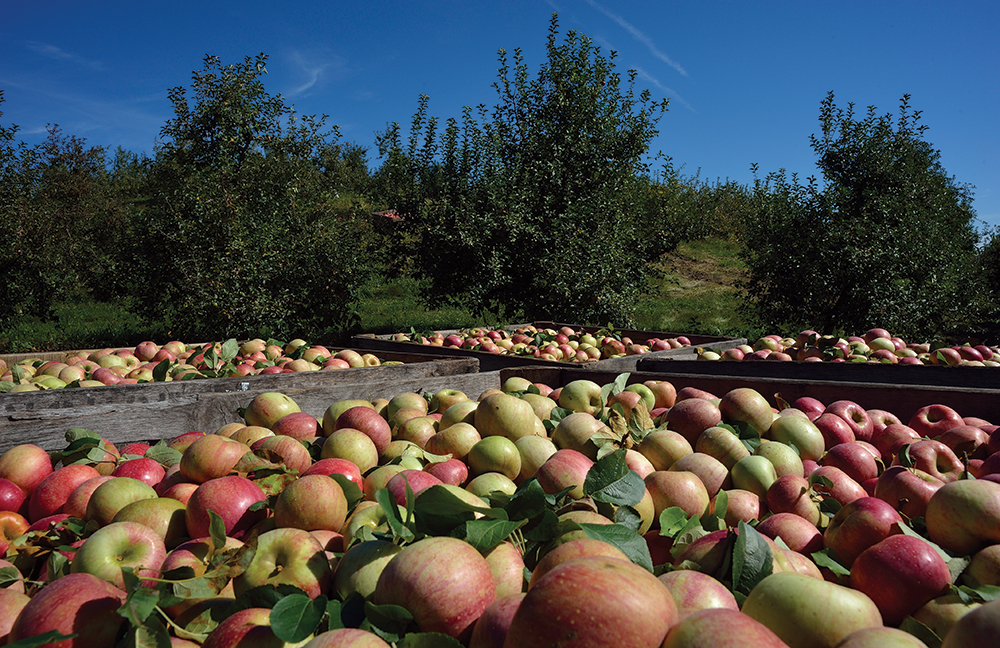
And, of course, apples are an important part of Pennsylvania’s modern agricultural economy, both as a domestic commodity and as an export to other countries. The United States is second only to China in the production of apples in the world. According to 2023 figures, Pennsylvania ranks fourth among the states, behind Washington, Michigan, and New York. The 2023 yield of apples in Pennsylvania weighed in at a total of 440 million tons.
We see apples every day as a common, bottom-of-the-bag ingredient in lunches and snacks for school and work, but we sometimes forget apples can be as splendidly noble as the mythical golden apples of the Hesperides that were the object of a storied quest by Hercules. And the centrality of apples in our culture is evident in our language. She’s the apple of my eye. An apples-to-apples comparison. An apple a day keeps the doctor away. The apple never falls far from the tree. When we say something is as American as apple pie, we’re actually referencing history: Amelia Simmons’ 1796 American Cookery, considered to be the very first American cookbook, contained a recipe for apple pie.
Further Reading
Bronner, Simon J. Popularizing Pennsylvania: Henry W. Shoemaker and the Progressive Uses of Folklore and History. University Park: Pennsylvania State University Press, 1996. / “Johnny Appleseed: A Pioneer Hero.” Harper’s New Monthly Magazine 43, no. 258 (November 1871): 830–836. / Kerrigan, William. Johnny Appleseed and the American Orchard: A Cultural History. Baltimore: Johns Hopkins University Press, 2012. / Means, Howard. Johnny Appleseed: The Man, the Myth, the American Story. New York: Simon & Schuster, 2011. / Simmons, Amelia. American Cookery. Hartford, MA: Hudson & Goodwin, 1796.
Don Sarvey, a former newspaper reporter and magazine editor, is a freelance writer who lives in Harrisburg. His previous articles for Pennsylvania Heritage include “The Making of a Leader: George C. Marshall” (Spring 2023) and “Agnes: Pennsylvania’s Most Devastating Natural Disaster” (Summer 2022).