
“An Office I had some kind of Right to”: Benjamin Franklin and the Origins of the U.S. Postal Service
Written by Lorett Treese in the Features category and the Summer 2025 issue Topics in this article: Andrew Bradford, Anthony Todd, Benjamin Franklin, Continental Congress, Hutchinson letters, Independence National Historical Park, John Foxcroft, newspapers, Philadelphia, printing, Stamp Act, U.S. Postal Service, William Goddard, William Hunter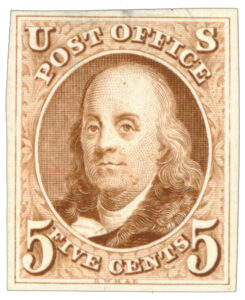
Benjamin Franklin has been featured on more than 130 U.S. postage stamps but comes in second, after George Washington, as the person who has appeared most frequently on them. Both patriots were on the first stamps issued on July 1, 1847, with Franklin in a fur-collared coat on the 5-cent stamp.
National Postal Museum, Smithsonian Institution
In 1788, near the end of his life, Benjamin Franklin (1706–90) summed up a lengthy and significant association with the postal system in America in a letter to his old friend Charles Thomson, then secretary of the Continental Congress. Franklin wrote, “On my Return from England the Congress bestow’d on me the Office of Postmaster General, for which I was very thankful. It was indeed an Office I had some kind of Right to, as having previously greatly enlarg’d the Revenue of the Post by the Regulations I had contriv’d and establish’d, while I posses’d it under the Crown.”
The earliest British American colonists were on their own when it came to distributing mail from the mother country that arrived on trading vessels. Massachusetts was first to pass an ordinance directing that all mail arriving on any ship be delivered to a specific tavern where recipients could call for their letters and packages or have the tavern owner deliver them for a fee. Some 17th-century colonial governors tried to establish post routes connecting the Eastern Seaboard settlements with little success. In 1710 Britain addressed the issue with the Post Office (Revenues) Act, bringing American mail distribution into a reformed British postal monopoly. A postmaster general in London would henceforward control the transmission of mail in the American colonies.
Colonial printers quickly learned that also serving as the local postmaster let them control the distribution of their broadsides, advertisements and printed material, which often included a newspaper. The local postmaster was first to receive news from colonial post riders and ships coming into port. This news became content for the newspaper that the postmaster wrote, edited and printed. Postmasters held a franking privilege, a perk allowing them to send their own mail, including their newspapers, free of charge.
In the 1720s Andrew Bradford (1686–1742) was Philadelphia’s postmaster and publisher of a city newspaper: The American Weekly Mercury. Once Benjamin Franklin established himself as a Philadelphia printer, he bought and revitalized a competing publication: The Pennsylvania Gazette. Bradford denied Franklin the right to distribute his newspaper through the mail. In his Autobiography, first published in 1791, Franklin recalled, “What I did send was by bribing the riders, who took them privately, Bradford being unkind enough to forbid it.” Franklin observed, “I thought so meanly of him for it, that, when I afterward came into his situation, I took care never to imitate it.”
Franklin got Bradford’s Philadelphia postmaster job in 1737 when Col. Alexander Spotswood, then deputy postmaster general for the American colonies, withdrew Bradford’s commission, for having failed to submit financial reports, and offered the position to Franklin. In his Autobiography, Franklin noted, “Tho’ the salary was small, it facilitated the correspondence that improv’d my newspaper, increas’d the number demanded, as well as advertisements to be inserted, so that it came to afford me a very considerable income.”
On October 27, 1737, Franklin’s Pennsylvania Gazette published the news, “Notice is hereby given that the post office of Philadelphia is now kept at B. Franklin’s in Market Street.”
As Philadelphia’s postmaster, Franklin adopted a system of metropolitan mail delivery already in use in London. It had long been the custom for post riders to deliver all regional mail to a city’s official post office where those expecting letters or packages had to come and claim them. In 1738 Franklin began publishing the names of addressees on mail awaiting pick up at the post office in his Pennsylvania Gazette, saving many exurban residents a fruitless journey. Later he added what came to be known as the “penny post.” Mail remaining uncalled for could be delivered directly to a city addressee for the fee of a penny.
Besides his work as printer and postmaster, Franklin was a savvy entrepreneur. Through partnerships, he financed print shops in other American colonies. He sold printing supplies wholesale. He produced content for his own publications, including his popular Poor Richard’s Almanack. Franklin created what today might be called a vertically integrated media enterprise.
In 1751 Franklin learned that Elliott Benger, the deputy postmaster general for the American colonies, was near death. Franklin began lobbying for the position. By that time, he had been Philadelphia’s postmaster for over a decade. He had also been appointed comptroller for the American postal system, a position second in rank to the American deputy postmaster. Franklin wrote Peter Collinson, a London merchant and lifelong friend, asking for his assistance: “The Place is in the Disposal of the Post Masters General of Britain with some of whom or their Friends you may possibly have Acquaintance.”
Realizing that it might be necessary to grease some palms, Franklin authorized Collinson to spend up to £300 to secure the position; however, he urged Collinson to be discreet: “As I have a respect for Mr. Benger I should be glad the Application were so managed as not to give any Offense if he should recover.”
Benger survived until 1753. On August 10 of that year, England’s postmaster general ordered that Benjamin Franklin together with William Hunter (c.1730–61) be appointed “Deputy Post Masters and Managers of all His Majesty’s Provinces and Dominions on the Continent of North America.” William Hunter of Williamsburg was a printer and the publisher of the Virginia Gazette who had also served as a city postmaster. The Franklin–Hunter partnership worked well, with Franklin in charge of the mail north from Pennsylvania and Hunter in charge of the southern colonies. Years later, after Hunter’s death, Franklin spoke warmly of their relationship. In a condolence letter to Hunter’s brother, Franklin recalled that the two of them had “Liv’d and transacted Business with the most perfect Harmony.”
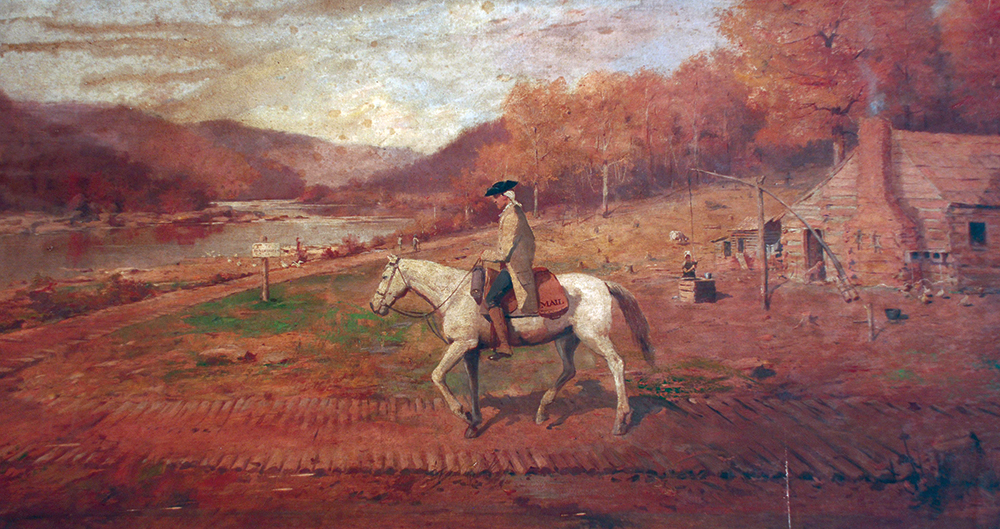
Lloyd Branson (1853–1925) created this scene of an early American mail carrier astride his horse, traveling through a rural area to make deliveries.
National Postal Museum, Smithsonian Institution
The partners soon agreed that New York City, chosen by their British bosses to be America’s central post office, was not the best location. Neither deputy postmaster relocated there. Hunter continued to live and work in Williamsburg while Franklin remained in Philadelphia. Franklin’s place of business on Market Street became the de facto central post office for the American colonies.
When Franklin and Hunter took office, intercolonial mail did not move very quickly. Post riders traveled on horseback. It could take three weeks for a rider to get from Philadelphia to Boston. New York to Boston took two weeks. In the summer, mail arrived once a week in Philadelphia, New York and Boston but only every other week in the winter. South of Virginia the roads were very poor, and the mail was often shipped from port to port by vessel.
Upon their appointments, Franklin and Hunter embarked on a journey from Maine to Virginia, inspecting post routes and post offices. They came up with new, more efficient routes, specifically routes that avoided river ferries. Post riders were routinely made to wait until a ferry operator had loaded his vessel with sufficient freight and paying passengers to make a crossing worthwhile. Franklin instructed post riders traveling between New York and Philadelphia to ride at night as well as by day. Franklin described this innovation in a 1764 letter to Anthony Todd (c.1718–98), secretary of the British post office, as an improvement “which has never heretofore been done in America.” He explained that a letter from Philadelphia to New York “can be sent from one place to another, and an Answer received the Day following, which before took a week.”
Based on Franklin’s difficulties in getting his Pennsylvania Gazette distributed, Franklin and Hunter took steps to prevent other printer-postmasters from similarly crippling their competition and post riders from expecting bribes. In 1758 they established standardized policies and rates for newspaper delivery. In their instructions to American postmasters, they acknowledged the importance of newspapers “which are on many Occasions useful to Government, and advantageous to Commerce and to the Publick.”
Franklin also standardized bookkeeping for local postmasters, who previously had been keeping records however they pleased. He printed broadsides with instructions and examples, distributing them to the local post offices. He required all postmasters to post their records in folio ledgers and submit these to inspectors, also abstracting quarterly reports for the central post office.
Before Franklin and Hunter instituted their reforms, the American post office had never generated revenue for the Crown. Their joint appointment allowed each of them an annual salary of £300, but that had to come out of the profits earned by the American postal system. Initially, rather than drawing a salary, the two deputy postmasters went into debt. In his Autobiography, Franklin recalled, “In the first four years the office became above nine hundred pounds in debt to us. But it soon after began to repay us.” In 1760 and 1761, the post office earned a surplus from which the deputy postmasters could recover their outlay and pocket a salary. Franklin added that eventually “we had brought it to yield three times as much clear revenue to the crown as the postoffice of Ireland.”
Much of what Franklin and Hunter accomplished in America, they directed from abroad. In 1757 Pennsylvania’s Assembly, its representative legislative body, sent Franklin to London to promote their interests with the Penn family and the British government. Hunter also left for England to improve his health. The two deputy postmasters directed operations in America through correspondence with James Parker, their secretary and comptroller. Parker, born in New Jersey, had worked with Franklin in Philadelphia, who helped him set up a printing business in New York. Parker employed Benjamin Franklin’s nephew, Benjamin Mecom, as an apprentice. In his letters to Franklin, Parker often mentioned how “Benny” was coming along.
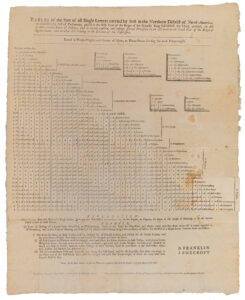
Colonial postmasters Benjamin Franklin and John Foxcroft issued this postal rate chart, listing the cost of postage for deliveries between various locations, in 1765.
National Postal Museum, Smithsonian Institution
William Hunter died in 1761, and Franklin’s superiors in London named John Foxcroft (d.1790) of Virginia to replace Hunter as Franklin’s new partner. Foxcroft had been private secretary to the governor of Virginia. His appointment may have been one reason Franklin decided to return to America in 1762. In June of 1763, Franklin informed Anthony Todd that the two deputy postmasters had met in Virginia, and Foxcroft had since traveled to Philadelphia where the two of them were “now proceeding in our intended Tour to inspect and regulate all the Offices in our Department, without which it will be impossible for us to render the regular Accounts required of us.”
That same year, the Treaty of Paris ended the French and Indian War. New France became British Canada where the British created the new province of Quebec. In March 1763 Todd wrote Franklin and Foxcroft that the merchants of Quebec “plainly appear to labor under many difficulties for the want of a safe and Speedy Conveyance of Letters.” He ordered the deputy postmasters to establish a post route from New York through Albany to Montreal and Quebec City. He also informed them that Hugh Finlay of Scotland would be appointed postmaster of Quebec.
In 1763 Todd also directed Franklin and Foxcroft to oversee the packet boats intended to carry mail monthly from New York to Falmouth in England. A packet boat was scheduled to depart New York the second Saturday of each month. Todd wrote the deputy postmasters that its timing was important so that all Americans could “calculate, according to the course of the Inland Posts, at what time to Write, so that their Letters for Europe may arrive by the proper day at New York.” In 1768 a second line of packet boats would be established between Charlestown and Falmouth, facilitating correspondence between the mother country and the southern American colonies.
Franklin left for England in 1764, once again acting as agent for the Pennsylvania Assembly. By that time in his life, he envisioned a new relationship between the American colonies and the Crown. His experience with the postal system and all the traveling it entailed had demonstrated to Franklin that the colonies shared common interests and could effectively work together. It was time for their representation in Parliament as a vital part of the British Empire.
Franklin had long been angling for a reduction in the postal rates, which made mailing a letter a luxury that some Americans could barely afford. He reasoned with British authorities that any revenue lost through a rate reduction would be made up by increased volume in the use of the postal system. In 1765 Parliament passed a new Post Office Act to more effectively administer the entire American system. It lowered domestic rates about 30 percent. It generally withdrew franking privileges from local postmasters and cracked down on abuses. It also divided the American postal system into two regions: a northern department extending from Virginia to Canada and a southern department including the Carolinas, Georgia, Florida, and the West Indian Islands to be headquartered in Charleston.
In 1765 Parliament also passed the far more famous Stamp Act, taxing the American colonies for military troops stationed in the colonies during the French and Indian War. The Stamp Act had nothing to do with the postal system in America. It stipulated that paper embossed with a revenue stamp had to be used not only for legal documents but also for popular consumer items like newspapers and playing cards. The stamped paper was produced in London and had to be purchased by American colonists with British currency.
Americans were outraged at being taxed without the consent of their colonial legislatures and with no representation in Parliament. Taxation without representation, they called it. They petitioned Parliament and the Crown for the Stamp Act’s repeal.
Benjamin Franklin opposed the Stamp Act. When the House of Commons considered its repeal, they questioned Franklin in his capacity as a deputy postmaster general for the American colonies. He argued that the act was impractical; how could this stamped paper be delivered? The post routes extended only so far into the frontier. Franklin testified, “Many of the inhabitants could not get stamps when they had occasion for them without taking long journeys and spending perhaps Three or Four Pounds, that the Crown might get Six Pence.”
Then what about the postal system itself, Franklin was asked. Do the colonists consider its rates a tax?
“Not as a tax,” Franklin replied, “but as a regulation and conveniency; every assembly encouraged it, and supported it in its infancy, by grants of money, which they would not otherwise have done; and the people have always paid the postage.”
This interview caused Franklin to be viewed in London as a champion of American interests. In 1768 John Montagu, earl of Sandwich, was appointed postmaster general, or Franklin’s new boss. Lord Sandwich favored the Stamp Act. Perhaps to get Franklin out of the public spotlight, he began implying that if Franklin was a deputy postmaster general in America, he should either return to America or resign his position.
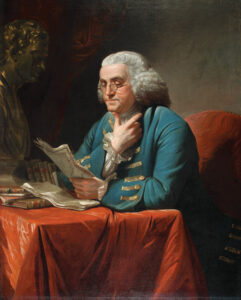
Benjamin Franklin was painted by Scottish artist David Martin (1737–97) in 1767. Detail of the image was later featured on a 39-cent stamp commemorating Franklin’s role as postmaster in 2006.
Pennsylvania Academy of the Fine Arts, Gift of Maria McKean Allen and Phebe Warren Downes through the bequest of their mother, Elizabeth Wharton McKean
Franklin managed to hold on to his job and remain in London until 1774, when he became involved in the infamous matter of the Hutchinson letters. Back in 1768 and 1769 Massachusetts governor Thomas Hutchinson had written to British authorities urging them to strengthen the colony’s executive branch of government over the legislative, therefore limiting the voice and power of the people. In 1772 an anonymous sender shared these letters with Franklin, who concluded that the governor had exaggerated insubordination in the colony, thus misleading Parliament. Franklin shared the letters with Thomas Cushing, speaker of the Massachusetts Assembly, but urged him not to make the letters public. In 1773 Samuel Adams, then clerk of the Massachusetts Assembly, leaked the content, if not the actual text, to the press. This caused public furor in Massachusetts forcing Hutchinson to flee the colony.
Although Franklin thought he had acted for the greater good of the British empire, he became persona non grata in England. On January 31, 1774, Anthony Todd sent Franklin a one-paragraph letter stating, “I have received the Commands of His Majesty’s Post Master General to signify to you that They find it necessary to dismiss You from being any longer Their Deputy for America.”
On February 18, 1774, Franklin wrote Foxcroft that though they would no longer be working together, “Let us part as we have liv’d so long, in Friendship.” He added, “It seems I am too much of an American. Take care of yourself, for you are little less.” John Foxcroft remained a deputy postmaster general for the American colonies; Franklin was replaced by Hugh Finlay.
Was Franklin bitter? In his Autobiography, in the same paragraph in which he commends himself for finally generating post office revenue for the Crown, he commented on his dismissal: “Since that imprudent transaction, they have received from it [the postal system] – not one farthing!”
The Post Office (Revenues) Act of 1710 had granted officials the right to intercept letters and open them, a practice of government spying that had already been common in England when the act was passed. Such a thing had rarely occurred in the American colonies, but Franklin thought it was increasingly likely, given the rising political unrest in America.
On February 15, 1774, he wrote Thomas Cushing that his dismissal might have been a warning to American postmasters that if they did not “promote the measures of administration, though against the interest and rights of the colonies, they must not expect to be continued.” He suggested that vacancies might be filled with loyalists, adding, “How safe the correspondence of your Assembly-committees along the continent will be through the hands of such officers, may now be worth consideration.”
In 1775, following armed conflict at Lexington and Concord, British authorities did in fact order the opening and screening of letters arriving in England on the packet boats from New York and Charleston. But rather than spying upon or persecuting individuals, their intent was to sample public opinion to learn exactly how widespread was the spirit of rebellion in America.
Other Americans shared Franklin’s misgivings about the security of the postal system in the colonies. William Goddard (1740–1817), another printer-postmaster from Providence, Rhode Island, who had been apprenticed to James Parker, had arrived in Philadelphia in 1767. He set up shop and started publishing a newspaper titled The Pennsylvania Chronicle, then the city’s third. In 1773 he established a second print shop in Baltimore, where he began publishing The Maryland Journal, and the Baltimore Advertiser, leaving his sister in charge of his Philadelphia operations.
Because Goddard and his newspapers strongly championed the patriot cause, he was wary that officially appointed postmasters were empowered to open letters and impede newspaper delivery. To bypass the official postal system, Goddard hired his own rider and established a route between Philadelphia and Baltimore for the use of merchants and residents of both cities, which he named the Constitutional Post. Goddard rapidly expanded his system. Unlike the official British postal monopoly, Goddard’s Constitutional Post was designed to be a subscription service. Profits would go toward expansion and improvements, not become government revenue. Subscribers would elect a committee to appoint postmasters, employ riders, and set rates. A postmaster general would be elected annually.
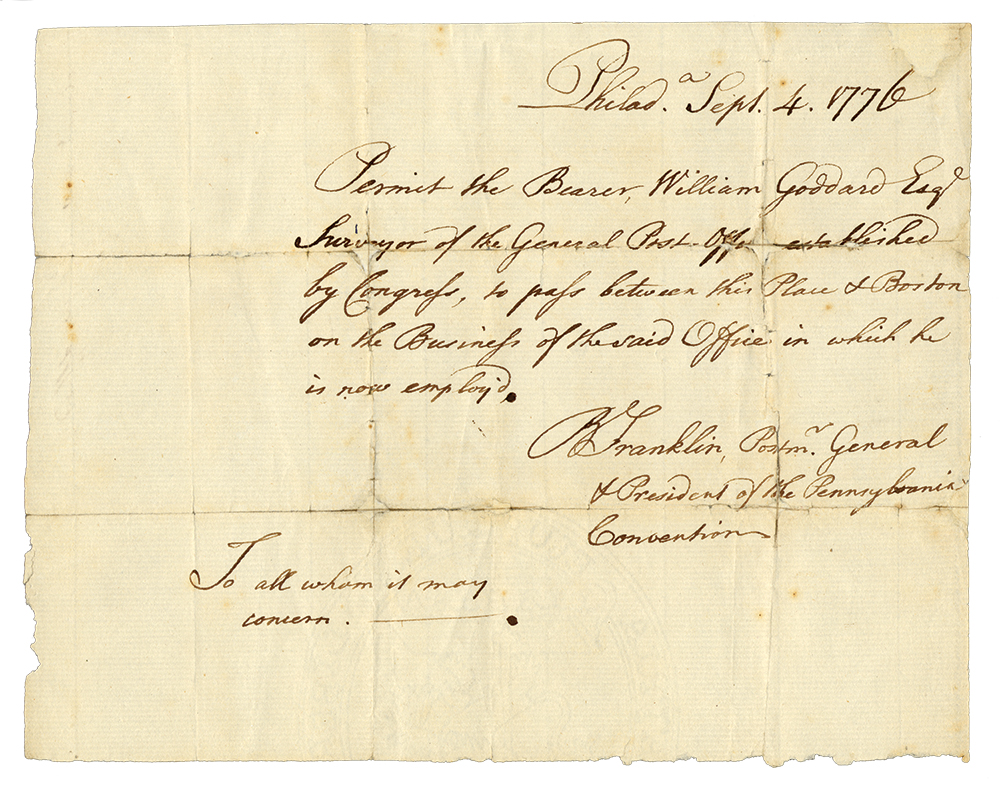
Postmaster General Franklin wrote this pass on September 4, 1776, for William Goddard, serving in his secondary position as “Surveyor of the General Post Office,” to travel from Philadelphia to Boston to conduct business.
National Postal Museum, Smithsonian Institution
In 1774 and 1775 Goddard traveled widely to promote his Constitutional Post, meeting with local patriots, colonial assemblies, and various committees of correspondence. By 1775 Goddard had 30 Constitutional Post Offices operating between New Hampshire and Williamsburg.
In the spring of 1774 Boston’s committee of correspondence created a subcommittee to plan a new American postal system based on Goddard’s suggestions. That September, Goddard traveled to Philadelphia to present this plan to the Continental Congress, then in session; however, Congress “tabled” his proposal, setting it aside without a vote or debate.
By the spring of 1775 the hostilities at Lexington and Concord meant that the American Revolution had begun. This created a more pressing need for speedy and secure intercolonial communication, especially for military intelligence.
On May 29, 1775, the Continental Congress appointed a committee to design a centralized postal system. Benjamin Franklin, with his extensive experience, was a committee member, and so was Samuel Adams, head of Boston’s committee of correspondence and a strong advocate for Goddard’s proposed system. Also serving on the committee were Richard Henry Lee of Virginia, Philip Livingston of New York, Thomas Lynch of South Carolina, and Thomas Willing of Pennsylvania.
By late July 1775 the committee submitted a plan for debate. The new system would be a government institution, not a subscription service like Goddard’s Constitutional Post. A postmaster general would be headquartered in Philadelphia to direct a system of routes from New England to Savannah, Georgia. Rates would be reduced, and profits would flow into the Continental Treasury.
Before the Continental Congress adjourned on July 26, 1775, its members agreed upon the committee’s report. Congress then proceeded to elect a postmaster general to serve for one year, or until another was appointed by a future Congress. “Benjamin Franklin, Esq.” was elected unanimously.
Congress also debated the fate of the official British government’s postal system. John Foxcroft and Hugh Finlay were still nominally in charge. Members of Congress decided to let it die a natural death, rather than killing it with legislation. The British postal system did little business during 1775, and on Christmas Day of that year, its New York headquarters ceased operations.
William Goddard was appointed surveyor of posts, charged with doing what he had already been doing, namely traveling the post routes and setting up post offices. He might have expected the position of secretary and comptroller, or second in command, but Franklin appointed his son-in-law, Richard Bache.
Neither Franklin nor Goddard remained in their positions very long. In the fall of 1776 Franklin left for France to serve as America’s ambassador to the court of Louis XVI. Goddard petitioned for a military appointment, which he failed to receive. He later returned to the printing business.
After the nation’s Articles of Confederation took effect in 1781, Congress passed An Ordinance for Regulating the Post-Office of the United States of America. The Constitution, written in 1787, authorized Congress to establish post offices and post routes. In 1789 Congress passed legislation officially creating a United States Post Office.
The new nation’s postal system was largely patterned upon the system Franklin had so long presided over and personally improved. In his Autobiography, the memoirs of his life, written between 1771 and 1790, Franklin devoted relatively little space to his postal system accomplishments; however, as he mentioned in his 1737 edition of Poor Richard’s Almanack, “Well done is better than well said.”
Sidebar: The B. Free Franklin Post Office and Franklin Court
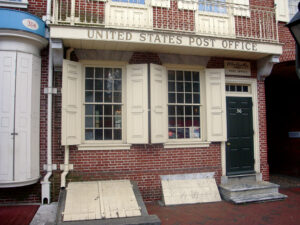
The B Free Franklin Post Office stands adjacent to the entrance of Franklin Court in Philadelphia.
Wikimedia Commons/Banfield
East of Independence Mall there’s a segment of Market Street that looks like it somehow survived more than two centuries of urban development. Surrounded by modern office buildings, shops and restaurants, five brick row houses suggest post-colonial Philadelphia. One of these is the B. Free Franklin Post Office.
This post office opened on July 26, 1975, exactly 200 years after the Second Continental Congress elected Banjamin Franklin as the first United States postmaster general. Here tourists and collectors can get a stamp on a postcard or envelope hand-canceled with Franklin’s personal and very cheeky revolutionary frank. As a colonial postmaster, Franklin had been entitled to send his own mail free of charge when he stamped it “Free. B. Franklin.” After British authorities dismissed him from his post as deputy postmaster general for the American colonies, Franklin changed his frank to “B. Free Franklin.” There is no documentary evidence that the British ever appreciated the innuendo.
The B. Free Franklin Post Office stands adjacent to the Market Street entrance of Franklin Court, an urban garden and museum complex administered by Independence National Historical Park. Franklin Court occupies property Franklin owned and the site of his Philadelphia residence and workplace. When visitors walk through an arched brick passageway, they see Franklin Court’s imposing frames of structural steel indicating the outlines of Franklin’s house and print shop. Popularly known as “ghost structures,” these frames were designed by the architectural firm Venturi and Rauch (now Venturi, Scott Brown and Associates) to indicate the size and location of these buildings in Franklin’s day. Franklin Court opened during the nation’s Bicentennial in 1976, a time when historians and preservationists were debating whether one should try to reconstruct historic structures based on scanty evidence, or whether it was better to simply evoke the past. Franklin Court combines both approaches.
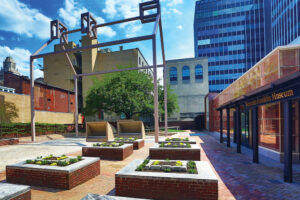
The steel “ghost” house in Franklin Court suggests the size and location of Franklin’s residence and a print shop he built in 1787.
National Park Service
When Benjamin Franklin returned from France in 1785, he enlarged the house he had constructed off Market Street about two decades earlier. He lived there the rest of his life with his daughter and son-in-law and their four children. In 1787 he built a print shop nearby for his grandson, Benjamin Franklin Bache, who had returned from France, having studied there with master printers.
Franklin created an entrance to his property by building two interlocking tenant houses divided by an arched 10-foot-wide carriage passageway at what is now 316–318 Market Street. He built a third tenant house at what is now 322 Market Street on what had been the former carriage entrance to his courtyard property. It became the residence and office of Benjamin Franklin Bache. There had been a house standing at what is now 320 Market Street. It was constructed in 1720, but in 1804 its then tenant purchased the property and rebuilt it. Another house constructed at what is now 314 Market Street was built in 1797.
During the 19th century, these structures facing Market Street were enlarged and altered. New owners raised their roofs by one or more stories, gave them new shopfront facades, and renovated their interiors.
In 1812 Franklin’s Bache heirs demolished Franklin’s house and rebuilt the courtyard area with rental properties along a narrow north–south street called Orianna Street. (You can still find Orianna Street between Third and Fourth streets in North Philadelphia.) The area became populated with shops.
In 1950 the National Park Service began purchasing the Orianna Street properties. Archaeological research began in 1953 and continued into the 1960s. Evidence of Franklin’s residence was discovered beneath Orianna Street, its pavements, and the areas beneath the buildings facing it. Some of these remains were preserved in situ and can now be viewed through shafts located amid Franklin Court’s ghost structures.
During the 1960s the National Park Service also conducted architectural and archaeological investigations in the five Market Street buildings. They discovered that much of their late 18th-century fabric had survived, including their interior walls and the arched carriage passageway between 316 and 318. Instead of demolishing these structures, the National Park Service removed their 19th- and 20th-century alterations, restoring their original height and reconstructing their facades to suggest the Philadelphia neighborhood where Franklin had lived and worked.
Today’s visitors to the Franklin Court complex can visit the Benjamin Franklin Museum. Renovated in 2011–13, its rooms contain exhibits reflecting Franklin’s accomplishments, character and wisdom.
They can also visit the Franklin Court Printing Office and the restored office of Benjamin Franklin Bache in the buildings at 320–322 Market Street. Costumed park rangers use vintage equipment to demonstrate operations in an 18th-century print shop.
Benjamin Franklin is remembered as a scientist, inventor, philosopher, statesman and diplomat. Although he never sorted mail in the B. Free Franklin Post Office or printed broadsides in the Franklin Court Printing Office, these historic sites commemorate what one might call his day job, as a printer and
postmaster.
Further Reading
Adleman, Joseph M. “A Constitutional Conveyance of Intelligence Public and Private.” Enterprise and Society 11, no, 4 (December 2010): 711–754. / Butler, Ruth Lapham. Doctor Franklin, Postmaster General. Garden City, NY: Doubleday, Doran & Co., 1928. / Coulson, Thomas. “Benjamin Franklin and the Post Office.” Journal of the Franklin Institute 250, no. 3 (September 1950): 191–212. / Flavell, Julie M. “Government Interception of Letters from America and the Quest for Colonial Opinion in 1775.” William and Mary Quarterly 58, no. 2 (April 2001): 403–430. / Franklin, Benjamin. The Autobiography of Benjamin Franklin. 1791; Reprint, New York: Modern Library, 2001. / Miner, Ward L. William Goddard: Newspaperman. Durham, NC: Duke University Press, 1962. / Smith, William. “The Colonial Post Office.” American Historical Review 21, no, 2 (January 1916): 258–275.
Lorett Treese is a regional historian and retired college archivist living in Chester County. She is the author of many articles and books on Pennsylvania history including The Storm Gathering: The Penn Family and the American Revolution and Valley Forge: Making and Remaking a National Symbol. Her most recent works deal with railroad history including her latest book, Railroads of the Eastern Shore.