
Albert Gallatin, Visionary of the Early Republic
Written by Brady Crytzer in the Features category and the Winter 2024 issue Topics in this article: Albert Gallatin, Alexander Hamilton, Democratic-Republican Party, Fayette County, Friendship Hill, immigration and immigrants, James Madison, Louisiana Purchase, National Road, Pennsylvania House of Representatives, Thomas Jefferson, U.S. House of Representatives, U.S. Senate, United States Treasury, War of 1812, Whiskey Rebellion
Friendship Hill, home of Albert Gallatin, near Point Marion in Pennsylvania’s Fayette County.
National Park Service / Victoria Stauffenberg
Albert Gallatin (1761–1849) came to America with a vision, not a dream. While tens of thousands of his fellow immigrants settled the New World in pursuit of personal success, he carried grander hopes. In his pursuit of shaping the young American nation, the Swiss-born Gallatin left behind an impressive legacy as a politician, a diplomat, and the longest-serving secretary of the treasury in U.S. history. During his long tenure in public life, Gallatin faithfully served four presidents and was a leading architect of the American republic during its most formative years. Despite being an influential figure in the Louisiana Purchase, the War of 1812, and the development of the National Road, Gallatin’s American vision was crafted in the wilds of the Pennsylvania frontier.
A New Geneva in a New World
Abraham Alfonse Albert Gallatin was born on January 29, 1761, in the Republic of Geneva. His father, Jean Gallatin, and mother, Sophie Albertine Rollaz, were both members of Geneva’s elite upper class. With major connections in both the government and the military, the Gallatins provided their son with a privileged life but neither lived to see the man he would become. By 1770 both of young Albert’s parents had died, leaving him an orphan. The child was raised by a distant cousin, Catherin Pictet, until the age of 12, when he was sent to the prestigious Academy of Geneva for his formal education.
The teenaged Gallatin soon became enamored with the greatest philosophers of his day and developed an obsession with the politics of reform and democratic virtue. A student of the Enlightenment, he read the works of Jean-Jacques Rousseau and Voltaire and developed a strong set of moral principles. By the age of 19 he was a proud republican and sought passage to the United States to put his beliefs into action. He was thrilled at the prospect, and later, in a 1783 letter to Jean Badollet, described the young nation as “the freest country in the universe.”
Gallatin’s American journey took him first to New England in 1780. After traveling throughout the region from Boston to Maine, he found life there unsatisfying. The region’s politics, he felt, were fickle and entrenched, and there were few opportunities for a newcomer to engage in meaningful reform. Furthermore, it was simply dull. Boston, he wrote to Badollet, was “highly boring.” He complained that there were “no public amusements and many superstitions of the sort that prevent one from singing, playing the violin, playing cards, bowling, etc.”
Rather than becoming lost in the shuffle of New England life, Gallatin elected to go west and test his fortunes in the vast Trans-Appalachian frontier. Following a business partnership with the French land speculator Jean Savary de Valcoulon, Gallatin quickly fell in love with the untamed beauty of the Ohio Country. For the next six years, he operated as a land agent and interpreter, crisscrossing the west and absorbing its unique frontier culture.
In September 1784 Gallatin met a 52-year-old George Washington outside of Morgantown during one of his famed speculation enterprises, and they discussed the lucrative possibilities found in the emerging American west. Although many viewed the landscape as unmanageable, Gallatin saw only raw potential in the region’s heavily forested mountains.
Finally, in 1786, Gallatin purchased 370 acres of land, which he named Friendship Hill, in Pennsylvania’s Fayette County. The purchase was modest, but it was from this bluff overlooking the Monongahela River that Gallatin’s American vision began to unfold.
Gallatin envisioned a bright future for his new neighborhood near the confluence of the Monongahela River and George’s Creek. On its banks he imagined industry and commerce fueled by a new canal that, according to his calculations, would pass directly by the site. He called it New Geneva and wrote, “we will, in a great degree, command the trade of this part of the country.”
In the years to come, Gallatin worked diligently with investors and capitalists to make his dream a reality, but it would never materialize. He financed a millworks and glassworks at the site, but labor was scarce and interest waned. “To be in debt is to me the worst of all situations,” he wrote, “and one in which I would never have fallen, had I never formed a society with others. . . . So long as that situation shall continue I will know no rest and no peace of mind.”
Despite New Geneva’s disappointing results, Gallatin developed a keen understanding of the region. Rather than simply settling in the backcountry, he fostered an intense desire to improve the wilderness through commercial and infrastructural investments. He despised superfluous debt and dedicated himself to enacting sensible fiscal policy. It was that vision that would later propel him to almost unimaginable heights in American public life and make him one of the leading policymakers of his time.
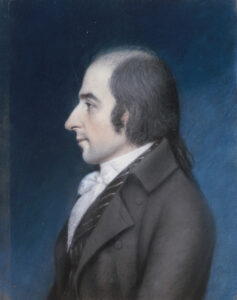
The earliest known portrait of Albert Gallatin is this profile created in pastel on light gray wove paper by English artist James Sharples, circa 1796, when Gallatin was serving in the U.S. House of Representatives.
The Metropolitan Museum of Art, New York (Gift of Miss Josephine L. Stevens, 1908)
Into the Arena
In January 1790 Secretary of the Treasury Alexander Hamilton (1757–1804) released the opening salvo in his attempt to redirect America’s faltering economy with the First Report on the Public Credit. In this sweeping document, Hamilton meticulously laid out an economic agenda to save the nation’s economy. At the core of the document was a commitment to public borrowing and leveraging debt as a tool of federal expansion. Across the country, states’ rights advocates railed against the plan as too broad, too irresponsible, and too intrusive; in the west, no voice was more prominent than that of Albert Gallatin.
Small in stature and speaking with a heavy accent, Gallatin was a vocal critic of Federalist fiscal policy. After living in Fayette County for only three years, he was chosen in 1788 to represent the region during debates over revising the United States Constitution, as well as the convention to amend Pennsylvania’s state constitution in 1789. Ultimately, in October 1790, the people of the western backcountry put their full faith behind Gallatin and elected him to the Pennsylvania House of Representatives. He flourished in the role and lived for extended periods in the state and national capital, Philadelphia. As Jacob Hiltzheimer, one of his colleagues from across the aisle, remarked, Gallatin was “masterful” and “very forcible” as an assemblyman.
It was during these first few years of his public life that Gallatin first tasted the bitter sting of public ignominy. In March 1791 Hamilton shocked the western frontier when he proposed a domestic excise tax on whiskey to balance America’s national debt. The law, known colloquially as the Whiskey Act, disproportionately penalized farmers in the backcountry, while offering favorable tax incentives designed to protect larger distillers. While Hamilton viewed the law as a means of both collecting revenue and forcefully imposing federal authority over the notoriously defiant frontier, settlers in western Pennsylvania bristled at its passage. They demanded that the law be revoked or rewritten to correct the injustices that they perceived in its conception and begged their representatives to lobby Congress on their behalf.
For the 30-year-old Gallatin, fresh off his first electoral victory, the stage seemed set for his first leap into the arena. Throughout 1791 and 1792 he was the consummate statesman. He regularly attended meetings in Fayette County and vigorously defended his constituents in the state capital.
As the months passed, however, the people of western Pennsylvania grew restless with the inadequacy of the government’s response and soon turned to more violent means of political expression. Treasury officers across the west were targeted for their involvement in the tax collection and were brutally attacked by armed bands of disgruntled locals. The tax collectors were tarred and feathered, burned with hot irons, and whipped; their homes were ransacked and set on fire. Extralegal courts were established in a direct challenge to federal authority, and the frontier slowly drifted toward a state of rebellion.
“My Only Political Sin”
Gallatin watched much of the insurrection, later known as the Whiskey Rebellion, unfold from the east and was ridiculed for his earlier part in the proceedings. He distanced himself from the worst offenders, but the damage to his credibility was severe. He recanted his support for the rebels entirely and prepared to rehabilitate the public image that he worked so hard to foster. In his later memoirs, he expressed remorse for the role he played in the early days of the rebellion, admitting that it was “my only political sin.”
For as difficult as they were, Gallatin’s political burdens at that time paled in comparison to the struggles of his personal life. Shortly after his election to the Pennsylvania House, Gallatin’s young wife, Sophia Allegre, died just five months after their marriage in October 1789. The young couple first met in Richmond, Virginia, when Albert lodged at Sophie’s family boarding house. Her sudden death was crippling for Gallatin, and his extended mourning overlapped with many of his public missteps during the Whiskey Rebellion. Although he struggled mightily, Gallatin would soon find a second chance at both love and politics in the fall of 1793.
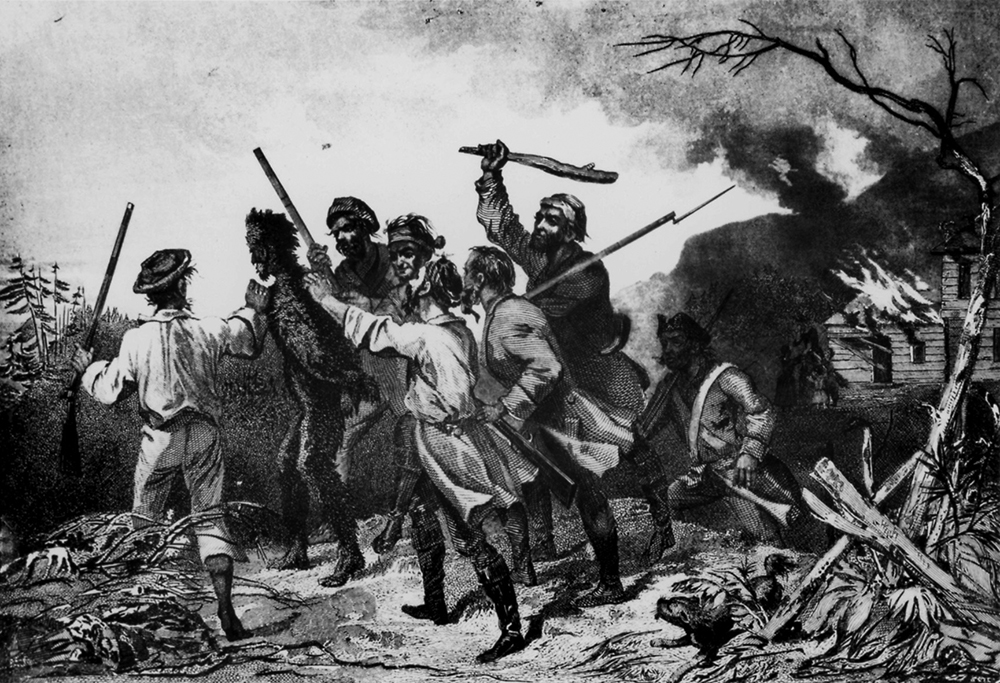
Gallatin sympathized with western Pennsylvania farmers protesting the federal government’s whiskey tax until they resorted to violent acts of malice, such as tarring and feathering local excise officers.
Pennsylvania Historical & Museum Commission
In February of that year, the Pennsylvania General Assembly took up the matter of selecting a new United States senator to represent the state in Philadelphia. As senators were selected via a legislative vote, the upper and lower houses of the commonwealth elected the Swiss-born Gallatin for the duty. To no surprise, most of his support came from the western and central tiers of Pennsylvania, and he was staunchly opposed by the Federalist easterners.
Nine months later, Gallatin’s fortunes continued to change when he married the 27-year-old Hannah Nicholson. As his new wife was the daughter of a famed Revolutionary War officer, James Nicholson, Albert’s social circle expanded, and his star continued to rise. Hannah and Albert forged a lifelong partnership; they would have six children and a marriage that lasted 55 years.
Gallatin brought his forceful convictions to the U.S. Senate in December 1793. He had a reputation as a fiscal hawk, but his earliest days in the chamber were clouded with doubt. As an immigrant, he failed to meet the required nine years residency as specified by the Constitution. For his political enemies, it made him an easy target for objection and removal.
On the opening day of the legislative session, Vice President John Adams was presented with a petition from the citizens of York, demanding that Gallatin be deposed from his seat. During the proceedings that followed, according to the Annals of Congress, Federalist opponents labeled the newcomer an “alien” and reminded the body that “one of the ancient republics made it death” for such a person “to intermeddle in their politics.” The proceedings were contentious, and due to their highly partisan nature, were the first Senate debates ever made open to the public. Thus, on February 28, 1794, the tally broke on party lines and Gallatin was formally removed from office with a vote of 14–12.
“A Real Treasure” in the House
Gallatin’s wit, intellect and natural talent for politics would not sideline him for long. In the same year that he was unceremoniously removed from the Senate, the 33-year-old Genevan was elected to the United States House of Representatives only nine months later. With a wealth of experience to his credit and free from the restrictive bonds of his immigration status, Gallatin swept into the chamber with vigor. He was readily accepted by the titans of the new Democratic-Republican Party, and his understanding of legislative finance made him an immediate asset. Alongside men like Virginia’s James Madison (1751–1836) and Pennsylvania’s Frederick Muhlenberg, Gallatin easily set himself apart as the chief economic visionary of the newly formed political party. In a letter to future president Thomas Jefferson (1743–1826), Madison glowed when speaking of his new colleague. “Gallatin is a real treasure,” he penned, “sound in his principles, accurate in his calculations, and indefatigable in his researches.”
For all his prior experience in government, Gallatin had never enjoyed the privileges that came with being a member of the majority party; the Fourth Congress gave him precisely that. In 1796 he flexed his fiscal muscle on a grand scale, publishing a broad critique of Federalist economic policy entitled A Sketch on the Finances of the United States. The scathing, 200-page document was received with great acclaim among states’ rights advocates, and it thrust him to the pinnacle of the party’s shifting leadership. Later that year, Madison announced to Congress that he would not seek reelection, and the limelight immediately shifted to the outspoken congressman from Pennsylvania.
Using the House Ways and Means Committee as his great pulpit, Gallatin wielded enormous influence over America’s spending habits throughout his tenure in Congress. As a party head, he vocally criticized the Adams administration for its handling of the Quasi-War with France and forcefully rallied against the elements of the president’s agenda that he believed to be unconstitutional. Gallatin railed vociferously against the legislation that became the Alien and Sedition Acts, claiming them to be gross violations of Americans’ civil rights with their restrictions on free speech and immigration. Although the measures would pass, they were but a temporary victory for the Federalist Party. The nation was swept up in a groundswell of support of the small government ideology of the Democratic-Republicans, and Jefferson’s election in 1800 seemed all but assured.
With Jefferson’s ascension to the presidency, America passed one of its first major tests in the peaceful transition of power, and conservatives across the country rejoiced. The Federalist Era of centralized government was over, and states were set to enjoy a period of unprecedented independence and self-determination. It was unclear what the new administration would look like, but Gallatin was surely part of its plans. The new president stated that he was “the only man in the United States who understands, through all the laberinths that Hamilton involv’d it, the precise state of the Treasury, and the resources of the Country.”
Gallatin was appointed secretary of the treasury on May 14, 1801, and would remain in that office for another 13 years. It was the role that would define his political career, and the enormity of it was not lost on him. “With the people on our side and the purity of our intentions, I hope we will be able to go on,” he wrote to his wife Hannah. “But indeed, my dear, this is an arduous undertaking in which I am called on to take a share.”

Gallatin was at the beginning of his tenure as secretary of the treasury when Gilbert Stuart painted this circa 1803 oil-on-canvas portrait. Under Jefferson, Gallatin reduced government spending and the national debt and arranged financing for the Louisiana Purchase.
The Metropolitan Museum of Art, New York (Gift of Frederic W. Stevens, 1908)
Reimagining the Frontier
Gallatin saw potential in the frontier. Its mountains and valleys were treacherous, but with a concerted investment in infrastructure and an easing of settlement, the future of the frontier seemed bright. As treasury secretary, Gallatin had finally been given the reins of power that he desired, and he capitalized on the influence of the office to make his American vision a reality.
Like President Jefferson, Gallatin viewed the frontier as an expanding realm of influence that was critical to the economic fortunes of the United States. While Americans pushed westward in great numbers, the diplomatic realities of the previous decades still dominated the politics of the early 19th century. France still controlled the Louisiana Territory, as well as the Mississippi River that defined it. Both Gallatin and Jefferson considered the nation’s growth to be paramount, and river traffic, as well as New Orleans, would be critical lynchpins of any future development. With the acquisition of the Louisiana Territory in the famed Louisiana Purchase of 1803, those plans could finally be made a reality. While the president waffled on the constitutionality of the proposed annexation of the 828,800 square miles of new territory, Gallatin played a forceful role in advocating for the acquisition.
In 1805 Jefferson announced his support for a federally funded investment in America’s infrastructure; where, when and how much would be determined by his venerable treasury secretary. In 1808 Gallatin published a bold vision for taming the frontier and modernizing its lands in his Report of the Secretary of the Treasury on the Subject of Public Roads and Canals. The document was characteristically thorough and offered a sweeping vision of an interconnected and prosperous nation. Included in his report were plans to construct major new roadways and canals in all corners of the continent. He hoped for canals across the Delmarva Peninsula, Cape Cod, and the Great Dismal Swamp of North Carolina. He called for new roadways to unify the Eastern Seaboard, in an early precursor to Interstate 95, and a road designed to open the west to the rich fortunes of the eastern markets. “The general utility of artificial roads and canals, is at this time so universally admitted, as hardly to require any additional proofs,” he wrote, “the community is nevertheless benefitted by the undertaking.”
Despite his grandiose arrangements, the realities of republican government would ultimately stifle Gallatin’s infrastructure dreams. Congress recoiled at the price tag of such a venture, and few Americans had the stomach to take on such a monumental task. Although most of the 1808 report fell by the wayside, some of the plans were later adopted by state legislatures and completed on a piecemeal basis. His greatest achievement, however, would be what was eventually called the National Road.
Gallatin orchestrated authorization for America’s first improved highway. For 50 years prior, commercial traffic from the East stalled at Cumberland, Maryland, the terminus of the Potomac River. With the completion of the National Road, however, Gallatin devised a plan for a roadway that would pass westward through his beloved Fayette County to the city of Wheeling, Virginia. In time the roadway would expand all the way to the state of Indiana, a lasting monument to Gallatin’s grand vision for a prosperous new nation.
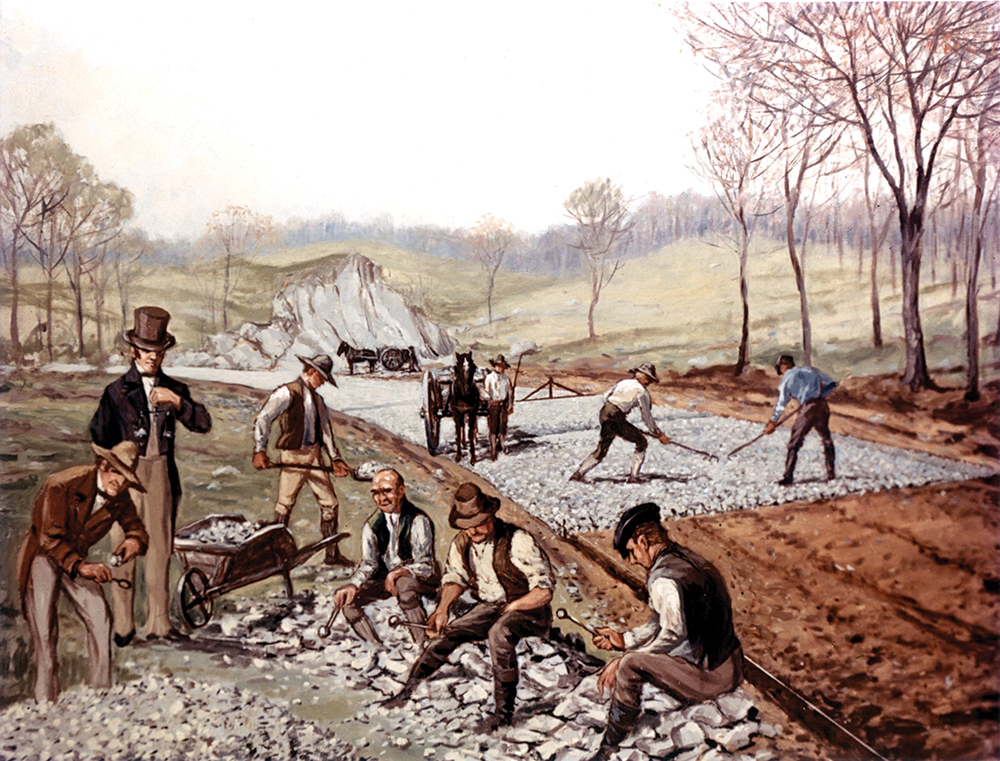
Despite Congress’ eventual rejection of Gallatin’s massive infrastructure plan, he was able to secure funding for the National Road, constructed between 1811 and 1837. The road would become a primary corridor for settlers moving west.
U.S. Department of Transportation, Federal Highway Administration
Aside from improving the landscape, Gallatin also believed that the peopling of the West suffered from a woefully unfair system. Since the Colonial Era, most of the real estate transactions focused on wealthy land speculation firms selling plots of wilderness to anxious buyers. In Gallatin’s estimation, this practice was inherently exclusionary; it served mainly to enrich the speculation class and priced out many Americans who would gladly settle the West otherwise. With expansion, efficiency and fairness in mind, Gallatin lobbied for the creation of more land offices. Rather than the government selling to the speculator who in turn sold to the buyer, the Treasury Department now allowed for direct sales to Americans seeking to start anew on the frontier. Federal land offices soon grew from four locations to 18 and opened the backcountry to a new generation of pioneer families.
“The Crimes of So Many Generations”
For all the promise that Gallatin saw in America, his adoration was not without its criticisms. For more than a century, the New World had fueled its economic engine on the labor of enslaved Africans. Gallatin found the enslavement of men and women abhorrent, antithetical to his American vision. He believed it to be a fundamental ill of American society that was unjust, morally corrupt, and “obviously contrary to the laws of nature.”
In the 18th century, slavery was ubiquitous in the American Colonies. Although the Pennsylvania General Assembly had passed An Act for the Gradual Abolition of Slavery on March 1, 1780, the law did not liberate individuals who were already enslaved. A registration that same year determined that there were 695 enslaved people in Westmoreland County alone, a huge settlement region including most of southwestern Pennsylvania.
Gallatin never wavered in his distaste for the practice. As a political activist, he joined the antislavery cause with gusto, counting himself as a member of the Pennsylvania Abolition Society. When the New World was rocked by a rebellion of enslaved people known as the Haitian Revolution (1791–1804), Gallatin firmly stated that it was the “natural consequences of slavery . . . the just punishment of the crimes of so many generations of slave traders and slave holders.” During his tenure in the Pennsylvania General Assembly, he had stood firmly behind these principles and helped to craft an official declaration stating that “slavery is inconsistent with every principle of humanity, justice, and right, and repugnant to the spirit and express letter of the Constitution of this Commonwealth.”
At the federal level, Gallatin was proactive in his efforts to curtail the slave trade whenever possible. In 1804 he joined the American Convention for Promoting the Abolition of Slavery and Improving the Condition of the African Race. In the House of Representatives, he unsuccessfully lobbied to stop the spread of slavery into the new territories west of the Georgia border, and as a diplomat he negotiated with Britain to abolish the African slave trade during peace negotiations to end the War of 1812.
War, Peace and the National Debt
When discussing his time in Jefferson’s cabinet, Gallatin recalled that “the reduction of the public debt was certainly the principle in bringing me into office.” From 1801 to 1802 he pressed a forceful economic agenda designed to diminish America’s fiscal obligations. In a two-fold approach, Gallatin introduced a plan to increase revenue by selling public lands and imposing new customs duties on the foreign goods moving into the country. It was bold and creative and, most importantly, it unburdened the American people with paying the $80 million debt themselves. His plan worked wonders, and in his first two years, Gallatin saw the national debt drop by $2 million.
For many of the achievements of Jefferson’s presidency, including financing a war against the Barbary pirates of North Africa and the Louisiana Purchase, Gallatin was a critical decision maker. Each action carried great economic risk, but the treasury secretary’s thoughtful planning and hawkish attention maintained the momentum of his debt reduction. Despite his success, he did not always see eye to eye with the president.
In 1807 Jefferson signed into law the Embargo Act, designed to block trade to both Britain and France during the Napoleonic Wars. For Gallatin, the act was in direct conflict with his debt-reduction strategy, but he enforced the restriction, nevertheless. By the time that Jefferson had left office in 1809, Gallatin was well established as the preeminent architect of American finance, and the national debt continued to plummet.
Although Gallatin hoped to serve as secretary of state under the next president, James Madison, his promotion would never come. Gallatin’s senatorial opponents threatened to block his appointment and instead pressured Madison to retain him as secretary of the treasury. The president obliged, and after threatening to resign, Gallatin once again accepted his role and continued his service.
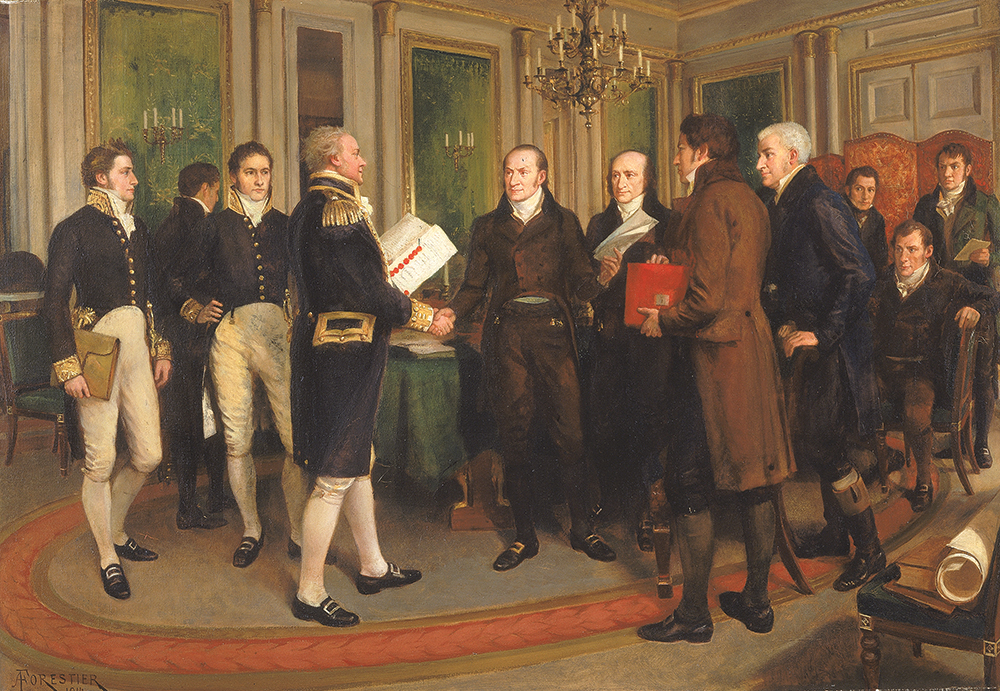
In The Signing of the Treaty of Ghent, Christmas Eve, 1814, artist Amédée Forestier depicted treaty delegates agreeing to the final terms that ended the War of 1812, with the leading American delegate, John Quincy Adams, shaking hands with British leader James Lord Gambier. Gallatin, one of the five American delegates, can be seen to the right of Adams, under the chandelier.
Smithsonian American Art Museum (Gift of the Sulgrave Institution of U.S. and Great Britain)
Madison’s tenure proved to be a trying time for Gallatin, as he saw his grasp on the nation’s financial health increasingly slip away. In 1811 Congress refused to renew the charter of the National Bank, for which Gallatin again threatened resignation. By January 1812 the Swiss immigrant’s already historic tenure as treasury secretary hit its pinnacle; the national debt reduction, which he greatly desired, also topped out. A decade after its implementation, Gallatin had cut America’s overall financial obligations nearly in half to $45 million.
Gallatin’s American vision of a debt-free nation was a pipedream, and the broader scope of foreign affairs soon forced that reality upon him. In June 1812 Madison signed a declaration of war against Great Britain. Worse yet, he charged Gallatin with the monumental task of financing the conflict. Despite his best efforts, Gallatin could only watch as an apparent war of choice, dubbed “Mr. Madison’s War,” destroyed his life’s work. While the War of 1812 raged, the national debt ballooned beyond his control.
In 1813 Gallatin was sent to Russia to serve as a peace negotiator and was quietly replaced in the cabinet by George W. Campbell. Although Gallatin faithfully negotiated with Britain in pursuit of peace over the next two years, he would never resume his role as treasury secretary again. By 1816 the national debt had exploded to $127 million, the highest America had ever seen. “We are laying the foundation of that national curse,” Gallatin opined, “a growing and perpetual debt.”
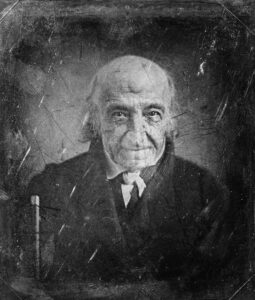
Following his retirement from public life, Gallatin became the first president of the National Bank in the City of New York, president of the New-York Historical Society, and cofounder and first president of the American Ethnological Society. This daguerreotype was made circa 1845.
Library of Congress, Daguerreotype Collection
Frontier Founder
Albert Gallatin’s service did not end when he officially left the Treasury Department in 1814. Over the next decade, he served presidents Madison and James Monroe as minister to France (1816–23) and President John Quincy Adams as minister to Great Britain (1826–27).
After leaving the public eye, Gallatin relocated to Manhattan where he became first president of the National Bank in the City of New York (1829–39) and later president of the New-York Historical Society (1843–49). In 1842 he cofounded the American Ethnological Society, where he specialized in the study of Native American languages as his new life’s passion. Both Albert and Hannah Gallatin died in 1849 and were buried in New York City’s Trinity Churchyard, alongside Gallatin’s old nemesis Alexander Hamilton.
As an immigrant, Gallatin believed in the promise of America. With a vision born on the Pennsylvania frontier, he became a critical architect of the nation’s financial, diplomatic and political future.
Further Reading
Adams, Henry. The Life of Albert Gallatin. Philadelphia: J.B. Lippincott, 1879. / Crytzer, Brady J. The Whiskey Rebellion: A Distilled History of an American Crisis. Yardley, PA: Westholme, 2023. / Dungan, Nicholas. Gallatin: America’s Swiss Founding Father. New York: New York University Press, 2010. / Hogeland, William. The Whiskey Rebellion: George Washington, Alexander Hamilton, and The Frontier Rebels Who Challenged America’s Newfound Sovereignty. New York: Simon & Schuster, 2010. / May, Gregory. Jefferson’s Treasure: How Albert Gallatin Saved the New Nation from Debt. Washington, D.C.: Regnery History, 2018. / McGraw, Thomas K. The Founders and Finance: How Hamilton, Gallatin, and Other Immigrants Forged a New Economy. Cambridge, MA: Belknap Press, 2014.
Sidebar: Friendship Hill
Albert Gallatin’s American vision began at home, and the land that he purchased in Pennsylvania was his sanctuary. Newly married, Gallatin reveled in the isolated beauty of the land that he dubbed “Friendship Hill.” It was to be his personal refuge, a place where he and his new bride Sophia Allegre would build their lives together. He wrote that “the new house . . . is almost compleated, it is well finished . . . situated on a most delightful spot.”
On a bluff overlooking the Monongahela River, Gallatin constructed a two-story brick house. His joy, though, would be short lived. In 1789 his wife died at the age of 23, leaving Albert a 28-year-old widower. Crestfallen, the young Swiss immigrant buried his wife on the property and pressed on, determined to make a life for himself in the west.
Gallatin would find love again when he married Hannah Nicholson in 1793, and they would intermittently reside at Friendship Hill for the next four decades. Hannah was raised as an urban socialite and often complained of the solitude of country living. For this reason, the Gallatins lived only sporadically at Friendship Hill throughout their marriage. Although Gallatin made improvements to his wilderness home in 1798 and again in 1823, he would never reside there for more than a few months at a time. The longest stretch of residency was 18 months from May 1824 to October 1825. The Gallatin family owned the estate until its sale in 1832, nearly 50 years after its purchase.
Today Friendship Hill National Historic Site is administered by the National Park Service. The site interprets Gallatin’s life and career, as well as the unique natural resources of western Pennsylvania that made the land so attractive to 18th-century settlers. For more information on hours, tours and activities at Friendship Hill National Historic Site, visit nps.gov/frhi/index.htm.
Brady J. Crytzer teaches history at Robert Morris University and is the author of seven books, including War in the Peaceable Kingdom: The Kittanning Raid of 1756 and The Whiskey Rebellion: A Distilled History of an American Crisis. He is the host of the cable series Battlefield Pennsylvania on the Pennsylvania Cable Network.