
A Gem in Bucks County: Pearl S. Buck International at 60
Written by Samantha Freise in the Hands-On History category and the Spring 2024 issue Topics in this article: Bucks County, China, civil rights, Green Hills Farm, Nobel Prize for Literature, Pearl S. Buck, Pearl S. Buck House, Pearl S. Buck International, Pulitzer Prize, Welcome House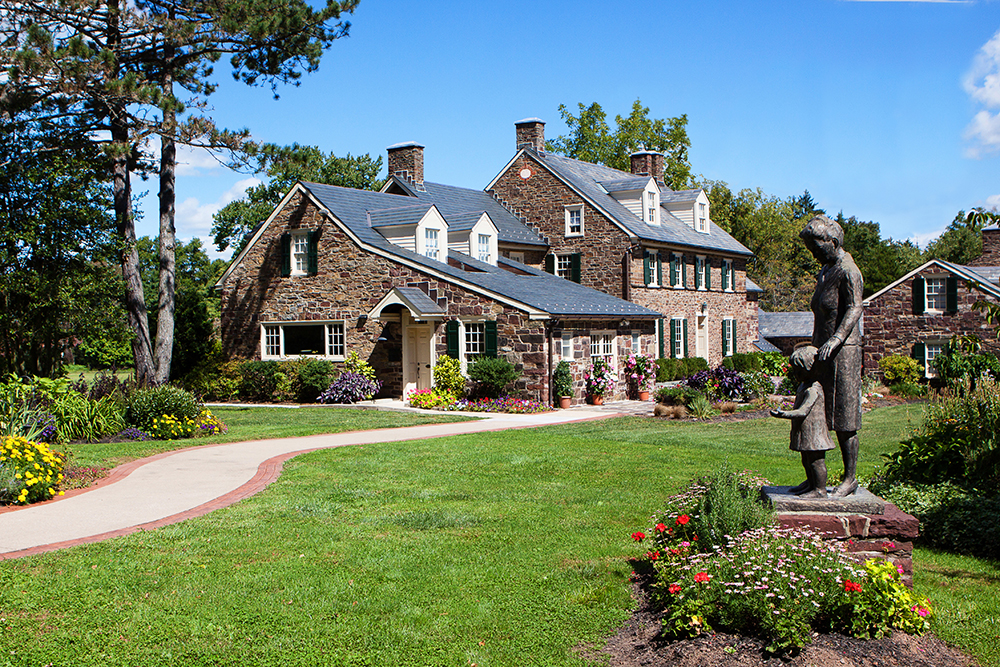
Pearl S. Buck purchased this house at Green Hills Farm in 1933 and lived there for 40 years.
Pearl S. Buck International / Aaron Mitchell Photography
To many Pennsylvanians, the name Pearl S. Buck is familiar as a famous past resident. Some know her as the Pulitzer Prize–winning author of The Good Earth and a Nobel laureate in literature. Others are aware of her as the founder of a child adoption agency, a civil rights activist, and a humanitarian. All these attributes in and of themselves are accurate descriptions of this notable Pennsylvanian whose legacy lives on through Pearl S. Buck International (PSBI), the Bucks County–based foundation she created in 1964. This year PSBI reflects on the remarkable life and legacy of this ahead-of-her-time woman as the organization celebrates 60 years of service to the local community and millions of children around the globe.
Sai Zhenzhu
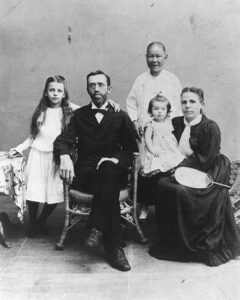
The Sydenstricker family in China, circa 1900. Pearl has her arm around her father Absalom, and her nanny, Wang Amah, stands behind mother Caroline who is holding baby Grace.
Pearl S. Buck International Archives
Born in 1892 to Presbyterian missionaries, Sai Zhenzhu, or in English, Pearl Sydenstricker, was a witty and intelligent child who grew up among the people of China. She lived in China throughout her childhood and young adult life, amounting to about 40 years. As a missionary child, she lived primarily in Zhenjiang, a crowded city on the Yangtze River surrounded by mountains and bamboo groves. Immersed in the native culture and language by her Chinese nanny, Wang, young Pearl saw the world in a different light than many American children. By the age of 6, she was fluent in Chinese, had published her first piece of writing in the local Shanghai Mercury newspaper, suffered the loss of several siblings, experienced being a minority, and witnessed the steady decline of the Chinese imperial family. This part of Pearl’s life forever influenced her work.
In 1917 Pearl married John Lossing Buck, an agricultural missionary. By 1920 she and her husband became instructors at the University of Nanking and celebrated the birth of their daughter, Carol Grace Buck. These events carried Pearl into adulthood during a difficult 10 years that would change the course of her life.
The 1920s sent the Buck family in many directions. In addition to their busy working life, Pearl’s mother died and the young couple learned that their daughter and only biological child had an unnamed intellectual disability. The difficulties of the decade came to a climax in March 1927 with the Nanking Incident, a violent conflict between warring factions over the city that resulted in many deaths. The Buck home, like those of other foreigners living in the city, was among the targets. The family was fortunate to survive.
Following this incident, Pearl Buck concentrated all her efforts on writing. She wrote about a subject she knew intimately and was close to her heart — life in China. This effort resulted in the eventual publication of her books East Wind, West Wind (1930) and The Good Earth (1931) by the John Day Company.
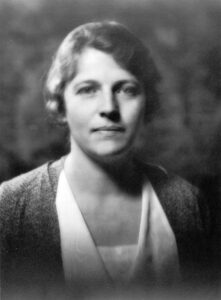
Pearl S. Buck, circa 1932, in a photograph by Arnold Genthe.
Library of Congress, Prints and Photographs Division
In 1932 The Good Earth won the Pulitzer Prize. This was a surprise to Pearl, as it was unusual for a novel set outside of the United States to win the award. Book sales soared and her popularity grew exponentially. In 1934 she left China, her beloved first home, for what would turn out to be the last time.
In America, Pearl divorced her first husband and married publisher Richard J. Walsh. They expanded their family by adopting six children. The Walsh family settled on Green Hills Farm in Bucks County, Pennsylvania. The property featured acres of open space, a barn, a milk house, and an 1820s stone farmhouse, with some portions dating to the 18th century — all of which still exist today.
Pearl and Richard expanded and updated the property to comfortably house their growing brood. Two libraries, a kitchen, tennis and basketball courts, and a pool were added and used not only by the family but also by neighbors, friends and the community at the invitation of the Walshes. This was where Pearl continued writing, spearheaded causes related to civil rights, and created a legacy that would change the lives of thousands of children.
In autumn of 1938, Pearl Buck was notified she would be the first American woman to receive the Nobel Prize for Literature. Her first reaction to this news was in Chinese: “I don’t believe it.”
An Era of Service
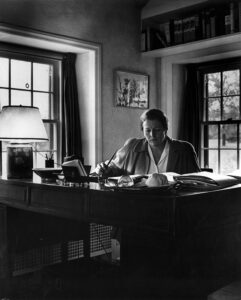
Pearl Buck working in her home office.
Pearl S. Buck International Archives
Pearl Buck’s Nobel Prize win was widely criticized by the American literary establishment, many of whom viewed her works as sentimental and simplistic, but her books remained popular with the public throughout her prolific career. After her win, she gained a level of fame that allowed her to become an outspoken advocate for women, children and minorities and uniquely poised her to engage in decades of charitable service.
The World War II era proved to be one of the most active periods in Pearl Buck’s life and set the stage for her humanitarian work. Much of 1941 was dedicated to fundraising for the many causes with which she and her husband were involved. They managed their newly founded East and West Association, dedicated to cultural exchange and understanding between Asia and America. The work of the association included public appearances, radio broadcasts, television and film coverage, and publication of the magazine Asia and the Americas, with international citizens, scholars and celebrities advocating for peace and harmony through understanding and acceptance. Pearl also had leadership roles in the China Emergency Relief Committee and United China Relief, organizations that sought to raise funds for humanitarian aid to China during the early days of the war against Japan. Both groups raised millions of dollars. Also that year, Pearl was awarded the Order of Jade by Chinese ambassador Hu Shih for recognition of her humanitarian service.
Welcome House
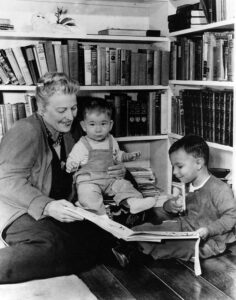
Pearl Buck reads to the first Welcome House children, Leon Yoder, in her arms, and David Yoder, in 1949.
Pearl S. Buck International Archives
Over the course of their marriage, Pearl and Richard Walsh adopted six children; this was in addition to Pearl’s biological daughter Carol and her adopted daughter Janice. Pearl felt that orphanages and foster homes did some good but there was a great amount of prejudice against nonmarital and biracial children. In late December 1948 a letter arrived at Green Hills Farm asking Pearl to help place a half East Indian, half American 15-month-old boy who had been rejected by his family. This was new territory for Pearl, but she took on the challenge to find a home for the boy. Unable to place him at first, she decided to take him into her home until she could find a solution. A few days later a second baby, half Chinese and half American, arrived at the farm. These children would be called Amerasian, a term coined by Pearl Buck to describe the many children born of Asian mothers and American fathers during the war. She soon became committed to finding families for not only Amerasians but also minority, disabled and older children who had been cast aside by other agencies.
To start the effort, Pearl began pulling together local parents and friends in Bucks County to temporarily foster children. She engaged Lloyd and Viola Yoder to spearhead this endeavor. The Yoders already had two children but decided to take in the two babies who had been dropped off at Green Hills Farm; those boys became David and Leon Yoder. The Yoders would expand their family by taking in 10 Amerasian children.
Over the next several years, Pearl created an administrative infrastructure, raised money, and incorporated a new adoption agency she named Welcome House. Although she did much of this work alone in the beginning, she later formed an alliance for this cause with many prominent Bucks County residents, such as lyricist and theatrical producer Oscar Hammerstein II, seedsman David Burpee and his wife Lois, and novelist James A. Michener. These friends became the founding board and longtime supporters of Welcome House. Through her hard work and determination, Pearl Buck eventually placed every child who came to her home. To these children, she would forever be their “Gran.” At the end of the Korean War, Welcome House became the first international adoption agency in the United States to serve biracial children and continued to operate in Bucks County until 2014. During that time, more than 7,000 children were placed in loving homes.
Pearl S. Buck Foundation
Taking up the cause of Amerasian children, Pearl Buck tried to rally public support in a series of articles and in a book, Children for Adoption. These publications and her efforts helped lead to gradual changes in international adoption law. The work was slow and the problem was growing exponentially. Pearl soon recognized that the majority of Amerasian children were not orphans and therefore could not be adopted in the United States. Another strategy was needed. After several attempts at getting government or veteran assistance, Pearl realized she needed another way to support these children in the countries of their birth.
In January 1964, Pearl was awarded the prestigious Gimbel Award for her humanitarian work. At the ceremony in Philadelphia, she announced that she would use the prize money to create a new organization: the Pearl S. Buck Foundation. In her founding statement, she announced: “This is the only agency to which I have ever given or will ever give my own name. I have done so because after 25 years of experience in the field of lost and needy children I have come to believe that the most effective efforts on their behalf are usually initiated by individuals who have a deep concern for human justice. The purpose of the Foundation is to publicize and eliminate injustices and prejudices suffered by children who, because of their birth, are not permitted to enjoy the educational, social, economic, and civil privileges normally accorded to children.”
To make this new endeavor a success, Pearl donated $500,000 of her own money to kickstart the foundation. A headquarters building was purchased on Delancey Place in Philadelphia, and satellite offices opened in Korea, Japan, Taiwan, the Philippines, Thailand and Vietnam over the course of six years.
In 1973 Pearl Buck passed away. She had bequeathed her Bucks County home and its contents to the Pearl S. Buck Foundation to help further the mission.
The Legacy Continues
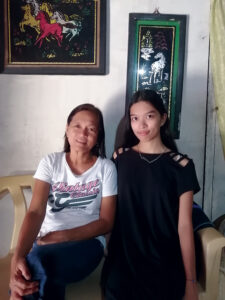
The legacy of Pearl S. Buck continues with PSBI’s child sponsorship program. In the Philippines, Juliana Reyes, right, has been sponsored by the Berrodin family for nine years, helping to provide her with healthcare, nutrition and education.
Pearl S. Buck International Archives
To sustain both organizations, Welcome House and the Pearl S. Buck Foundation were merged into the organization now known as Pearl S. Buck International in 1991. Welcome House continued to do international adoptions until 2014, when the agency closed due to changes in international adoption laws.
PSBI’s international headquarters is located at Pearl Buck’s former home of Green Hills Farm. PSBI provides opportunities to explore and appreciate other cultures, builds better lives for children around the globe, and promotes the legacy of its founder by preserving and interpreting her home.
Since 1964 PSBI has established successful international humanitarian programs across Asia as well as Kenya through a child sponsorship program. More than 2 million children and their families have been provided education, nutrition, healthcare and psychosocial services through the program. Because of PSBI’s model of matching one child to one sponsor, their relationship is unique and rewarding. Sponsors receive letters, drawings and photos about their children and their progress.
Some of these relationships last a lifetime. Bucks County residents Susan and Frank Berrodin, for example, have sponsored a child through PSBI for nine years. Juliana lives in the Philippines and dreams of being an accountant. Over the course of their sponsorship, the Berrodins have helped provide Juliana with healthcare, nutrition and education and are now assisting her as she attends a university in the Philippines majoring in accounting.
In 1980 the Pearl S. Buck House was given the status of National Historic Landmark and opened as a historic house museum. The beautiful and iconic stone farmhouse contains an intact collection that makes the everyday existence and legacy of Pearl Buck come to life. Visitors to the house museum can experience her personal story through artifacts—from the cabinet full of dishes used for her family meals to the typewriter on which she wrote The Good Earth. The Pearl S. Buck House is open to the public for tours and programming year-round.
Further Reading
Buck, Pearl S. A Biographical Sketch of Pearl S. Buck. New York: John Day, 1946. / —. My Several Worlds. New York: John Day, 1954. / Conn, Peter. Pearl S. Buck: A Cultural Biography. New York: Cambridge University Press, 1996. / Spurling, Hilary. Pearl Buck in China: Journey to the Good Earth. New York: Simon & Schuster, 2011. / Yoder, Dale. Pearl Buck’s Living Legacy: The Welcome House Story. Morgantown, PA: Masthof Press, 1999.
Samantha Freise is the curator and historic site director at Pearl S. Buck International and is a member of the Pennsylvania Heritage Foundation Board of Directors.